

Term:Luffing Crane
 « Back to Glossary Index
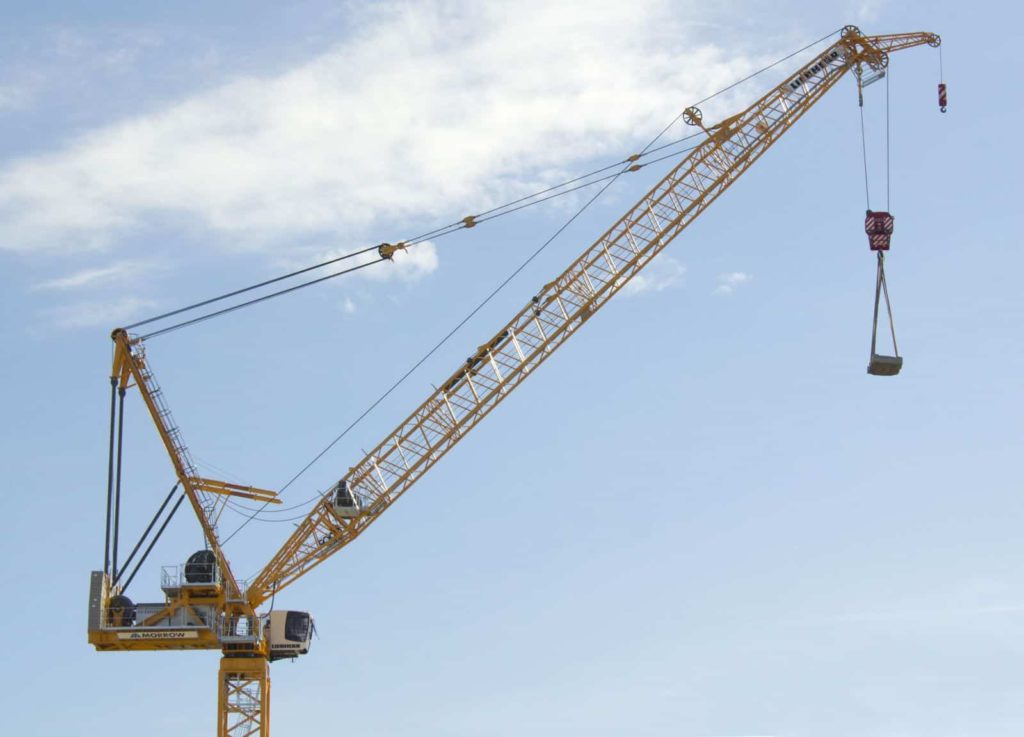
A luffing crane (or “luffer”) is a tower crane whose jib is pinned at its base and raised or lowered to change the hook’s reach. Instead of running a trolley along a flat jib, it moves the load in and out by changing the jib angle. That lets it work on tight urban sites and around other cranes.
Below: how luffing works, luffer vs hammerhead, when it’s worth the cost, and its limits.
Editable template
Get the Crane Preinstallation Checklist
An editable checklist to work through before your crane is erected, so site prep and paperwork are confirmed before erection day instead of during it.
What does “luffing” mean on a crane?
Luffing is raising or lowering a crane’s jib or boom to change its working radius (the horizontal distance from the crane’s centre to the hook). Raise the jib and the hook comes in closer; lower it and the hook reaches further out. The term comes from sailing.
How a luffing crane works
A luffer has the same mast, slewing ring and cab as other tower cranes. The difference is the jib:
- Luffing motion: a luffing winch (or hydraulic cylinders on smaller units) raises and lowers the jib. This is how the operator controls radius.
- Hoisting: a separate hoist winch raises and lowers the hook, as on any tower crane.
- Slewing: the upper works rotate on the slewing ring to swing the load.
- Short counter-jib: the counterweight sits on a compact rear section, so the tail swing radius is small.
On most tower luffers, the hook height changes as the jib moves, so operators coordinate hoist and luff together. A level luffing crane keeps the load at a constant height while the jib moves, using a compensating rope arrangement or control system. They are more common in ports and shipyards than on building sites.
Luffing crane vs hammerhead crane
A hammerhead (including flat-top cranes) has a fixed horizontal jib and moves the load in and out on a trolley.
| Luffing crane | Hammerhead / flat-top | |
|---|---|---|
| How radius changes | Jib angle goes up and down | Trolley runs along a horizontal jib |
| Slewing footprint | Small: jib can be raised and tail is short | Large: full jib and counter-jib always swing |
| Oversailing neighbours | Much easier to avoid | Often needs swing (oversail) agreements |
| Multiple cranes | Jibs can be raised to clear each other | Needs height staggering and zoning |
| Cycle speed | Typically slower | Typically faster, trolleying is quick |
| Cost | Typically higher to rent, erect and run | Typically lower |
| Best fit | Tight urban sites, high-rise, crowded skylines | Open sites, long reach, high pick rate |
For more on crane types, foundations and erection, see our guide to construction tower cranes.
When to use a luffing crane
- Tight urban sites: when the building fills the lot and a horizontal jib would sweep over streets, rail lines or neighbouring buildings.
- Avoiding oversailing: when neighbours won’t grant air rights or crane swing agreements, or the cost of getting them is high.
- Multiple cranes: when several cranes share a site or a skyline, luffers can work in overlapping zones by raising their jibs.
- Obstructions: when towers or power lines limit where a jib can swing.
- Heavy picks close in: luffers often handle heavy loads well at short and medium radius, which suits high-rise cores and precast.
Limitations
- Slower cycles: luffing is slower than trolleying, which can cut pick rates on busy floors.
- Higher cost: rental, erection and dismantling typically cost more than a comparable hammerhead.
- Height and airspace: a raised jib makes the crane much taller, which can trigger FAA notice in the US or NAV CANADA and Transport Canada review near airports or above set heights.
- Operator skill: hoist and luff must be coordinated.
- Out-of-service setup: the jib is parked in the manufacturer’s out-of-service position and typically left free to weathervane, which affects how close it can sit to neighbours.
Whatever the crane, plan each pick with load charts, radius and ground conditions. Our article on how to plan your next construction crane lift walks through it, and heavy or complex picks should go through a critical lift permit. Tower cranes in the US fall under OSHA’s cranes and derricks standard (29 CFR 1926 Subpart CC) and ASME B30.3. In Canada, CSA Z248 and provincial regulations apply. Check your local jurisdiction and the crane’s engineer.
FAQ
What is a luffer crane?
“Luffer” is site slang for a luffing jib tower crane: a crane that changes reach by raising and lowering its jib instead of using a trolley.
What is luffing in a crane?
Luffing is the up-and-down movement of the jib or boom that changes the working radius. It’s one of the crane’s three main motions, along with hoisting and slewing.
Is a luffing crane a tower crane?
Usually, yes. On building sites “luffing crane” almost always means a luffing jib tower crane. Mobile and crawler cranes can also be fitted with a luffing jib.
Why use a luffing crane instead of a hammerhead?
To work in a small footprint: no oversailing neighbours, close to other cranes, around obstructions. On an open site, a hammerhead is usually faster and cheaper.
What is a luffing jib?
A jib hinged at its base that can be raised and lowered. On crawler cranes, a luffing jib (sometimes called a luffing fly) mounts on the main boom to add reach over obstacles.
What is the difference between luffing and slewing?
Luffing moves the jib up and down to change reach. Slewing rotates the whole upper crane on its slewing ring to swing the load around. A luffer does both, often at the same time, while hoisting raises and lowers the hook.
Summary
A luffer trades speed and cost for a smaller footprint. On a tight, crowded site, or where neighbours won’t allow oversailing, it’s often the right call. Involve the crane supplier early in your preconstruction planning, and see our tower crane infographic for the main parts.
Related templates: Crane Preinstallation Checklist, Critical Lift Permit, Tower Crane Inspection Report
« Back to Glossary Index