
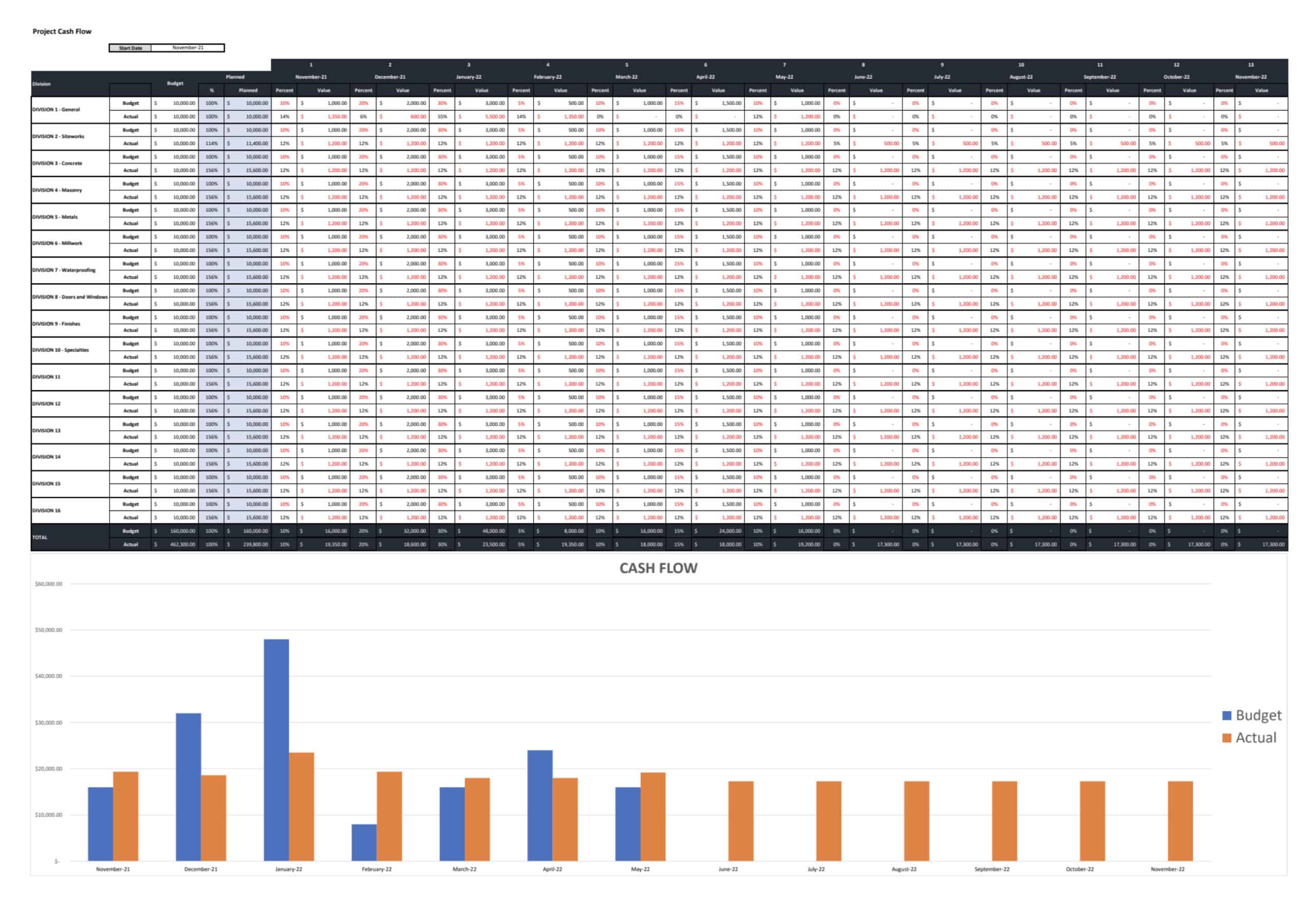
Construction Cash Flow Forecast
$6.99
Use this document to forecast your project cash flow and track against it by division.
Templates are starting points. Adapt them to your contract and to the laws and safety rules where you work. They are not legal advice.
Product FAQ
You will receive your documents and files immediately after you complete the checkout process. You will receive a link on the checkout page as well as via email.
As long as the document remains on Essential Construction you will be able to download it once purchased.
Yes, in most cases (with the exception of stock photography and ebooks) the files you will receive are editable.
We accept debit, all credit cards (Visa, Amex Mastercard etc) as well as payments via Apple Pay, Google Pay and Paypal.
Our return policy varies based on the product, for more information you can find our detailed return policy here.
Our documents are for use on your projects. You may not resell these documents on other marketplaces.
Full Description
This construction cash flow template helps you forecast what a project will spend and when, then track actual spend against that forecast by division. Knowing your cash flow lets you tell the client and your finance team when funds will be needed to pay subcontractors and suppliers.
What is a construction cash flow forecast?
A construction cash flow forecast is a month-by-month projection of the money a project will spend, and often receive, over its life. It spreads the budget for each division or trade across the months that work is scheduled, so you can see the peaks and the total cumulative spend. Owners use it to plan funding, and contractors use it to plan payment applications and working capital. Updating it with actual costs shows whether the project is spending ahead of or behind plan.
When to use it
- At tender or project startup, to give the client a funding forecast
- Monthly, to compare actual spend against the forecast
- When the schedule changes and the spend profile needs to be updated
- Before preparing a progress payment application
- When reporting project financial status to management
What’s included
This cash flow document is a spreadsheet (.xlsx) that includes:
- Forecasted cash flow
- Budgeted cash flow
- Breakdown by division or trade
- Monthly periods
How to fill it out
- Enter the budget for each division or trade from your estimate or contract breakdown.
- Use the construction schedule to decide which months each division’s work falls in.
- Spread each division’s budget across those months to build the forecast.
- Check the monthly totals and cumulative spend look realistic.
- Each month, enter actual costs and compare them with the forecast.
- Update the remaining months when the schedule or budget changes.
Common mistakes to avoid
- Spreading costs evenly across the project. Real spend usually builds slowly, peaks mid-project and tails off.
- Ignoring payment timing. Money owed and money paid are rarely in the same month.
- Forgetting retention and long-lead items that are paid for early.
- Leaving the forecast unchanged after the schedule moves.
Related templates and guides
- Bar Chart, Scurve and Cash Flow
- General Construction Schedule (With S-Curve)
- Contractor Application For Progress Payment
- Construction Financial Reporting – Why It’s Important and How To Do It
- Why Construction Projects Go Over Budget
Frequently asked questions
How do you forecast cash flow on a construction project?
Start with the budget broken down by division or trade, then use the schedule to place each item’s cost in the months the work happens. Add up each month to get the spend profile and the cumulative total. Update it monthly with actual costs and schedule changes.
What is an S-curve in construction cash flow?
When cumulative spend is plotted against time, most projects form an S shape: slow at the start, steep in the middle when most trades are working, and flattening toward completion. Comparing actual spend with the planned S-curve shows whether the project is ahead of or behind plan.
Why is cash flow important in construction?
Contractors often pay for labor, materials and subcontractors before they are paid by the client, and retention holds back part of each payment. Without a forecast, a profitable project can still run short of cash. Owners also need it to arrange funding on time.
What is the difference between budgeted and forecast cash flow?
Budgeted cash flow is the original plan based on the approved budget and schedule. Forecast cash flow is the current best estimate of future spend, updated as costs and timing change. Comparing the two shows how the project has moved from plan.
How often should a cash flow forecast be updated?
Monthly is common, lined up with the cost report and payment application cycle. Update it sooner if there is a major change to scope, schedule or budget, so the client and your finance team are not working from old numbers.






Josh Moke –
Pretty good starting point. Have to tweak them all to work how I want.
Thabiso –
I would like to get a quote of all documents