
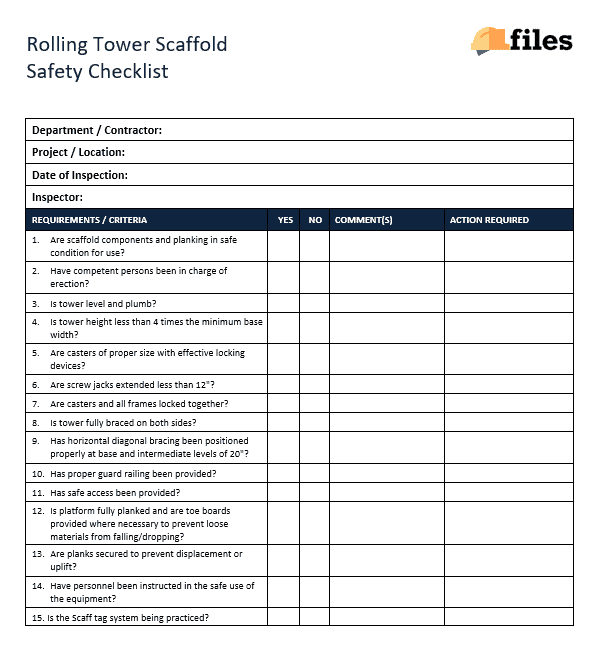
Rolling Scaffold Safety Checklist
$4.99
Rolling Tower Scaffold Safety Checklist are often used to ensure that a rolling tower scaffold is safe to use prior to the conducted of elevated activities.
Templates are starting points. Adapt them to your contract and to the laws and safety rules where you work. They are not legal advice.
Product FAQ
You will receive your documents and files immediately after you complete the checkout process. You will receive a link on the checkout page as well as via email.
As long as the document remains on Essential Construction you will be able to download it once purchased.
Yes, in most cases (with the exception of stock photography and ebooks) the files you will receive are editable.
We accept debit, all credit cards (Visa, Amex Mastercard etc) as well as payments via Apple Pay, Google Pay and Paypal.
Our return policy varies based on the product, for more information you can find our detailed return policy here.
Our documents are for use on your projects. You may not resell these documents on other marketplaces.
Full Description
This rolling scaffold safety checklist is a scaffolding safety checklist for mobile tower scaffolds, the wheeled towers often called baker scaffolds. It is used to confirm that a rolling tower scaffold is safe to use before anyone starts elevated work on it.
What is a rolling scaffold safety checklist?
A rolling scaffold safety checklist is a short inspection form completed before a mobile tower scaffold is used. It walks the inspector through the parts that cause most incidents on rolling towers: casters and brakes, base and leveling, frames and bracing, platforms, guardrails, access and the ground or floor the tower stands on. When every item passes and the form is signed, the tower can be used. If something fails, the tower is tagged out until it is fixed.
When to use it
- Before each shift on which a rolling tower or baker scaffold will be used.
- After the tower has been moved to a new work area.
- After the scaffold is altered, extended or reassembled.
- After high winds, an impact or anything that could affect its stability.
- During site safety walks and audits of access equipment.
What’s included
The download is an editable Word document (.docx) containing a rolling tower scaffold safety checklist. It is designed to confirm that a rolling tower scaffold is safe to use before elevated activities are carried out. Because it is a Word file, you can add your project details, company logo and any checks required by your site safety plan or the scaffold manufacturer.
How to fill it out
- Fill in the project, location, scaffold ID or tag number, date and inspector name.
- Check the ground or floor: level, firm, clear of holes, debris and cables.
- Check casters, wheel locks and any outriggers or stabilizers required by the manufacturer.
- Inspect frames, braces, pins and platforms for damage, missing parts and correct installation.
- Confirm guardrails, toe boards and safe access such as built-in ladders or hatches are in place.
- Check overhead hazards such as power lines and openings in the floor nearby.
- Record any defects, tag the scaffold out if it fails, sign the checklist and keep it on file.
Common mistakes to avoid
- Moving the tower with people or materials on the platform unless the manufacturer and the applicable rules specifically allow it.
- Using the tower with one or more wheel locks off.
- Climbing the frame ends instead of using the designed access.
- Building higher than the manufacturer’s height-to-base limits without outriggers.
Related templates and guides
- Mobile Scaffold Inspection Checklist
- Scaffold Inspection Register
- Scaffold Inspection Checklist Template
- Construction Safety Meeting – Scaffold Safety
- Guide: The Basics of Fall Protection
Frequently asked questions
How often should a scaffold be inspected?
In the US, OSHA requires a competent person to inspect scaffolds for visible defects before each work shift and after any occurrence that could affect structural integrity. Other countries have similar rules. For rolling towers, also check the tower each time it is moved or altered.
What is a baker scaffold?
Baker scaffold is a common name for a small, narrow rolling scaffold, usually one bay with a single platform. It is popular for interior work such as drywall, ceilings, electrical and painting because it fits through doorways and moves easily. It still needs locked wheels, guardrails where required and a pre-use check.
Can you move a rolling scaffold with someone on it?
As a general rule, no. Workers should climb down and materials should be removed before a tower is moved. Riding a rolling scaffold is only permitted under strict conditions set by regulations and the manufacturer, so check both before allowing it on your site.
Do rolling scaffolds need guardrails?
Usually, yes. OSHA requires fall protection on scaffolds where workers are more than 10 feet above a lower level, and guardrails are the normal method on rolling towers. Many contractors fit guardrails on every rolling tower platform regardless of height as a site rule.
What should a scaffolding safety checklist cover?
The ground or floor, base plates or casters, frames and bracing, platforms and planking, guardrails and toe boards, access, ties or outriggers, overhead hazards such as power lines, and the inspection tag. The checklist should be signed and dated by the person who carried out the check.


Reviews
There are no reviews yet