

We may earn a commission when you buy through links on this page, as an Amazon Associate. Learn more.
Most work boots come with a thin foam insole that’s flat within a few months. That’s why so many tradespeople end up with sore feet, aching knees and a tight lower back by the end of the week. The boot is still fine. The insole is done.
A good aftermarket insole is the cheapest comfort upgrade you can make. For $15 to $65, the right one can make a pair of boots feel better than the day you bought them, and it can make a real difference if you stand or walk on concrete all day.
To find the best insoles for work boots, we compared eight of the most popular options, from a $13 gel insole to a $65 orthotic with a million-mile guarantee. Below you’ll find our picks, a guide to choosing the right type for your feet and boots, and answers to the questions we hear most.
Quick answer: support or cushioning?
Work boot insoles do one of two jobs, and most of the confusion comes from mixing them up:
- Support insoles have a firm arch and a deep heel cup. They hold your foot in a better position so your arch doesn’t collapse during a long shift. Choose support if you have flat feet, heel pain, plantar fasciitis or feet that roll inward (plantar fasciitis is the most common cause of heel pain). Our picks: Superfeet Green, PowerStep Pinnacle Work and Tread Labs Ramble.
- Cushioning insoles are soft and absorb impact. Choose cushioning if your feet are healthy but tired and sore after a day on concrete. Our picks: Timberland PRO Anti-Fatigue, Spenco Heavy Duty Work and Dr. Scholl’s Work.
If you’re not sure, start with a cushioned insole that has a moderate arch, like the Timberland PRO. If your feet still hurt after a couple of weeks, move to a support insole.
Our top picks at a glance
| Pick | Insole | Arch support | Cushioning |
|---|---|---|---|
| Best overall | Superfeet Green | Firm, high | Light |
| Best for standing on concrete | Timberland PRO Anti-Fatigue | Moderate | High |
| Best for plantar fasciitis | PowerStep Pinnacle Work | Semi-rigid | Medium |
| Best long-term value | Tread Labs Ramble | Firm, 4 heights | Light |
| Best shock absorption | Spenco Heavy Duty Work | Soft | High |
| Best budget cushioning | Dr. Scholl’s Work | Light | High |
| Best budget arch support | WalkHero Arch Support | Medium-firm | Light |
| Best for western boots | Ariat Energy Max Work | Moderate | Medium-high |
Price guide: $ under $20, $$ $20–45, $$$ over $45. Prices are per pair.
The 8 best insoles for work boots
1. Best overall: Superfeet Green
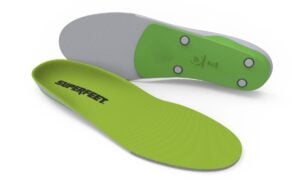
Superfeet All-Purpose Support High Arch (Green) Insoles
The insole tradespeople have trusted for decades. A firm stabilizer cap, deep heel cup and high arch keep your foot structured inside roomy work boots for up to a year.
- Arch support: Firm, high arch
- Cushioning: Light
- Volume: High (roomy boots)
- Fit: Trim to fit
Our take
Ask a room full of tradespeople which insole they put in their boots and you'll hear "the green ones" more than any other answer. Superfeet's All-Purpose Support High Arch, still sold in the same bright green and formerly called Superfeet Green, has more than 34,000 Amazon ratings and has been a jobsite staple for decades.
It isn't a soft insole. Underneath the foam is a firm plastic stabilizer cap that holds the shape of the arch and heel. The idea is to support the structure of your foot, not to cushion it like a pillow. A deep, sculpted heel cup holds the fatty pad under your heel in place so your body's own cushioning does its job. On concrete, that structure is what keeps your arches from collapsing by the end of a 10-hour shift.
The top layer is high-density closed-cell foam with a moisture-wicking, odor-reducing cover. It's trim to fit. Superfeet recommends sizing up if you're between sizes and cutting it down to match your boot's original insole.
This version has a high arch and high volume, which suits roomy work boots. If you have low arches or flat feet, Superfeet makes the same design with a medium arch. Superfeet says its insoles keep their shape for up to 12 months of use.
Expect a short break-in. The firm arch can feel strange for the first few days, so wear them for half a shift at first. And if you want soft cushioning above all else, this isn't the insole for you. Look at the Timberland PRO or Dr. Scholl's instead.
For most people in work boots who want lasting support rather than temporary softness, this is still the one to beat.
Pros
- Firm stabilizer cap and deep heel cup hold the foot's structure
- Proven over decades on job sites
- High-volume shape suits roomy work boots
- Odor-reducing, moisture-wicking top cover
- Keeps its shape up to 12 months (manufacturer)
Cons
- Firm, not cushy; takes a few days to break in
- High arch isn't right for flat feet (medium arch version available)
- One of the pricier options
| Brand | Superfeet |
|---|---|
| Arch support | Firm, high arch |
| Cushioning | Light |
| Volume | High (roomy boots) |
| Fit | Trim to fit |
| Lifespan | Up to 12 months (manufacturer) |
2. Best for standing on concrete: Timberland PRO Anti-Fatigue
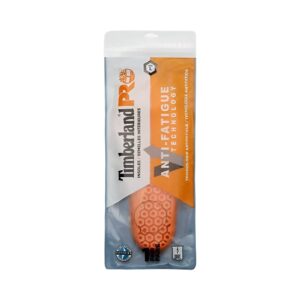
Timberland PRO Anti-Fatigue Technology Insole
Timberland PRO's inverted-cone anti-fatigue foam, sold on its own. The best cushioning upgrade for anyone standing or walking on concrete all day.
- Arch support: Moderate, contoured
- Cushioning: High (anti-fatigue cones)
- Volume: Medium to high
- ESD version: Available
Our take
If you've ever worn a pair of Timberland PRO boots, you've probably felt this technology already. Anti-Fatigue Technology is built into most Timberland PRO work boots, and Timberland sells it as a replacement insole that fits in almost any work boot. With more than 20,000 Amazon ratings, it's one of the most popular work boot insoles you can buy.
The secret is the shape of the foam. The underside is covered in inverted cones of shock-absorbing foam. When your foot lands, the cones compress to absorb the impact, then rebound to return energy into your next step. Timberland says the foam resists compression set, so it bounces back instead of flattening out after a few weeks the way cheap foam does. The cone design also uses less material, which keeps the insole light.
The footbed is contoured to the shape of the foot with a moderate arch. It's built for cushioning and fatigue reduction rather than structural correction, so it's a great match for people with normal arches who are just sore after a long day on slab.
Timberland also makes an ESD (electrostatic dissipative) version. If your boots are ESD rated, use that version so you don't defeat the rating.
The trade-offs: it's thicker than the factory insole in many boots, so snug boots may feel tighter. And if you have flat feet or plantar fasciitis, the arch support probably isn't enough on its own. Look at the PowerStep or Superfeet for that.
For pure comfort on concrete at a fair price, this is the insole we'd buy first.
Pros
- Inverted-cone foam absorbs impact and returns energy
- Resists flattening over time
- Light for the amount of cushioning
- ESD version available for ESD-rated boots
- Fair price and huge number of positive reviews
Cons
- Moderate arch; not enough for flat feet or plantar fasciitis
- Thicker than many factory insoles
- Cushioning-focused, not corrective
| Brand | Timberland PRO |
|---|---|
| Arch support | Moderate, contoured |
| Cushioning | High (anti-fatigue cones) |
| Volume | Medium to high |
| ESD version | Available |
3. Best for plantar fasciitis: PowerStep Pinnacle Work
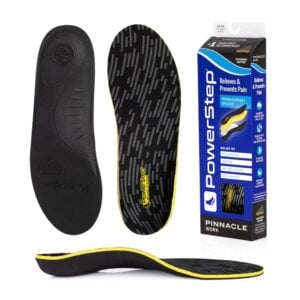
PowerStep Pinnacle Work Insoles
A podiatrist-designed orthotic built for work boots, with a semi-rigid arch shell and deep heel cradle. Our pick for plantar fasciitis and heel pain.
- Arch support: Semi-rigid shell, neutral arch
- Cushioning: Medium (dual layer)
- Volume: Work boot volume
- Best for: Plantar fasciitis, overpronation
Our take
Heel pain is one of the most common complaints we hear from people who stand on concrete all day, and plantar fasciitis is often the cause. PowerStep's Pinnacle line is one of the best-known over-the-counter orthotics for it, and the Pinnacle Work is the version built for work boots.
The core of the insole is a semi-rigid polypropylene arch shell with a neutral arch. It supports the arch and limits overpronation, where the foot rolls inward and strains the plantar fascia. A deep heel cradle cups the heel to keep the foot stable. PowerStep says its arch shape was designed by a podiatrist.
Above the shell are two layers of cushioning: PowerStep's ShockAbsorb foam on top of an EVA base. That combination makes it more comfortable underfoot than most rigid orthotics, which matters when you're on your feet for 10 hours.
The work version is shaped for the higher volume of work boots. It works best in boots with a removable factory insole, so take the original out first. PowerStep makes its insoles in the USA.
A firm arch shell takes some getting used to. Most people need a week or so of shorter wear before it feels natural. And if you have neutral feet with no pain, the support can feel like more than you need. In that case, the Timberland PRO is a better fit.
If you're dealing with heel pain, arch pain or overpronation, this is the first insole we'd try before spending money on custom orthotics. If the pain doesn't improve, see a podiatrist.
Pros
- Semi-rigid arch shell supports the arch and limits overpronation
- Deep heel cradle for stability
- Dual-layer cushioning over the shell
- Shaped for work boot volume
- Made in the USA
Cons
- Firm shell needs a week or so of break-in
- More support than neutral, pain-free feet need
- Works best with the factory insole removed
| Brand | PowerStep |
|---|---|
| Arch support | Semi-rigid shell, neutral arch |
| Cushioning | Medium (dual layer) |
| Volume | Work boot volume |
| Best for | Plantar fasciitis, overpronation |
| Made in | USA |
4. Best long-term value: Tread Labs Ramble
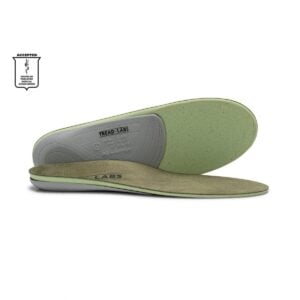
Tread Labs Ramble Insoles
A firm, two-part insole in four arch heights with a molded arch support Tread Labs guarantees for a million miles. Buy once and replace only the top cover.
- Arch support: Firm, 4 arch heights
- Cushioning: Light (replaceable top cover)
- Volume: Low to medium
- Guarantee: Arch support: 1 million miles (manufacturer)
Our take
Most insoles are one piece: once the foam wears out, the whole thing goes in the garbage. Tread Labs took a different approach. The Ramble is a two-part system: a firm molded arch support and a separate foam top cover that you replace when it wears out.
That design is what makes the Ramble good value despite the price. Tread Labs says its molded arch supports are "built to last a million miles. If they ever break or lose their shape, we'll send you a new pair." Replacement top covers cost a fraction of a new pair, so over a few years the Ramble can cost less than buying cheaper insoles every six months.
The other big advantage is fit. The Ramble comes in four arch heights: low, medium, high and extra high. Tread Labs has you check your wet footprint to pick the right one. Most insoles come in one arch height and leave you to hope it matches your foot.
The support is firm but flexible. Tread Labs describes the Ramble as its firm option, built for people who want real arch support rather than cushioning. The top cover adds a layer of foam for comfort, but this isn't a soft insole.
It's on the thin side compared with cushioned work insoles, which helps in boots that are already snug. Tread Labs also sells metatarsal pads that attach to the insole if you get pain in the ball of your foot.
The downsides are price and availability. At around $65 it's one of the most expensive insoles here, and popular sizes and arch heights sometimes sell out. If you want one insole that will last for years and match your arch exactly, it's worth it.
Pros
- Four arch heights to match your foot
- Molded arch support guaranteed for a million miles
- Replaceable top covers lower the long-term cost
- Firm, flexible support
- Thin enough for snug boots
Cons
- Expensive up front
- Firm, not cushioned
- Popular sizes and arch heights sometimes sell out
| Brand | Tread Labs |
|---|---|
| Arch support | Firm, 4 arch heights |
| Cushioning | Light (replaceable top cover) |
| Volume | Low to medium |
| Guarantee | Arch support: 1 million miles (manufacturer) |
5. Best shock absorption: Spenco Heavy Duty Work
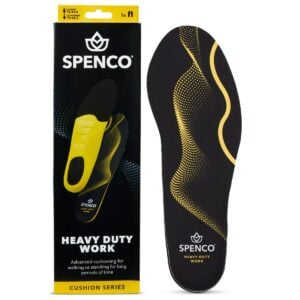
Spenco PolySorb Heavy Duty Work Insole
Thick heel and forefoot crash pads for maximum shock absorption, with soft arch support. Built for long shifts walking on hard surfaces.
- Arch support: Soft
- Cushioning: High (heel and forefoot pads)
- Volume: Medium
- Best for: Walking on hard surfaces
Our take
Spenco has made insoles for more than 50 years, and its PolySorb Heavy Duty, now sold as the Spenco Heavy Duty Work Insole, is built for one job: absorbing the pounding of a long day on hard surfaces.
Most of the shock in walking hits two places: the heel when it strikes the ground, and the ball of the foot when you push off. Spenco puts extra material in both. A thick SpenCore heel pad sits right under the heel strike, and a SpenCore forefoot crash pad cushions the front of the foot. The rest of the insole is Spenco's lightweight PolySorb foam.
A deep heel cup keeps the foot centered, and a metatarsal arch support helps take pressure off the ball of the foot. A "first ray drop zone" under the big toe joint is designed to allow a more natural push-off. The top cover is low friction to cut down on hot spots and blisters.
The arch support is soft. Spenco designed it for people who want some support without a stiff feel. That makes it comfortable from the first day, with no break-in, but it won't correct flat feet or significant overpronation. For that, look at the PowerStep or Superfeet.
It's a great pick if you walk a lot on site: long walks between buildings, up and down stairs, or along slab and gravel all day. The heel and forefoot pads take the sting out of every step.
With nearly 7,000 Amazon ratings at around 4.4 stars, it's well proven. Note that some listings still use the older PolySorb Heavy Duty name.
Pros
- Thick heel pad and forefoot crash pad absorb impact
- Metatarsal support eases pressure on the ball of the foot
- Comfortable from day one, no break-in
- Deep heel cup keeps the foot centered
- Low-friction top cover reduces hot spots
Cons
- Soft arch won't correct flat feet or overpronation
- Thicker heel can lift your foot in snug boots
- Sold under two names, which can be confusing
| Brand | Spenco |
|---|---|
| Arch support | Soft |
| Cushioning | High (heel and forefoot pads) |
| Volume | Medium |
| Best for | Walking on hard surfaces |
6. Best budget cushioning: Dr. Scholl’s Work
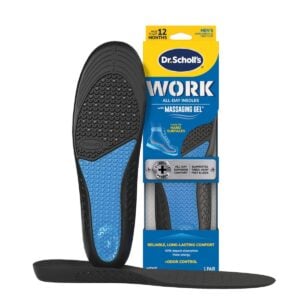
Dr. Scholl's Work All-Day Superior Comfort Insoles
Massaging Gel cushioning for hard surfaces at a price you can buy every few months. With more than 60,000 ratings, it's the most popular work insole on Amazon.
- Arch support: Light
- Cushioning: High (Massaging Gel)
- Volume: Medium
- Fit: Trim to fit
Our take
The Dr. Scholl's Work insole is the one you'll find at every drugstore and big-box store, and with more than 62,000 Amazon ratings averaging 4.5 stars, it's the most reviewed work insole on this list. At around $13, it's also the cheapest.
The key feature is Dr. Scholl's Massaging Gel. Gel cushioning runs along the insole to absorb shock from hard surfaces like concrete, asphalt and wood floors. Dr. Scholl's says the insole distributes foot pressure evenly to reduce fatigue in your feet and legs. A responsive cushioning layer adds some energy return, and an odor control treatment keeps them fresher.
They're trim to fit and sold in men's and women's sizes. Swapping them in takes a minute.
Keep your expectations realistic. This is a comfort insole, not an orthotic. The arch support is light, so it won't do much for flat feet, high arches or plantar fasciitis. Gel adds some weight and bulk compared with foam. And at this price, expect to replace them more often than a premium insole.
That last point isn't necessarily a downside. Fresh cheap insoles every few months can feel better than worn-out expensive ones. If your boots are comfortable but your feet are tired at the end of the day, the Dr. Scholl's Work is an easy, low-risk upgrade.
If you want more support for heavier body weight, Dr. Scholl's suggests its Extra Comfort or Heavy Duty Support lines instead.
Pros
- Very low price
- Gel cushioning for concrete and other hard surfaces
- Odor control
- Trim to fit, men's and women's sizes
- Easy to find in stores
Cons
- Light arch support; not an orthotic
- Wears out faster than premium insoles
- Gel adds some weight and bulk
| Brand | Dr. Scholl's |
|---|---|
| Arch support | Light |
| Cushioning | High (Massaging Gel) |
| Volume | Medium |
| Fit | Trim to fit |
7. Best budget arch support: WalkHero Arch Support
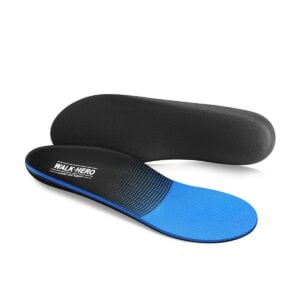
WalkHero Arch Support Insoles
Real arch support and a deep heel cup for about $15. A budget orthotic-style insole with more than 76,000 Amazon ratings.
- Arch support: Medium-firm
- Cushioning: Light
- Volume: High (work boots)
- Material: EVA foam
Our take
WalkHero isn't a household name, but its arch support insole is one of the best-selling insoles on Amazon, with more than 76,000 ratings. The appeal is simple: you get the structure of an orthotic-style insole for about the price of a basic cushion insole.
The insole is built around a structured arch support and a deep heel cup. The arch improves alignment and helps with flat feet and overpronation. The heel cup holds the heel in position and protects it when you land. WalkHero markets it for plantar fasciitis, heel spurs and Achilles tendonitis.
It's made of EVA foam, which keeps it light and absorbs shock. WalkHero designed it for wider, high-volume footwear like work boots, so it's a good fit in most lace-up boots once you take the factory insole out.
The trade-offs show up in reviews. Some owners find it firmer than they expected, and some say there's little cushioning under the ball of the foot. EVA also compresses faster than the materials in premium insoles, so it won't last as long as a Superfeet or Tread Labs.
Still, if you've never tried arch support and don't want to spend $50 to find out whether it helps, this is a smart place to start. If it does help, you can upgrade to the PowerStep or Superfeet later.
Pros
- Structured arch support and deep heel cup at a budget price
- Light EVA construction
- Designed for high-volume footwear like work boots
- Huge number of owner reviews
Cons
- Firm, with little forefoot cushioning
- EVA wears out faster than premium materials
- Less refined fit than name-brand orthotics
| Brand | WalkHero |
|---|---|
| Arch support | Medium-firm |
| Cushioning | Light |
| Volume | High (work boots) |
| Material | EVA foam |
8. Best for western boots: Ariat Energy Max Work
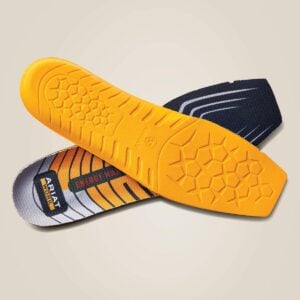
Ariat Energy Max Work Insole (Wide Square Toe)
A cushioned replacement insole shaped for wide square toe and round toe western work boots, the boots most generic insoles don't fit.
- Arch support: Moderate
- Cushioning: Medium-high (rebound foam)
- Toe shape: Wide square toe (round toe available)
- Best for: Western and pull-on work boots
Our take
If you wear western-style pull-on work boots, you've probably tried a regular insole and found it didn't fit. Wide square toe boots are a different shape at the front, and most insoles are cut for a round toe. Ariat solves that with an insole shaped for its own boots.
The Energy Max Work insole comes in wide square toe and round toe versions. Pick the one that matches your boot. Inside, a rebound foam layer cradles the foot and spreads out pressure, and an open-cell foam layer helps regulate temperature. The anatomically shaped cushioning is designed to hold up over long days.
The liner wicks moisture and uses Agion antimicrobial technology to fight odor, which matters in pull-on boots that don't breathe as well as lace-ups. With more than 4,600 Amazon ratings averaging 4.6 stars, it's well liked by people who wear Ariat boots.
This is a cushioning insole, not a corrective one. The arch support is moderate, so if you need serious support, you're better off with a PowerStep or Superfeet, assuming you can find one that fits a square toe.
It's also designed around Ariat's boot shapes. It will fit many other wide square toe western boots, but check the shape against your current insole before you buy.
If you wear Ariat or similar western work boots and your factory insoles are worn flat, this is the easiest way to get the comfort back.
Pros
- Shaped for wide square toe (round toe version available)
- Rebound foam spreads pressure
- Antimicrobial, moisture-wicking liner
- Highly rated by Ariat boot owners
Cons
- Moderate arch support
- Designed around Ariat's boot shapes
- Not for standard lace-up work boots
| Brand | Ariat |
|---|---|
| Arch support | Moderate |
| Cushioning | Medium-high (rebound foam) |
| Toe shape | Wide square toe (round toe available) |
| Best for | Western and pull-on work boots |
Also worth considering
- Superfeet Work Cushion. Superfeet’s softer, anti-fatigue insole built for work boots, with lightly structured support for all arch heights. A good middle ground if the Green feels too firm. An ESD version is also available. Check price on Amazon.
- Protalus M-100 Elite. Built for work boots around one of the deepest heel cups you can buy, which holds the heel in a neutral position. Worth a look if your knees or hips ache as well as your feet. Check price on Amazon.
- Spenco Total Support Max. A firmer Spenco with a rigid support pod to slow overpronation, a deep heel cup and a metatarsal pad. A good option for heavier workers who need more structure than the Heavy Duty. Check price on Amazon.
- Your boot maker’s replacement insole. Brands like Thorogood, Red Wing and KEEN sell replacement footbeds shaped for their own boots. If you love how your boots felt when they were new, this is the simplest fix.
- Heated insoles. For winter work outside, battery-heated insoles can keep your feet warm all day. They add bulk and need charging, so they’re a cold-weather add-on rather than an everyday insole.
How we chose
We started with the insoles tradespeople recommend most, plus the best-selling and most-reviewed work insoles on Amazon. Then we compared them on what matters inside a work boot:
- Support: arch shape and firmness, heel cup depth and whether the insole holds its shape under a full day’s load.
- Cushioning: how well it absorbs impact on concrete and other hard surfaces.
- Fit: volume, thickness and whether it works with the room inside a typical safety-toe boot.
- Durability: materials, manufacturer lifespan claims and guarantees.
- Owner feedback and value: recurring complaints across tens of thousands of reviews, and cost per month of use.
Specs and claims come from the manufacturers. Where we quote a lifespan or guarantee, it’s the manufacturer’s figure. We update this guide as products change.
How to choose insoles for work boots
1. Decide between support and cushioning
This is the most important choice. A firm, supportive insole changes how your foot sits and moves. A soft, cushioned insole makes each step feel softer but doesn’t change your foot’s position. Many people buy the softest insole they can find, feel great for two weeks, and then find their feet hurt again once the foam packs down. If you have any ongoing pain, support usually matters more than softness.
2. Know your arch
Wet your foot and step on a piece of cardboard or a dark floor:
- Flat or low arch: you see almost the whole footprint. Look for firm support with a low or medium arch, like the PowerStep Pinnacle Work or the Tread Labs Ramble in a low height.
- Normal arch: you see the heel and forefoot joined by a band about half the width of the foot. Most insoles will work. Choose based on whether you want support or cushioning.
- High arch: you see the heel and forefoot with a thin band or nothing between them. High arches don’t absorb shock well, so look for a high-arch support with good cushioning, like the Superfeet Green.
3. Match the insole to your boot’s volume
Work boots have more room inside than sneakers, which is why work-specific insoles are often thicker. Always take out the factory insole before putting in the new one. Stacking insoles raises your foot, crowds your toes and can make your heel slip.
Pay attention to the toe box in safety-toe boots. A thicker insole lifts your foot toward the steel or composite cap. Your toes should never touch the cap, so if they do after adding an insole, choose a thinner one.
4. Understand the materials
- Polyurethane (PU) and EVA foam: the most common. EVA is light and inexpensive but compresses faster. PU is denser and lasts longer.
- Gel: absorbs impact well and holds up better than soft foam, but adds weight.
- Memory foam: feels great in the store but packs out quickly under a full day’s weight. It’s fine for light use, less so for 10-hour shifts.
- Plastic shells (polypropylene and similar): the firm layer in supportive insoles that holds the arch and heel shape. They outlast the foam on top.
5. Check your boot’s safety ratings
Most insoles don’t affect a boot’s safety-toe or puncture-resistance ratings, since those come from the toe cap and sole. Electrical ratings are different. If your boots are rated ESD (electrostatic dissipative) or SD (static dissipative), the insole is part of the path that drains static, and a regular insole can stop the boot from meeting its rating. Use an insole that’s rated for ESD footwear, like the Timberland PRO Anti-Fatigue ESD or Superfeet Work ESD, or check with your boot’s manufacturer.
6. Get the size right
Some insoles are sized to your shoe size, and others are trim to fit. For trim-to-fit insoles, take out your boot’s factory insole, lay it on top of the new one with the heels lined up, trace around it and cut along the line. Trim a little at a time from the toe end. You can always take more off.
7. Give them time
Firm, supportive insoles need a break-in period. Wear them for half a shift for the first few days, then build up. Some muscle soreness in the arch is normal for the first week. Sharp pain isn’t. Cushioned insoles usually feel good right away.
How long do work boot insoles last?
With daily use in work boots, most insoles last about 6 to 12 months. Cheap foam insoles may only last a few months, while firm support insoles like the Superfeet Green are designed to keep their shape for up to a year. Tread Labs goes further, guaranteeing its molded arch supports for a million miles and selling replacement top covers.
Replace your insoles when:
- The foam is visibly flattened, especially under the heel and ball of the foot.
- The arch has collapsed, cracked or no longer holds its shape.
- The top cover is worn through or the insole smells no matter what you do.
- The aches you bought them to fix start coming back.
A good habit is to replace your insoles every time you resole or replace your boots, and to keep a second pair to swap in so each pair can dry out overnight.
If you’ve had foot, heel or knee pain for more than a couple of weeks, or you have diabetes, numbness or a foot injury, see a podiatrist. Over-the-counter insoles help a lot of people, but they aren’t a replacement for a proper diagnosis or custom orthotics.
Work boot insole FAQ
Should you put insoles in work boots?
For most people who wear work boots every day, yes. Factory insoles are usually thin foam that flattens quickly. A good insole adds support, absorbs impact on hard surfaces and can make your boots last longer before they feel worn out.
What are the best insoles for standing on concrete all day?
For healthy feet, a cushioned insole with a moderate arch, like the Timberland PRO Anti-Fatigue or Spenco Heavy Duty Work. If you have flat feet or heel pain, a supportive insole like the PowerStep Pinnacle Work or Superfeet Green will usually help more over a long shift.
Are gel or foam insoles better for work boots?
Gel absorbs impact well and tends to hold up better than soft foam, but it’s heavier. Dense foams like polyurethane last longer than soft memory foam. The bigger question is whether you need support or cushioning; the material matters less than the design.
How often should I replace work boot insoles?
About every 6 to 12 months with daily use, or sooner if they’re flattened, cracked or your pain comes back.
Can insoles help with knee or back pain?
They can. When your arches collapse or your feet roll inward, it changes how your knees and hips line up, and that can add to knee and lower back pain. A supportive insole helps some people a lot. If pain continues, see a doctor or podiatrist.
Can I put new insoles on top of the ones that came with my boots?
No. Take the factory insole out first. Stacking insoles makes your boots too tight, crowds your toes against the safety cap and can cause blisters and heel slip.
Will an aftermarket insole affect my boot’s safety rating?
Usually not for safety toes or puncture protection. But if your boots are ESD or static dissipative rated, use an ESD-rated insole or the rating may no longer hold.
Are expensive insoles worth it?
Often, yes. Premium insoles use firmer shells and denser foams that last longer, so the cost per month can be close to cheap insoles you replace more often. But a $15 insole is a smart way to find out whether insoles help you before spending more.
The bottom line
For most people in work boots, the Superfeet Green is the insole to buy: firm, proven support that lasts up to a year. If your feet are healthy but sore after a day on concrete, get the Timberland PRO Anti-Fatigue. For heel pain or plantar fasciitis, start with the PowerStep Pinnacle Work. And if you just want to try insoles for the price of lunch, the Dr. Scholl’s Work or WalkHero are low-risk places to start.
Need new boots to go with them? See our picks for the best work boots for construction, plus the best hard hats and best safety glasses for construction.
Wear one of these? Rate it on its product page or tell us what you think in the comments.