
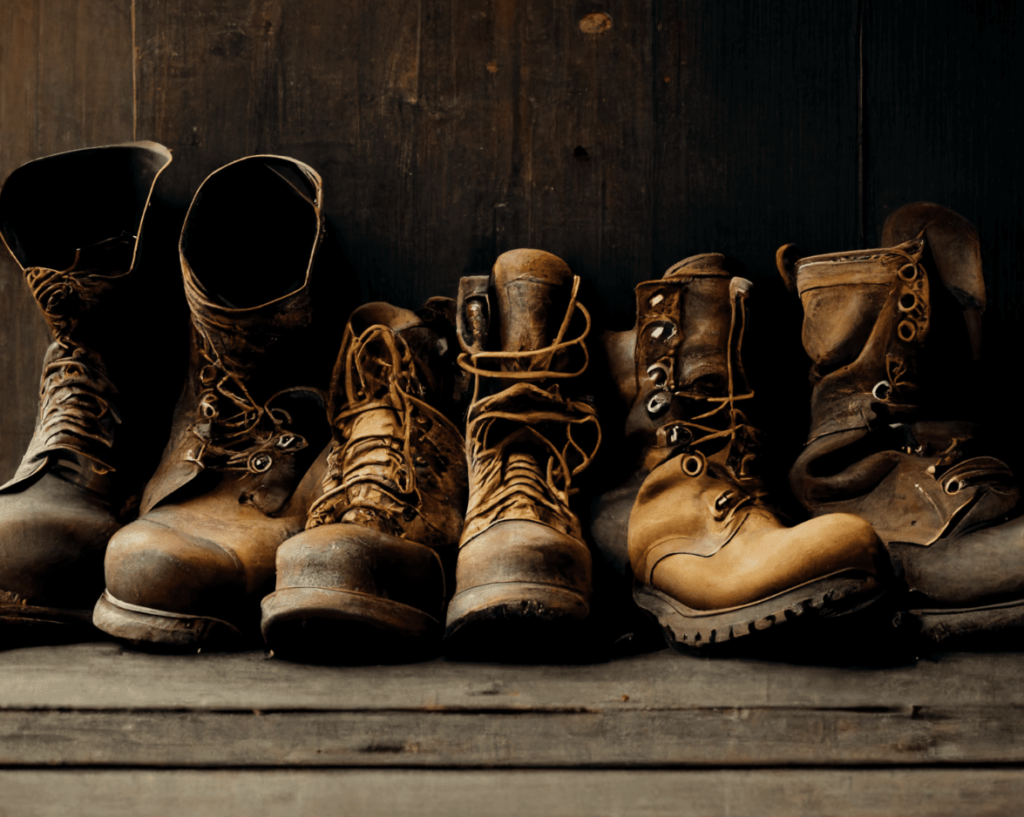

We may earn a commission when you buy through links on this page, as an Amazon Associate. Learn more.
Ask anyone on a construction site which work boots are best and you’ll get a strong opinion. Whether you’re a plumber, an electrician, a laborer or an ironworker, you spend 8 to 10 hours a day in them. The right pair protects your feet and keeps your knees and back from paying for it later.
We compared eight popular construction work boots on safety rating, waterproofing, comfort, build quality and price, including boots we’ve worn on our own sites. Here are our picks, followed by a guide to choosing the right pair.
Our top picks at a glance
| Pick | Boot | Height | Safety toe | Waterproof |
|---|---|---|---|---|
| Best overall | Thorogood 1957 Series 8″ | 8″ | Steel | Yes |
| Best value | Timberland PRO Pit Boss 6″ | 6″ | Steel | No |
| Best waterproof 8-inch | Carhartt 8″ CMW8200 | 8″ | Steel | Yes |
| Best lightweight | Timberland PRO TiTAN 8″ | 8″ | Alloy | Yes |
| Best for wide feet | KEEN Utility Milwaukee 6″ | 6″ | Asymmetric steel | Yes |
| Best for hot surfaces | Irish Setter Wingshooter ST 6″ | 6″ | Non-metallic | Yes |
| Best cushioning | Wolverine DuraShocks 8″ | 8″ | Soft or steel | Varies |
| Best pull-on | Carhartt 11″ Wellington | 11″ | Steel | Yes |
Prices change often, so check the current price on each pick. Roughly: $ under $150, $$ $150–200, $$$ over $200.
The 8 best work boots for construction
1. Best overall: Thorogood 1957 Series 8″
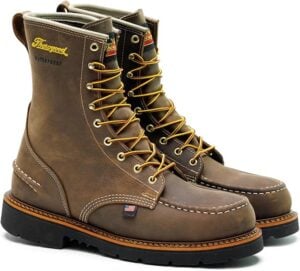
Thorogood 1957 Series 8" Waterproof Steel Toe Moc Toe Boot
An American-made, storm-welted moc toe boot that's comfortable out of the box and built to last for years. Pricey, but worth it if you're on your feet every day.
- Height: 8"
- Safety toe: Steel
- Waterproof: Yes
- EH rated: Yes
Our take
If you want an American-made work boot, look no further than the Thorogood 1957 Series 8". It's pricey, but the construction and materials are hard to beat. I've owned a pair myself and can vouch for what the five-star reviews say.
They fit well and are comfortable all day. The MAXWear 90 outsole flexes more than most work boot soles and grips well on gravel and wet or oily surfaces. The steel toe meets ASTM F2413-18, and the boot is EH rated for electrical hazard protection.
The upper is full-grain leather on a storm welt. In plain terms, the sole is stitched to the upper, so it won't peel off like a glued sole and the boot can be resoled. A waterproof membrane and gusseted tongue keep water out, which helps road crews, plumbers and anyone working in wet conditions.
Thorogood makes the 1957 Series in its US plants with USA and globally sourced components.
I'd recommend this boot to anyone who works construction full time.
Pros
- Made in the USA
- Storm-welted construction can be resoled
- Waterproof with a gusseted tongue
- EH rated, slip-resistant outsole
- Comfortable with little break-in
Cons
- Expensive
- Oiled leather needs regular care to stay in good shape
| Brand | Thorogood |
|---|---|
| Height | 8" |
| Safety toe | Steel |
| Waterproof | Yes |
| EH rated | Yes |
| Construction | Storm welt (resoleable) |
| Made in | USA |
2. Best value: Timberland PRO Pit Boss 6″
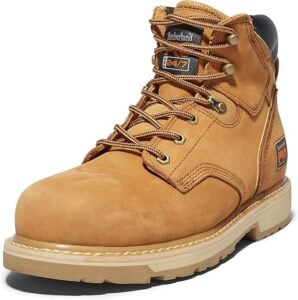
Timberland PRO Pit Boss 6" Steel Toe Work Boot
One of the most popular work boots on construction sites, with tens of thousands of reviews. Tough, reasonably priced and a safe first pair.
- Height: 6"
- Safety toe: Steel
- Waterproof: No
- EH rated: Varies by version
Our take
If you've ever searched for the best work boots, you've probably come across the Pit Boss. It shows up at the top of most round-ups and has more than 27,000 ratings on Amazon. Roofers, drywallers and every other trade wear them.
So why is the Pit Boss so popular?
The full-grain leather upper is tough and the stitching holds up. The steel toe meets ASTM impact and compression standards, and the rubber outsole resists oil, slips and abrasion. The padded collar keeps the ankle comfortable.
Price is the other big draw. You get a durable boot at a fair price that lasts for years.
Two things to know. The Pit Boss isn't waterproof, so it's not the pick for wet sites. And electrical hazard (EH) ratings differ between versions, so check the label if you need EH protection.
Pros
- Proven design with a huge number of positive reviews
- Fair price for a full-grain leather steel toe
- Oil and slip-resistant outsole
- Comfortable padded collar
Cons
- Not waterproof
- Some break-in time
- EH rating varies by version, so check the label
| Brand | Timberland PRO |
|---|---|
| Height | 6" |
| Safety toe | Steel |
| Waterproof | No |
| EH rated | Varies by version |
3. Best waterproof 8-inch: Carhartt 8″ CMW8200
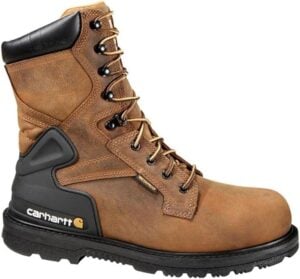
Carhartt 8" Waterproof Steel Toe Work Boot (CMW8200)
A solid all-around 8" waterproof steel toe from a brand you already trust. Good protection, good grip and a fair price.
- Height: 8"
- Safety toe: Steel
- Waterproof: Yes
- EH rated: Yes
Our take
You've probably worn Carhartt pants, a coat or a shirt. The boots are built to the same standard.
The CMW8200 has a full-grain leather upper and a waterproof bootie. The sole is direct-attached, which bonds it to the upper so it's unlikely to separate. The steel toe and shank are EH rated.
The dual-density outsole resists oil and slips and has a deep tread that grips well on ladders and slick surfaces.
Some owners say they're on the heavy side. They're steel toe work boots, so take that with a grain of salt. The ankle has plenty of padding, which adds support on uneven ground.
Pros
- Waterproof with a full bootie
- Steel toe and shank, EH rated
- Oil and slip-resistant outsole
- 8" height for ankle support
- Reasonable price for the spec
Cons
- On the heavy side
- Some owners find them narrow
- Direct-attach sole can't be resoled
| Brand | Carhartt |
|---|---|
| Height | 8" |
| Safety toe | Steel |
| Waterproof | Yes |
| EH rated | Yes |
| Construction | Direct attach |
4. Best lightweight: Timberland PRO TiTAN 8″
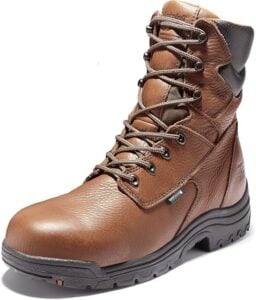
Timberland PRO TiTAN 8" Waterproof Alloy Toe Boot
An alloy safety toe keeps the weight down, so this 8" waterproof boot feels closer to a hiker. Good for sites where you walk all day.
- Height: 8"
- Safety toe: Alloy
- Waterproof: Yes
- EH rated: Yes
Our take
If you want a light, comfortable work boot that still holds up, the TiTAN is worth a look.
The secret is the alloy safety toe. It's lighter than steel and meets the same ASTM I/75 and C/75 impact and compression ratings. Combined with a leather upper built like a hiker, the boot feels light and flexible for an 8" safety boot. Owners often describe it as feeling like a slipper.
The leather upper is waterproof and the seams are well stitched. The rubber outsole cushions your step, which helps if you're walking a big site all day. The boot is also EH rated.
At 8" tall it gives more ankle support than the 6" boots on this list.
Pros
- Lighter than most steel toe boots
- Waterproof leather upper
- Alloy toe meets ASTM I/75 C/75, EH rated
- 8" ankle support
Cons
- Hiker-style sole isn't as tough as a heavy lug on rough demolition sites
- Pricier than the Pit Boss
| Brand | Timberland PRO |
|---|---|
| Height | 8" |
| Safety toe | Alloy |
| Waterproof | Yes |
| EH rated | Yes |
5. Best for wide feet: KEEN Utility Milwaukee 6″
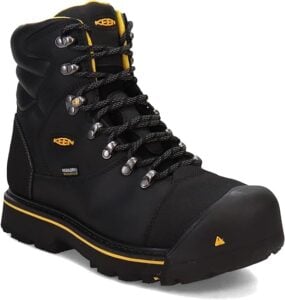
KEEN Utility Milwaukee 6" Waterproof Steel Toe Boot
KEEN's asymmetric steel toes give you more room in the toe box than most safety boots. A comfortable, waterproof 6" pick for wide feet.
- Height: 6"
- Safety toe: Asymmetric steel
- Waterproof: Yes (KEEN.DRY)
- EH rated: Yes
Our take
A jobsite has water, mud and puddles, and a waterproof boot like the KEEN Milwaukee keeps your feet dry all day.
The first thing I notice on these is the leather. It's waterproof full-grain leather, not synthetic, with Tough-Tec guards on the toe and heel where boots usually wear first.
The main feature is KEEN's asymmetric steel toe. Each toe cap is shaped for a left or right foot, which gives your toes more room than a standard cap. If you have wide feet or your toes get crushed in other safety boots, try these.
The removable dual-density footbed and padded collar make them comfortable for a full shift. The steel toe meets ASTM F2413 and the boot is EH rated.
The downsides: they're only 6" tall, and the color choices are limited. If your site requires 8" boots, look elsewhere.
Pros
- Roomy asymmetric steel toe
- Waterproof leather upper with a breathable membrane
- Tough-Tec toe and heel guards
- EH rated
Cons
- Only 6" tall
- Limited color options
- Chunkier look than a traditional work boot
| Brand | KEEN Utility |
|---|---|
| Height | 6" |
| Safety toe | Asymmetric steel |
| Waterproof | Yes (KEEN.DRY) |
| EH rated | Yes |
6. Best for hot surfaces: Irish Setter Wingshooter ST 6″
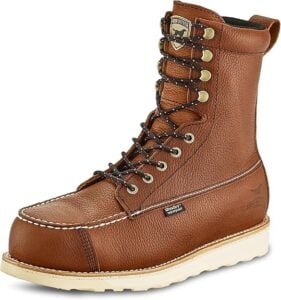
Irish Setter Wingshooter ST 6" Waterproof Safety Toe Boot
A classic leather work boot with a non-metallic safety toe and a heat-resistant sole rated to 475°F. A strong pick for paving and roofing crews.
- Height: 6"
- Safety toe: Non-metallic
- Waterproof: Yes (UltraDry)
- EH rated: Yes
Our take
The Irish Setter Wingshooter ST has some of the best reviews of any boot on this list, and it's easy to see why. It looks like a classic leather boot but meets modern safety standards.
The safety toe is non-metallic, so it's lighter than steel, doesn't conduct cold and won't set off metal detectors. It meets ASTM F2413-18 for impact, compression and electrical hazard (EH), plus ASTM F3445-21 for slip resistance.
The outsole is rated heat resistant (HRO) up to 475°F. If you've ever had cheap boots start to melt on fresh asphalt or a hot roof, you'll appreciate that.
The full leather upper uses Irish Setter's UltraDry waterproofing, and the stitching holds up well with very few reports of the boot coming apart.
The version we link to is the 6" boot. Irish Setter makes other heights and toe options, so check the listing before you buy.
Pros
- Non-metallic safety toe is lighter than steel and doesn't conduct cold
- Heat-resistant outsole rated to 475°F
- Waterproof leather upper
- EH and slip-resistance ratings
Cons
- Runs about a half size small for some
- Fits on the slim side
- Pricier than most
| Brand | Irish Setter (Red Wing) |
|---|---|
| Height | 6" |
| Safety toe | Non-metallic |
| Waterproof | Yes (UltraDry) |
| EH rated | Yes |
| Outsole | Heat resistant to 475°F |
7. Best cushioning: Wolverine DuraShocks 8″
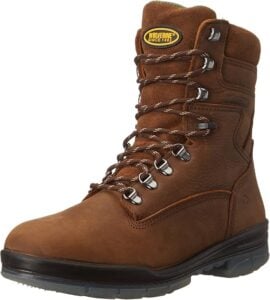
Wolverine DuraShocks 8" Work Boot
Wolverine's DuraShocks cushioning takes the sting out of a day on concrete. A comfortable, well-built 8" boot from a brand that's been around since 1883.
- Height: 8"
- Safety toe: Soft or steel (check listing)
- Waterproof: Varies by version
- Comfort: DuraShocks cushioning
Our take
Wolverine has made boots in Rockford, Michigan since 1883, and the DuraShocks line is one of its most popular.
The main feature is the DuraShocks cushioning system. It absorbs impact and returns energy with each step, so your legs feel less beat up at the end of a day on concrete.
The leather upper is well stitched and the sole is direct-attached, which makes it less likely to separate.
Owner reviews are mostly positive. Many say the fit is great and the boot holds up well to wear and tear.
One important note: DuraShocks boots come in both soft toe and steel toe versions. If your site requires safety toes, make sure the listing you pick says steel toe.
Pros
- DuraShocks cushioning for concrete and hard floors
- Well-built leather upper
- Direct-attached sole is unlikely to separate
- Trusted brand with a long history
Cons
- Not every version is waterproof
- Soft and steel toe versions share a name, so check before you buy
| Brand | Wolverine |
|---|---|
| Height | 8" |
| Safety toe | Soft or steel (check listing) |
| Waterproof | Varies by version |
| Comfort | DuraShocks cushioning |
8. Best pull-on: Carhartt 11″ Wellington
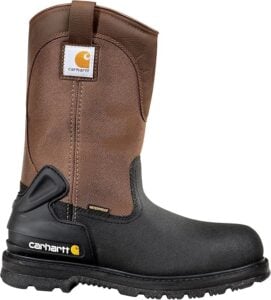
Carhartt 11" Insulated Waterproof Wellington (Steel Toe)
A tall, insulated pull-on boot for mud, water and cold mornings. If you don't need the height, choose a 6" or 8" boot instead.
- Height: 11" pull-on
- Safety toe: Steel
- Waterproof: Yes (Storm Defender)
- EH rated: Yes
Our take
If your work includes deep mud, standing water or trenches, you may need a boot taller than the standard 6" or 8". The Carhartt 11" Wellington is built for that.
The Storm Defender waterproof membrane keeps water out while letting sweat escape. The Helcor leather upper resists abrasion, and a TPU heel guard adds stability on uneven ground.
It has 400g of insulation, so it's a good cold-weather boot but can run warm in summer. The steel toe meets ASTM standards and is EH rated. That rating means it's tested to withstand 18,000 volts under dry conditions.
The polyurethane lug outsole resists oil and grips well. The boot is heavier than a lace-up because of the height.
It's a pull-on, which is a blessing and a curse. You save time with no laces, but pull-ons don't hug your foot as closely and can slip around if you get the size wrong.
Pros
- 11" height for mud and water
- Waterproof and insulated (400g)
- Steel toe, EH rated
- Pull-on design, no laces to break or snag
Cons
- Heavy
- Can run warm in summer
- Looser fit than a lace-up
| Brand | Carhartt |
|---|---|
| Height | 11" pull-on |
| Safety toe | Steel |
| Waterproof | Yes (Storm Defender) |
| EH rated | Yes |
| Insulation | 400g |
How we chose
We started with the boots we see most on construction sites and the best-rated safety boots on Amazon. For each one we checked:
- Safety rating: the ASTM F2413 toe rating, plus electrical hazard (EH) and slip-resistance ratings.
- Comfort: weight, cushioning, toe room and break-in, for long days on concrete.
- Build quality: leather, stitching and how the sole is attached, since that decides how long a boot lasts.
- Owner feedback: recurring fit and durability complaints across thousands of reviews.
- Value: what you get for the money, from entry-level to premium.
We’ve worn several of these boots on our own sites. We update the picks as models and prices change.
How to choose work boots for construction
1. Pick the right safety toe
- Steel toe: the most common choice. Strong, thin and inexpensive, but heavier and colder in winter.
- Alloy toe (aluminum or titanium): same protection rating as steel, but lighter.
- Composite / non-metallic toe: lighter again, doesn’t conduct cold or heat, and won’t set off metal detectors. The cap is a little bulkier.
- Soft toe: no protection. Fine for some trades, but most commercial sites require a safety toe.
2. Read the ASTM label
OSHA requires protective footwear on construction sites wherever there’s a risk of foot injury (29 CFR 1926.95–96). Safety footwear in the US is tested to ASTM F2413, and the label inside the tongue tells you what a boot is rated for:
- M I/75 C/75: men’s boot with impact and compression protection. This is the safety toe rating.
- EH: electrical hazard. A secondary layer of protection against live circuits, tested to 18,000 volts in dry conditions.
- PR: puncture-resistant sole plate, worth having on demo and framing sites with nails.
- SR (ASTM F3445): tested slip resistance.
In Canada, look for the CSA green triangle patch.
3. Choose a height
- 6″: lighter and easier to move in. Good for interior trades and finish work.
- 8″: more ankle support on uneven ground, rebar and excavation. Many commercial sites require 6″ minimum and some require 8″.
- Pull-on / Wellington (10–11″): best for mud, water and concrete pours. Quick to put on, but a looser fit.
4. Decide if you need waterproof
If you work outside, in trenches or around concrete washout, get a waterproof boot with a membrane. They run warmer, so for dry interior work a non-waterproof leather boot like the Pit Boss is cooler and often cheaper.
5. Look at how the sole is attached
Welted boots (Goodyear or storm welt) have the sole stitched on and can be resoled, so a good pair can last years. Direct-attach and cemented soles are bonded to the upper. They’re lighter, more flexible and cheaper, but once the sole wears out, you replace the boot.
6. Get the fit right
Try boots on at the end of the day when your feet are largest, wearing your work socks. You want a snug heel and room to wiggle your toes, with the safety cap clear of them. If you’re on concrete all day, a good aftermarket insole is the cheapest comfort upgrade you can make. See our picks for the best insoles for work boots.
Construction work boots FAQ
Are steel toe boots required on construction sites?
OSHA requires protective footwear where there’s a risk of foot injury, but it doesn’t require steel specifically. Alloy and composite safety toes are tested to the same ASTM F2413 standard. Most general contractors require a safety toe on site, so check your site rules.
Steel toe or composite toe: which is better?
Both meet the same ASTM impact and compression rating. Steel is thinner and cheaper. Composite is lighter, doesn’t conduct cold and won’t set off metal detectors. If you work outside in winter or walk a lot, composite or alloy is more comfortable.
How long should construction work boots last?
With daily use, most work boots last 6 to 12 months. A well-made welted boot can last several years with care and a resole. Replace them once the tread is worn smooth, the sole separates, the safety toe has taken a heavy hit, or the waterproofing fails.
What are the most comfortable work boots for construction?
Comfort comes down to fit, weight and cushioning. Of our picks, the Timberland PRO TiTAN (light alloy toe), the Wolverine DuraShocks (cushioned sole) and the KEEN Milwaukee (roomy toe box) are the most comfortable for long days.
How do I break in new work boots?
Wear them around the house or for half days for the first week, with the socks you’ll work in. Condition the leather, and don’t soak them or heat them to speed things up. That damages the leather and the glue.
The bottom line
If you want one boot that does it all and will last, buy the Thorogood 1957 Series. On a budget, the Timberland PRO Pit Boss is a proven, affordable work boot for construction workers. If you walk a big site all day, the lighter Timberland PRO TiTAN is easier on your legs.
Protect your head and eyes too. See our picks for the best hard hats for construction and the best safety glasses for construction.
Got a pair you’d swear by? Tell us in the comments.
This website definitely has all the information I wanted about this subject and
didn’t know who to ask.