
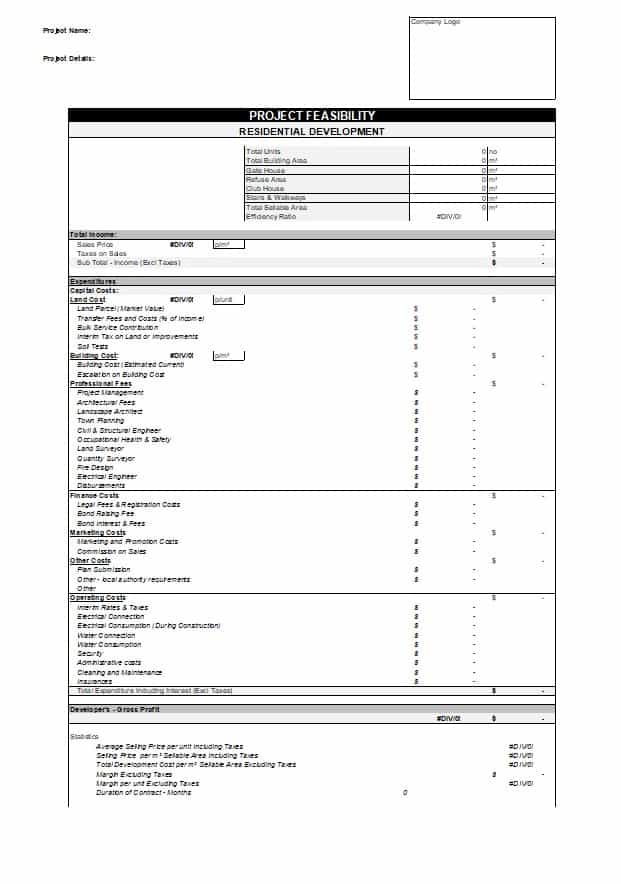
Project Feasibility Template
$4.99
Determine if your development is feasible with this useful spreadsheet.
Templates are starting points. Adapt them to your contract and to the laws and safety rules where you work. They are not legal advice.
Product FAQ
You will receive your documents and files immediately after you complete the checkout process. You will receive a link on the checkout page as well as via email.
As long as the document remains on Essential Construction you will be able to download it once purchased.
Yes, in most cases (with the exception of stock photography and ebooks) the files you will receive are editable.
We accept debit, all credit cards (Visa, Amex Mastercard etc) as well as payments via Apple Pay, Google Pay and Paypal.
Our return policy varies based on the product, for more information you can find our detailed return policy here.
Our documents are for use on your projects. You may not resell these documents on other marketplaces.
Full Description
This property development feasibility template is a spreadsheet for checking whether a development project is feasible and how profitable it could be before you commit to it. It is most suitable for residential development but can be adjusted for other project types, and it calculates gross profit as both a total amount and a percentage.
What is a development feasibility study?
A development feasibility study is an early financial test of a property project. It estimates the expected revenue, such as sales of homes or units, and subtracts the expected costs, such as land, construction, professional fees, finance and sales costs, to see whether the project makes enough profit to justify the risk. Developers use it to decide whether to buy a site, how much to offer for it and whether the project is worth taking to lenders or partners.
When to use it
- Screening a potential site before making an offer
- Comparing different schemes for the same site, such as more units or a different product mix
- Testing the effect of higher construction costs or lower sale values
- Preparing a first-pass summary for partners, investors or lenders
- Reviewing an existing project when costs or market conditions change
What’s included
The template is a spreadsheet for assessing the feasibility and profitability of a project. It is set up for residential development and can be adjusted to suit other projects. It calculates gross profit as a total monetary value and as a percentage.
How to fill it out
- Describe the project: site, number and type of units, and the main assumptions.
- Enter the expected revenue, such as the sale value of each unit or the total project value.
- Enter the land or acquisition cost and related costs.
- Enter construction costs, using an estimate or cost per area appropriate to the type of building.
- Add professional fees, permits, finance costs, marketing and sales costs, and a contingency.
- Review the calculated gross profit in total and as a percentage.
- Test the result by changing key assumptions, such as sale values and build costs, to see how sensitive the profit is.
Common mistakes to avoid
- Using optimistic sale values without checking recent comparable sales.
- Leaving out soft costs such as fees, permits, finance and sales commissions.
- No contingency for construction or design risk.
- Treating a first-pass feasibility as a final budget. Update it as design and pricing develop.
Related templates and guides
- Construction Cash Flow Forecast
- Development Economics for Construction Projects
- Construction Cost Estimate Template – Excel
- Proforma
- Contingency
Frequently asked questions
What is a property development feasibility?
It is a calculation that compares the expected revenue from a development with its total costs to find the likely profit. It helps a developer decide whether a project is viable, what they can afford to pay for land and whether the return justifies the risk, before significant money is spent.
What costs should a development feasibility include?
Include land and acquisition costs, construction costs, professional and consultant fees, permits and approval costs, finance costs, marketing and sales costs, taxes where relevant, and a contingency. Leaving out soft costs is one of the most common reasons a feasibility overstates profit.
What is the difference between gross profit and net profit in a feasibility?
Gross profit is the revenue minus the development costs included in the calculation. Net profit goes further and deducts items such as taxes and other costs not included in the gross figure. Always check which costs a template includes before comparing results between projects.
What profit margin should a development target?
There is no single figure. Target margins depend on the market, the type and size of project, the level of risk and lender requirements. Many lenders and investors set a minimum margin before they will fund a project, so confirm their requirements early.
Is a feasibility study the same as a pro forma?
They are closely related. A pro forma is a financial projection of a project’s revenue, costs and returns. A development feasibility often takes the form of a simple pro forma at an early stage, and becomes more detailed as the design, pricing and financing are developed.


Reviews
There are no reviews yet