
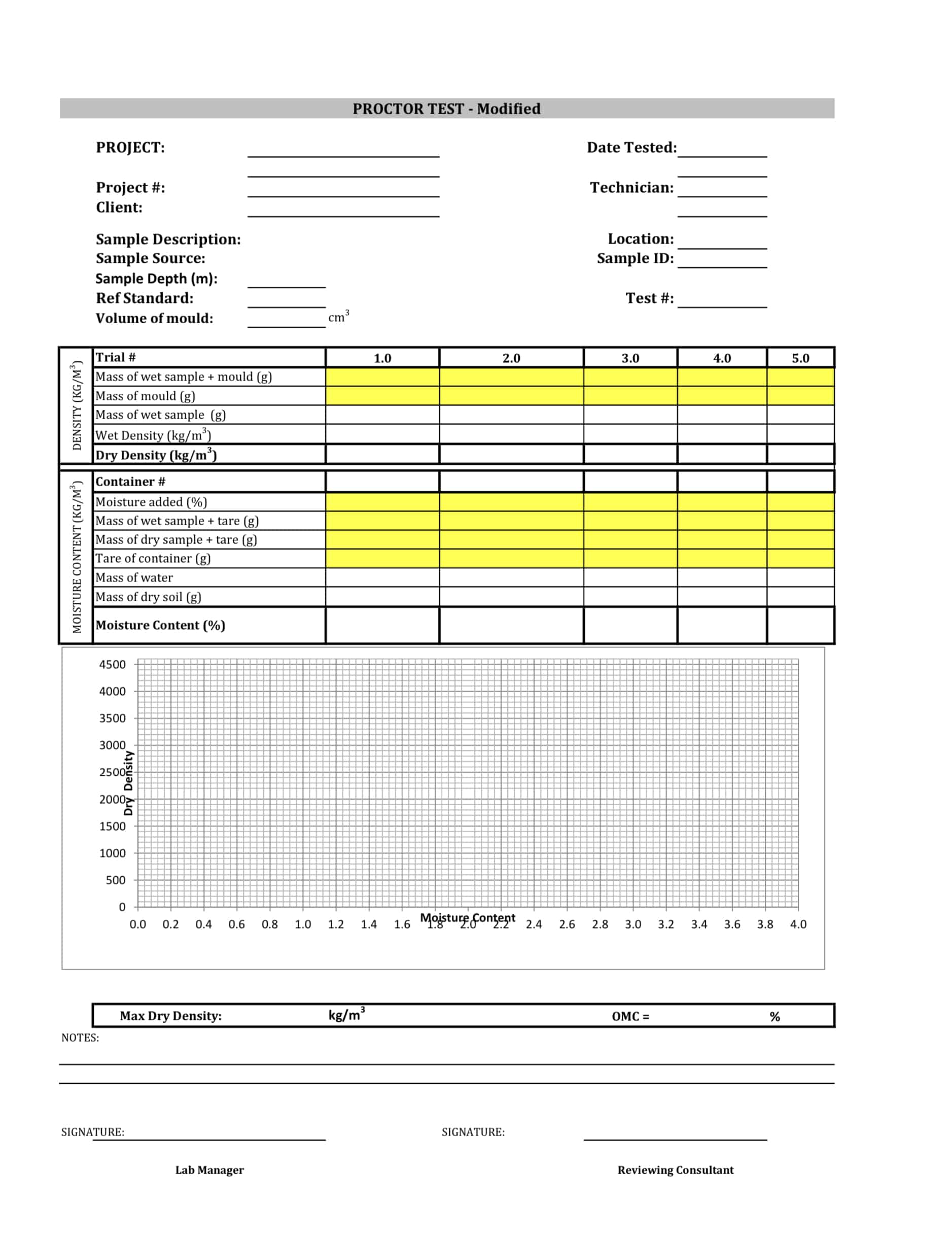
Proctor Test Report Template
$4.99
Templates are starting points. Adapt them to your contract and to the laws and safety rules where you work. They are not legal advice.
Product FAQ
You will receive your documents and files immediately after you complete the checkout process. You will receive a link on the checkout page as well as via email.
As long as the document remains on Essential Construction you will be able to download it once purchased.
Yes, in most cases (with the exception of stock photography and ebooks) the files you will receive are editable.
We accept debit, all credit cards (Visa, Amex Mastercard etc) as well as payments via Apple Pay, Google Pay and Paypal.
Our return policy varies based on the product, for more information you can find our detailed return policy here.
Our documents are for use on your projects. You may not resell these documents on other marketplaces.
Full Description
This Proctor test report template is a concise spreadsheet for recording the results of a Proctor compaction test carried out at the materials laboratory. Use it to document the moisture-density relationship of your soil so field compaction can be checked against a clear, consistent lab reference.
What is a Proctor test report?
A Proctor test report records the results of a laboratory compaction test on a soil or granular sample. The sample is compacted in a mold at several moisture contents, and the dry density is calculated for each point. The results are plotted as a compaction curve, and the report states the maximum dry density (MDD) and optimum moisture content (OMC). On site, field density tests are compared with this maximum to calculate the percent compaction required by the specification.
When to use it
- Establishing the reference density for fill, subgrade or base course material
- Testing a new borrow source or a change in imported fill
- Reporting lab results to the engineer, owner or general contractor
- Checking whether field compaction results meet the specified percentage
- Building a quality record for earthworks and backfill
What’s included
The template is a spreadsheet for a concise Proctor test report. It is designed to record the results of a Proctor test on your soil, as done at the materials laboratory, in a consistent format you can file with your earthworks quality records.
How to fill it out
- Enter the project, sample number, sample location or source, date sampled and date tested.
- Describe the material and note the test method used, standard or modified Proctor.
- Record the moisture content and the wet and dry density for each compaction point.
- Plot or check the compaction curve and identify the peak.
- Report the maximum dry density and optimum moisture content clearly.
- Add the tester’s name, any remarks and the reviewer’s sign-off.
- Issue the report to the site team so field density tests use the correct reference.
Tips
- Run a new Proctor whenever the material changes noticeably. Using the wrong reference gives misleading compaction results.
- Label each report with the material source so field testers pick the right one.
- Check the specification for which test, standard or modified, the percent compaction is based on.
Related templates and guides
- Handbook of Geotechnical Investigation Design Tables
- Earth Work & Soil Compaction Construction Equipment Presentation
- QAQC Checklist – Site Works (Excavation)
- Controlling Quality on the Construction Site
Frequently asked questions
What is a Proctor compaction test?
It is a laboratory test that finds the moisture content at which a soil can be compacted to its highest dry density. Soil is compacted in a mold in layers with a standard hammer at several moisture contents. The results give the maximum dry density and optimum moisture content used to control compaction in the field.
What is the difference between the standard and modified Proctor tests?
Both follow the same principle, but the modified test uses more compaction energy: a heavier hammer, a greater drop height and more layers. In the US they are covered by ASTM D698 (standard) and ASTM D1557 (modified). Modified Proctor is common for roads, base course and heavily loaded areas.
What is the Proctor value?
Proctor value usually refers to the maximum dry density from the Proctor test, sometimes reported together with the optimum moisture content. Field compaction is expressed as a percentage of this value, for example 95% of maximum dry density.
What does 98% compaction mean?
It means the dry density measured in the field is 98% of the maximum dry density found in the laboratory Proctor test for that material. The specification states the required percentage and whether it refers to the standard or modified Proctor result.
Can you get over 100% compaction?
Yes. Field density can exceed the lab maximum when site equipment applies more energy than the lab test, or when the material on site differs from the sample tested. Results well above 100% are a sign to check that the right Proctor reference is being used.


Reviews
There are no reviews yet