
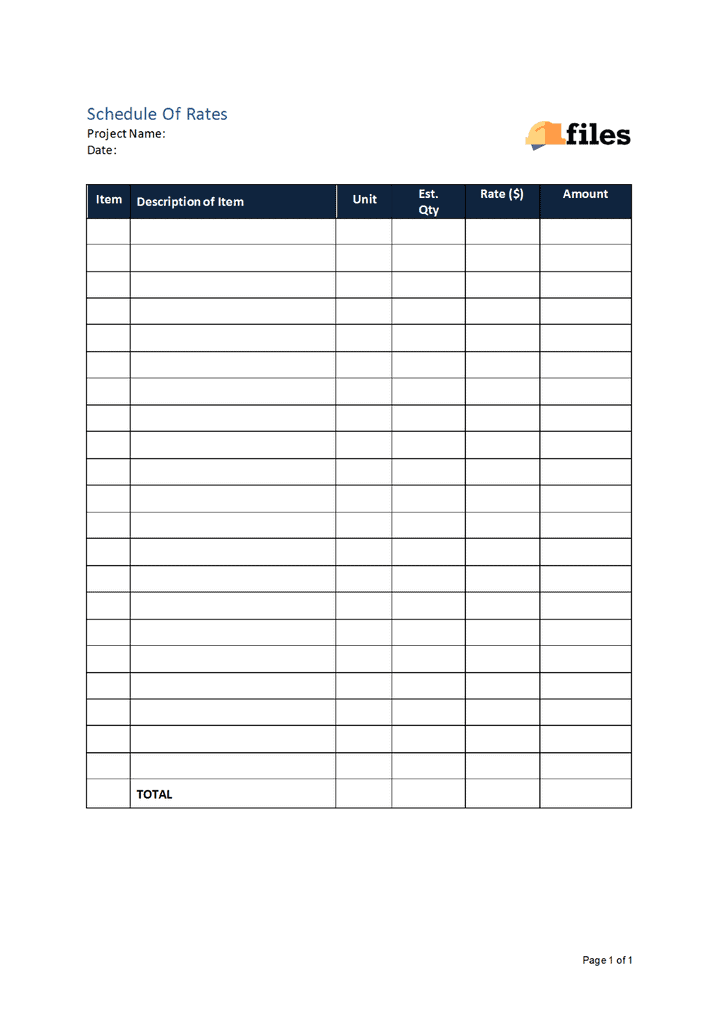
Schedule Of Rates
$2.99
Templates are starting points. Adapt them to your contract and to the laws and safety rules where you work. They are not legal advice.
Product FAQ
You will receive your documents and files immediately after you complete the checkout process. You will receive a link on the checkout page as well as via email.
As long as the document remains on Essential Construction you will be able to download it once purchased.
Yes, in most cases (with the exception of stock photography and ebooks) the files you will receive are editable.
We accept debit, all credit cards (Visa, Amex Mastercard etc) as well as payments via Apple Pay, Google Pay and Paypal.
Our return policy varies based on the product, for more information you can find our detailed return policy here.
Our documents are for use on your projects. You may not resell these documents on other marketplaces.
Full Description
This schedule of rates template lets you agree and record the unit rates a subcontractor or vendor will charge for labor, equipment, tools and materials on your project. Fill it out when you award a contract so everyone prices extra work, variations and remeasured items from the same agreed numbers.
What is a schedule of rates?
A schedule of rates (SOR) is a contract document that lists items of work, labor, plant or materials with an agreed price per unit, such as per hour, per day, per square meter or per ton. Unlike a fixed lump sum, the final amount depends on the quantities actually used. A schedule of rates is used for remeasured work, term or maintenance contracts, daywork and to value variations when the scope changes.
When to use it
- When awarding a contract to a subcontractor or supplier and agreeing their rates
- When quantities are uncertain and the work will be remeasured as it is done
- For term, maintenance or call-out contracts that run over many small jobs
- To price daywork, extra work and change orders against agreed rates
- To set equipment hire and labor rates before work starts on site
- During tendering, to compare rates between bidders on the same basis
What’s included
The download is a Word document (.docx) laid out as a schedule of rates. It lets you identify each item, its quantity and the rate that will be charged throughout the project. You can add or remove lines to suit the trade, and attach the completed schedule to the subcontract or purchase order.
How to fill it out
- Enter the project name, contract or package reference and the subcontractor or vendor name.
- List each item of work, labor category, piece of equipment or material on its own line.
- State the unit for each item, such as hour, day, square meter, cubic yard or each.
- Enter the estimated quantity where you have one, so you can check the expected total.
- Enter the agreed rate and note whether it includes overhead, profit, fuel, operators or consumables.
- Note any conditions, such as overtime rates, minimum call-out charges or how long the rates are fixed.
- Have both parties sign and attach the schedule to the contract.
Tips
- Define exactly what each rate includes. Most rate disputes come from unclear inclusions.
- Use the same units as your estimate and bill of quantities so you can compare easily.
- Agree how rates will change if the job runs longer than planned.
- Keep daywork records signed daily so they can be valued against the schedule.
Related templates and guides
- Bill of Quantities – itemized quantities for pricing the full scope.
- Unit Price Bid Review and Analysis Spreadsheet – compare unit rates across bidders.
- Construction Bid Template
- Construction Tendering – Everything You Need To Know
- Browse all estimating templates
Frequently asked questions
What does SOR mean in construction?
SOR stands for schedule of rates. It is a list of agreed unit prices for labor, plant, materials or items of work. The contractor is paid by multiplying each rate by the quantity actually carried out, which makes it useful when the full scope or quantities are not known at the start.
What is the difference between a schedule of rates and a bill of quantities?
A bill of quantities lists measured quantities for a defined scope, and bidders price each line to reach a total. A schedule of rates focuses on the unit prices themselves, often with approximate or no quantities. A bill of quantities usually supports a fixed scope; a schedule of rates suits remeasured or uncertain work.
What should a schedule of rates include?
At a minimum: a description of each item, its unit of measure, the agreed rate and what the rate includes. Many schedules also show estimated quantities, overtime or premium rates, minimum charges and how long the rates are valid. Clear inclusions prevent most disputes.
When is a schedule of rates contract used?
It is common for maintenance and repair programs, term contracts, emergency work and early works where the extent is unclear. It is also used alongside lump sum contracts to value variations and daywork, so changes can be priced quickly using rates agreed in advance.






Reviews
There are no reviews yet