

We may earn a commission when you buy through links on this page, as an Amazon Associate. Learn more.
Cold feet end a winter workday faster than cold hands. Once your toes go numb, you lose balance on ladders and footing on ice, and you start making mistakes. The best winter work boots fix that with the right amount of insulation for how hard you work, a waterproof shell, a safety toe that meets ASTM F2413, and an outsole that still grips when the rubber gets cold.
For most construction workers, the best winter work boot is the Danner Quarry USA 8″ 400G. It pairs a GORE-TEX lining with 400g of Thinsulate Ultra, a composite toe rated ASTM F2413-24 I/C EH and a Vibram Fire & Ice outsole, and it can be recrafted when the sole wears out. If you want insulated work boots for less, the Carhartt Rugged Flex CMF8389 gives you the same insulation weight and a composite toe for well under the Danner’s price. For standing work in deep cold, step up to the 1,200g Rocky Blizzard Stalker or the Baffin Derrick pac boot.
Below are our eight picks, a comparison table, and a buying guide that covers how many grams of insulation you need, waterproof membranes, composite vs steel toes in the cold, traction on ice, fit with winter socks, drying boots overnight, and how to spot frostbite and trench foot.
Quick answer: the best winter work boots
- Best overall: Danner Quarry USA 8″ 400G
- Best value: Carhartt Rugged Flex 8″ Insulated
- Best for wide feet: KEEN Utility Dover 8″
- Best budget for extreme cold: Rocky Blizzard Stalker
- Best pac boot for subzero work: Baffin Derrick
- Best pull-on for slush and mud: Muck Arctic Sport Steel Toe
- Best winter logger: Georgia Boot G9382 GORE-TEX Logger
- Best for gloved hands (BOA): Irish Setter Kasota 8″ BOA
These are all insulated, waterproof boots with a safety toe. If you’re after a general-purpose work boot for the rest of the year, see our guide to the best work boots for construction; none of the picks below repeat from that list.
Best insulated work boots compared
| Pick | Boot | Insulation | Safety toe |
|---|---|---|---|
| Best overall | Danner Quarry USA 8″ 400G | 400g Thinsulate Ultra | Composite |
| Best value | Carhartt Rugged Flex 8″ Insulated | 400g Thinsulate | Composite |
| Best for wide feet | KEEN Utility Dover 8″ | 600g KEEN.WARM | Carbon |
| Best budget for extreme cold | Rocky Blizzard Stalker | 1,200g Thinsulate Ultra | Steel |
| Best pac boot for subzero work | Baffin Derrick | Removable multi-layer liner | Composite + plate |
| Best pull-on for slush and mud | Muck Arctic Sport Steel Toe | 5mm neoprene + fleece | Steel |
| Best winter logger | Georgia Boot G9382 GORE-TEX Logger | 400g Thinsulate Ultra | Steel |
| Best for gloved hands (BOA) | Irish Setter Kasota 8″ BOA | 400g | Composite + plate |
Insulation and safety toe details come from each manufacturer. Price guide: $ under $150, $$ $150–$250, $$$ over $250, based on typical listed prices when we checked.
The 8 best winter work boots for construction
1. Best overall: Danner Quarry USA 8″ 400G
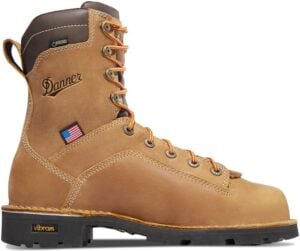
Danner Quarry USA 8" 400G Insulated Composite Toe Work Boot
A GORE-TEX lined, 400g Thinsulate Ultra work boot with a composite toe, EH rating and Vibram Fire & Ice outsole. Made in Portland, Oregon, and recraftable.
- Model: Quarry USA 8" 400G NMT (style 17321)
- Height: 8 in
- Insulation: 400g 3M Thinsulate Ultra
- Waterproofing: GORE-TEX liner
Our take
The Quarry USA has been a jobsite standard for more than a decade, and the 400G NMT version is the one we'd buy for a full winter of construction work. It's warm enough for most cold days on site, it stays dry, and it's built to be rebuilt rather than thrown away.
Danner lines it with GORE-TEX and packs in 400 grams of 3M Thinsulate Ultra insulation. That's the right amount for people who keep moving: framers, concrete crews, electricians and plumbers walking a site all day. It keeps the cold out without turning the boot into a sauna by lunchtime. The composite safety toe (NMT means non-metallic toe) meets ASTM F2413-24 I/C EH, so it's rated for impact, compression and electrical hazard. A composite toe also doesn't conduct cold the way a steel cap can.
Underneath is Danner's Vibram Quarry Fire & Ice outsole, an oil- and slip-resistant rubber compound that Vibram and Danner designed to grip in both extreme cold and heat. It has a 90° heel for ladders and a non-linear lug pattern that sheds mud and snow. The boot is stitchdown built on Danner's 610 last, which gives a wide, stable platform and room in the toe. A fiberglass shank and OrthoLite footbed round it out.
Danner now makes the Quarry in its Portland, Ore. factory with imported components, and the boot is recraftable. When the sole wears out, Danner's recrafting service can rebuild it. Danner lists the pair at 85 oz.
Owners rate the Quarry line highly.
Who it's not for: anyone standing still in subzero weather all day (look at 1,000g+ or a pac boot), and buyers on a tight budget. At about $340 list, it's one of the most expensive boots here, though Danner and retailers often discount it.
Pros
- GORE-TEX lining with 400g Thinsulate Ultra
- Composite toe, ASTM F2413-24 I/C EH
- Vibram Fire & Ice outsole with 90° heel
- Made in Portland, Ore. with imported components
- Recraftable stitchdown construction
Cons
- Expensive at full price
- 400g is not enough for standing still in subzero cold
- Heavy at 85 oz per pair (manufacturer)
| Brand | Danner |
|---|---|
| Model | Quarry USA 8" 400G NMT (style 17321) |
| Height | 8 in |
| Insulation | 400g 3M Thinsulate Ultra |
| Waterproofing | GORE-TEX liner |
| Safety toe | Composite (non-metallic) |
| Standard | ASTM F2413-24 I/C EH |
| Outsole | Vibram Quarry Fire & Ice, oil and slip resistant, 90° heel |
| Construction | Stitchdown, recraftable |
| Weight (manufacturer) | 85 oz per pair |
| Widths | Medium (D), Wide (EE) |
| Made in | USA (Portland, Ore.) with imported components |
Why we picked it: The Quarry USA 400G gets the basics of a winter work boot right and adds the things that make a boot worth $300. GORE-TEX keeps snowmelt out while letting sweat escape, 400g of Thinsulate Ultra is the right warmth for people who keep moving, and the composite toe is rated ASTM F2413-24 I/C EH without conducting cold the way steel can. The Vibram Fire & Ice outsole has a 90° heel for ladders and a lug pattern that sheds snow. Danner now builds it in Portland, Oregon, and its recrafting service can rebuild the boot, so a good pair lasts several winters.
Who it’s for: Framers, concrete and site crews, electricians, plumbers and superintendents who walk a site all day in temperatures from the teens to the 40s. It’s also a good one-boot answer for people who work outside in late fall and early spring, when heavier insulation would be too hot.
Watch-outs: It’s heavy at 85 oz per pair, and 400g isn’t enough if you’re standing still for hours in single digits. List price is about $340, though Danner and retailers often discount it (it was $255 on Danner’s site when we checked). It comes in medium and EE wide.
2. Best value: Carhartt Rugged Flex 8″ Insulated
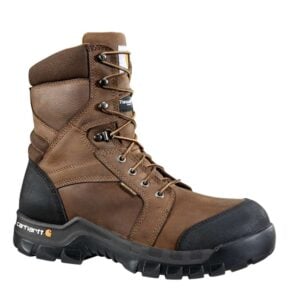
Carhartt Rugged Flex Waterproof Insulated 8" Composite Toe Work Boot (CMF8389)
400g Thinsulate, a Storm Defender waterproof membrane, a composite toe rated ASTM F2413-24 EH and a slip-rated outsole, in medium and wide widths, for about $200 or less.
- Model: CMF8389 Rugged Flex Waterproof Insulated 8"
- Height: 8 in
- Insulation: 400g 3M Thinsulate
- Waterproofing: Storm Defender waterproof, breathable membrane
Our take
If you want a proper insulated safety boot without spending $300, the Carhartt Rugged Flex CMF8389 is the one to buy. It covers every winter basic, it comes in wide widths.
Carhartt pairs its Storm Defender waterproof, breathable membrane with 400 grams of 3M Thinsulate insulation. That's the same insulation weight as boots costing far more, and it's the sweet spot for active work in cold weather.
The composite safety toe is light, non-metallic and non-conductive, and Carhartt says the boot meets ASTM F2413-24 for electrical hazard and ASTM F3445-24 for slip resistance. The rubber lug outsole is oil and slip resistant, has ladder-lock grooves in the defined heel. Rubber caps on the toe and heel protect the leather where boots wear first.
Comfort comes from an EVA midsole, a cushioned PU insole and a fiberglass shank. The Rugged Flex upper is designed to move with your foot, so it feels less stiff on day one than a traditional welted logger.
It's sold in medium and wide (W) widths, sizes 8 to 15.
Who it's not for: anyone who wants a recraftable or welted boot, anyone working in deep snow (8 in isn't tall enough), and anyone standing still in single-digit temperatures, who will want more insulation.
Pros
- 400g Thinsulate with waterproof, breathable membrane
- Composite toe; ASTM F2413-24 EH and F3445-24 SR (manufacturer)
- Medium and wide widths
- Rubber toe and heel guards
Cons
- Not a welted or recraftable boot
- 8 in shaft is short for deep snow
| Brand | Carhartt |
|---|---|
| Model | CMF8389 Rugged Flex Waterproof Insulated 8" |
| Height | 8 in |
| Insulation | 400g 3M Thinsulate |
| Waterproofing | Storm Defender waterproof, breathable membrane |
| Safety toe | Composite |
| Standard | ASTM F2413-24 EH; ASTM F3445-24 SR |
| Outsole | Oil- and slip-resistant rubber lug, heat resistant to 572°F |
| Widths | Medium, Wide |
| Sizes | 8–15 |
Why we picked it: The CMF8389 covers every winter essential for well under the Danner’s price. You get 400g of 3M Thinsulate, Carhartt’s Storm Defender waterproof, breathable membrane, and a composite toe that Carhartt says meets ASTM F2413-24 EH. The outsole is rated for slip resistance under ASTM F3445-24. Rubber caps on the toe and heel protect the leather where boots wear out first, and it’s sold in medium and wide.
Who it’s for: Anyone who wants a safe, warm, dry composite-toe boot for active winter work without spending $300: apprentices, general laborers, carpenters, roofers in the shoulder season and anyone buying boots for a crew.
Watch-outs: It isn’t built to be recrafted the way the Danner is, or resoled like the welted Georgia logger. The 8-inch shaft is too short for deep snow. Check Carhartt’s own site for sale prices.
3. Best for wide feet: KEEN Utility Dover 8″
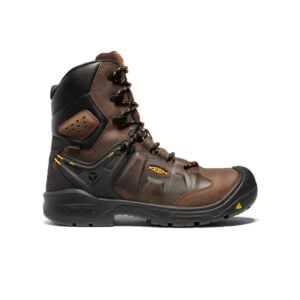
KEEN Utility Dover 8" 600g Insulated Waterproof Work Boot (Carbon Toe)
KEEN's roomy fit with left- and right-specific carbon safety toes, 600g KEEN.WARM insulation and KEEN.DRY waterproofing. Built in the USA, in regular and wide.
- Model: Dover 8" Insulated Waterproof (Carbon Toe)
- Height: 8 in
- Insulation: 600g KEEN.WARM
- Waterproofing: KEEN.DRY membrane
Our take
Thick winter socks make a tight boot tighter, and a cold, cramped toe box is one of the fastest ways to cold feet. KEEN is known for roomy toe boxes, and the Dover takes that further with asymmetrical carbon safety toes shaped for left and right feet. That's why it's our pick for wide feet in winter.
KEEN uses 600 grams of its KEEN.WARM synthetic insulation, a step up from the 400g boots on this list, plus its KEEN.DRY waterproof membrane. That makes it a good choice for colder regions or for jobs with more standing, such as inspection, layout or running equipment.
The carbon toe is non-metallic. KEEN says it's 15% lighter than a steel toe and lists the boot as meeting ASTM F2413-18 M I/75 C/75 EH. The oil- and slip-resistant rubber outsole meets ASTM F1677 Mark II slip testing, per KEEN, and is heat resistant to 572°F. A 90° heel helps on ladders.
KEEN builds the Dover in the USA from global materials using KEEN.FUSION construction, which bonds the upper to the sole without glue. The Luftcell midsole is filled with tiny air bubbles for cushioning on hard surfaces. It comes in regular and wide widths. KEEN lists it at $245.
Who it's not for: people with narrow or low-volume feet, who may find KEEN's fit sloppy; anyone who needs a resoleable boot; and anyone who wants the cheapest insulated safety boot. If you like KEEN but want a welted boot, look at the KEEN Camden 8" in the same 600g weight.
Pros
- Roomy fit with left- and right-specific carbon toes
- Regular and wide widths
- 600g KEEN.WARM insulation
- ASTM F2413-18 M I/75 C/75 EH (manufacturer)
- Built in the USA
Cons
- Not resoleable
- Too roomy for narrow feet
- Pricier than other 600g boots
| Brand | KEEN Utility |
|---|---|
| Model | Dover 8" Insulated Waterproof (Carbon Toe) |
| Height | 8 in |
| Insulation | 600g KEEN.WARM |
| Waterproofing | KEEN.DRY membrane |
| Safety toe | Carbon (non-metallic), asymmetrical |
| Standard | ASTM F2413-18 M I/75 C/75 EH |
| Outsole | Oil- and slip-resistant rubber, heat resistant to 572°F, 90° heel |
| Construction | KEEN.FUSION (glue-free bonded) |
| Widths | Regular, Wide |
| Made in | USA, with global materials |
Why we picked it: Winter socks are thicker, and a tight boot squeezes your foot and cuts circulation, which makes your toes colder. KEEN’s fit is roomy, and the Dover uses left- and right-specific carbon safety toes that leave more space for your toes. It also comes in wide. Inside, 600g of KEEN.WARM insulation and a KEEN.DRY membrane put it a step warmer than the 400g boots here.
Who it’s for: Workers with wide feet or high-volume feet, anyone who wears thick wool socks or a liner-plus-sock system, and people in colder regions or slower-moving roles who want more warmth than 400g without going to a 1,000g boot.
Watch-outs: If you have narrow feet, KEEN’s fit may feel sloppy, and your heel may lift. The KEEN.FUSION construction is durable but not resoleable. At $245 list, it’s not cheap for a non-welted boot. If you want the same 600g warmth in a stitched welt, KEEN’s Camden 8″ is the alternative.
4. Best budget for extreme cold: Rocky Blizzard Stalker
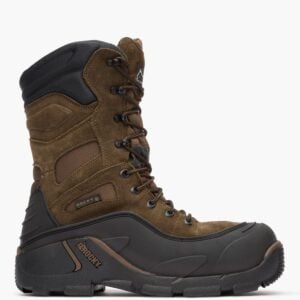
Rocky Blizzard Stalker Steel Toe Waterproof 1200G Insulated Work Boot
1,200 grams of Thinsulate Ultra, a 9-inch waterproof upper and a steel toe with EH protection for around $110 to $150.
- Model: Blizzard Stalker Steel Toe (FQ0007465)
- Height: 9 in
- Insulation: 1,200g 3M Thinsulate Ultra
- Waterproofing: Rocky Waterproof construction (guaranteed)
Our take
Most boots with 1,000 grams or more of insulation cost well over $200. The Rocky Blizzard Stalker gives you 1,200 grams of 3M Thinsulate Ultra and a safety toe for a lot less, which makes it our budget pick for the coldest days.
That much insulation is for low activity in serious cold: running a loader, flagging, standing at a pump or doing inspection work in single digits. Rocky backs it with its guaranteed waterproof construction, and the 9-inch upper with an extended, gusseted tongue helps keep snow and slush out.
The steel toe meets ASTM F2413 for impact and compression (Rocky quotes a 75-pound rating) and the boot meets the ASTM F2413 electrical hazard standard. A rubber vamp across the front takes kicks and scuffs better than bare leather. Rocky's multi-directional Blizzard Max outsole is designed for traction on uneven and snow-covered ground.
Inside there's a removable mesh PU footbed, a TPU heel stabilizer and a padded foam collar. Rocky lists the weight at 6.1 pounds per pair in size 10, so it's not light.
Rocky lists it at $149.99.
Who it's not for: anyone walking or climbing all day, because 1,200g will make your feet sweat, and sweat is what makes feet cold. It's only sold in medium (D) width. And it's a steel toe, which some workers find colder than composite in deep cold, though the heavy insulation helps.
Pros
- 1,200g Thinsulate Ultra for low-activity cold
- Low price for this much insulation
- 9 in waterproof upper with rubber vamp
- Steel toe with EH (ASTM F2413)
Cons
- Too warm for active work
- Heavy
| Brand | Rocky |
|---|---|
| Model | Blizzard Stalker Steel Toe (FQ0007465) |
| Height | 9 in |
| Insulation | 1,200g 3M Thinsulate Ultra |
| Waterproofing | Rocky Waterproof construction (guaranteed) |
| Safety toe | Steel |
| Standard | ASTM F2413 protective toe and EH |
| Upper | Split suede and 900-denier nylon, rubber vamp |
| Outsole | Multi-directional Blizzard Max |
| Weight (manufacturer) | 6.1 lb per pair, size 10 |
| Widths | Medium (D) |
Why we picked it: 1,200 grams of Thinsulate Ultra usually means a $250 boot. Rocky sells the Blizzard Stalker Steel Toe for $149.99, and Amazon has often had it for less. It has a 9-inch waterproof upper with a rubber vamp across the front, a steel toe that meets ASTM F2413 for protective toe and EH, and a lug outsole built for snow.
Who it’s for: People who stand or sit in serious cold: equipment operators, flaggers, inspectors, pump and heater watch, and anyone working in single digits or below without much walking. It’s also a sensible spare pair for the coldest weeks of the year.
Watch-outs: That much insulation will make your feet sweat if you walk or climb all day, and damp socks get cold fast. It’s a heavy boot, and the upper isn’t full-grain leather.
5. Best pac boot for subzero work: Baffin Derrick
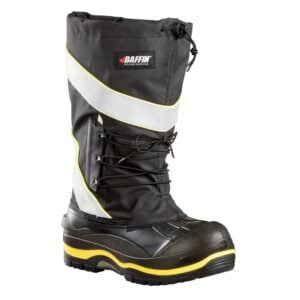
Baffin Derrick Safety Toe and Plate Insulated Pac Boot
A tall pac boot with a removable multi-layer liner, composite toe and plate, and Baffin's Polar rating for -49°F to -76°F. Built for the coldest sites.
- Model: Derrick STP (POLA-MP02)
- Style: Pac boot with removable liner
- Height: 16.5 in
- Cold rating (manufacturer): Polar: -49°F to -76°F during moderate activity
Our take
When the temperature drops well below zero and you're outside all shift, a regular insulated boot isn't enough. You need a pac boot: a waterproof rubber or PU bottom, a tall upper and a thick removable liner. Baffin is a Canadian company that specializes in extreme cold, and the Derrick is its safety pac boot for industrial and construction work.
Baffin gives the Derrick its top Polar rating, which it describes as comfort during moderate activity in temperatures from -49°F to -76°F (-45°C to -60°C). That's Baffin's own field rating, not a lab standard, but it tells you where this boot sits. The warmth comes from a removable Comfort-Fit inner boot with several layers: a wicking next-to-foot layer, foam, hollow-fiber insulation, a reflective aluminum membrane and a wool blend. A waffle-comb footbed and a double aluminum insole sit underneath to reflect cold from the ground.
Because the liner comes out, you can dry it overnight and swap in a spare (Baffin sells replacement liners). That alone solves the biggest winter boot problem: putting your feet into damp boots the next morning.
The 16.5-inch upper is oil- and acid-resistant neoprene with a D-ring lace front and a hi-vis reflective band. The base is lightweight PU with a rubber outsole, a GelFlex anti-fatigue midsole and a multi-directional lug for snow. It has a composite safety toe and puncture-resistant plate, and Baffin lists it as electric shock resistant (ESR/EH). Baffin's page doesn't print the ASTM F2413 marking, so check the label if your site requires it.
Who it's not for: anyone climbing ladders and scaffolds all day. At 10.26 lb per pair (size 9, per Baffin) and 16.5 in tall, it's a boot for standing, walking and running equipment, not for agile work. It's also overkill above about 10°F.
Pros
- Baffin's top Polar cold rating (manufacturer)
- Removable multi-layer liner dries overnight
- Composite toe and puncture-resistant plate
- 16.5 in neoprene upper keeps out deep snow
- Hi-vis reflective band
Cons
- Heavy: 10.26 lb per pair (manufacturer)
- Clumsy on ladders
- Expensive
- ASTM marking not listed on Baffin's page
| Brand | Baffin |
|---|---|
| Model | Derrick STP (POLA-MP02) |
| Style | Pac boot with removable liner |
| Height | 16.5 in |
| Cold rating (manufacturer) | Polar: -49°F to -76°F during moderate activity |
| Insulation | Removable Comfort-Fit multi-layer inner boot |
| Waterproofing | B-Tek Dry waterproof base |
| Safety toe | Composite toe and plate |
| Electrical | Electric shock resistant (ESR/EH) per Baffin |
| Upper | Oil- and acid-resistant neoprene, hi-vis band |
| Weight (manufacturer) | 10.26 lb per pair, size 9 |
Why we picked it: Below about 0°F, a pac boot beats a leather work boot. The Derrick has a 16.5-inch neoprene upper, a waterproof PU and rubber base, and a removable multi-layer liner with reflective and wool-blend layers. Baffin gives it its top Polar rating, for moderate activity in temperatures from -49°F to -76°F. That’s Baffin’s own field rating, not a lab test, but Baffin builds boots for polar expeditions and it shows. It also has a composite toe and puncture-resistant plate, and Baffin lists it as electric shock resistant.
Who it’s for: Pipeline, utility, oil and gas and civil crews in the northern states, Alaska and Canada; anyone running equipment or standing in snow for a full shift in subzero cold. The removable liner is a big plus on multi-day jobs, because you can dry it overnight or swap in a spare.
Watch-outs: At 10.26 lb a pair (size 9, per Baffin), it’s heavy and clumsy on ladders and scaffolds. It’s overkill above about 10°F. Baffin’s product page doesn’t print an ASTM F2413 marking, so if your site requires one, check the label on the boot. It’s also one of the priciest boots here.
6. Best pull-on for slush and mud: Muck Arctic Sport Steel Toe
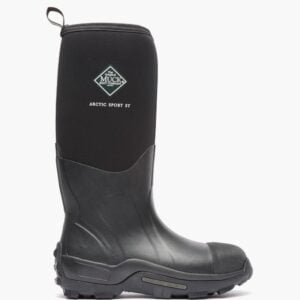
Muck Arctic Sport Steel Toe Insulated Rubber Work Boot
A 16-inch, 100% waterproof neoprene and rubber pull-on with a steel toe rated ASTM F2413 M I/75 C/75 EH. The boot for slush, mud and wet snow.
- Model: Arctic Sport Steel Toe (ASPSTL)
- Style: Pull-on rubber knee boot
- Height: 16 in (16.5 in calf)
- Insulation: 5mm neoprene bootie, fleece lining, 2mm thermal foam underfoot
Our take
Leather boots lose to slush eventually. On sites with standing water, melting snow, wet concrete or mud, a rubber boot is the only thing that stays dry all day. The Muck Arctic Sport Steel Toe is the insulated rubber safety boot we'd choose.
The upper is a 5mm neoprene bootie wrapped in rubber, with a warm fleece lining and 2mm of thermal foam underfoot. Muck says the whole boot is 100% waterproof. Muck lists a comfort range down to -40°F. Treat that as a manufacturer claim: neoprene boots are warm while you're moving, but they don't match a 1,000g boot or a pac liner when you're standing still.
It has a steel toe and steel shank and meets ASTM F2413-11 M I/75 C/75 EH, per Muck. The self-cleaning MS-1 lug outsole is designed for mud, snow and dirt, and an EVA midsole adds cushioning. The full height is 16 inches with a 16.5-inch calf, so you can wade through slush without it coming over the top.
Being a pull-on, it's quick to get on and off at the trailer door, and you can hose it clean at the end of the day. Muck sells it in whole sizes only, in medium width.
Who it's not for: anyone walking long distances or climbing a lot, because rubber knee boots don't support the ankle like a laced boot. It also comes in whole sizes only, so half sizes need to size up and use a thick sock. On dry, very cold days, a leather insulated boot will be more comfortable.
Pros
- 100% waterproof neoprene and rubber (manufacturer)
- Steel toe, ASTM F2413-11 M I/75 C/75 EH
- 16 in height for slush and mud
- Pulls on in seconds, hoses clean
Cons
- Whole sizes only
- Less ankle support than a laced boot
- -40°F claim is optimistic for standing work
| Brand | Muck Boot Company |
|---|---|
| Model | Arctic Sport Steel Toe (ASPSTL) |
| Style | Pull-on rubber knee boot |
| Height | 16 in (16.5 in calf) |
| Insulation | 5mm neoprene bootie, fleece lining, 2mm thermal foam underfoot |
| Temperature claim (manufacturer) | As low as -40°F |
| Waterproofing | 100% waterproof rubber and neoprene |
| Safety toe | Steel, with steel shank |
| Standard | ASTM F2413-11 M I/75 C/75 EH |
| Outsole | Self-cleaning MS-1 lug |
| Sizes | Whole sizes 5–15, medium width |
Why we picked it: Slush, wet snow and mud soak leather boots eventually. The Arctic Sport Steel Toe is a 16-inch rubber and 5mm neoprene boot that Muck says is 100% waterproof, with a fleece lining and 2mm thermal foam underfoot. It has a steel toe and shank and meets ASTM F2413-11 M I/75 C/75 EH. Muck lists a comfort range down to -40°F.
Who it’s for: Excavation, utility, concrete and site-work crews; anyone working in standing water, mud or slush; and anyone who wants a boot they can pull on at the truck and hose off at the end of the day.
Watch-outs: Treat the -40°F claim as optimistic if you’re standing still. Neoprene doesn’t breathe, so bring a dry pair of socks. Rubber knee boots give less ankle support than a laced boot, which matters on ladders and rough ground. Muck sells it in whole sizes only, so half sizes should size up and wear a thicker sock.
7. Best winter logger: Georgia Boot G9382 GORE-TEX Logger
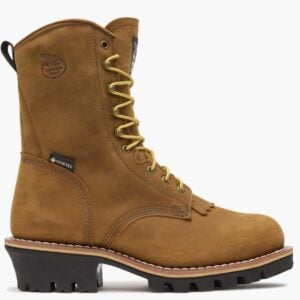
Georgia Boot Steel Toe GORE-TEX Waterproof 400G Insulated Logger Boot (G9382)
A 10-inch Goodyear-welted logger with a GORE-TEX lining, 400g Thinsulate Ultra, a steel toe and a cleated Vibram outsole. Resoleable, in medium and wide.
- Model: G9382 Steel Toe GORE-TEX 400G Insulated Logger
- Height: 10 in
- Insulation: 400g 3M Thinsulate Ultra
- Waterproofing: GORE-TEX
Our take
Logger boots are built for rough ground, and a tall logger is a smart winter boot for anyone working outside on uneven, snowy or icy terrain: site prep, utility crews, linemen, fence and deck builders. The Georgia Boot G9382 adds GORE-TEX and insulation to a classic logger.
The 10-inch full-grain leather upper gives more ankle support and snow protection than an 8-inch boot. GORE-TEX keeps water out while letting sweat escape, and 400 grams of 3M Thinsulate Ultra insulation keeps you warm without overheating when you're moving. It's fully lined with a moisture-wicking material and has a fully gusseted tongue to keep snow out of the laces.
The outsole is a one-piece, cleated Vibram Tacoma in rubber. Georgia says it resists abrasion, oil, chemicals, heat and metal chips. The tall logger heel bites into snow and mud and locks onto ladder rungs. It's Goodyear welted with a steel shank, so a cobbler can resole it, and the hooks and eyelets are set on steel washers so they won't pull out.
It has a steel toe that meets ASTM F2413 for protective toe, and Georgia's description says it also meets the ASTM electrical hazard standard. A removable kiltie (the fringed flap over the laces) acts as a brush guard. Georgia lists it at 5 lb per pair in size 10, and it comes in medium (D) and wide (EE).
Who it's not for: anyone working mostly on flat concrete slabs and finished floors, where a tall logger heel feels awkward; anyone who wants a composite toe; and anyone who hates a break-in period. Welted leather loggers take a couple of weeks to soften.
Pros
- GORE-TEX lining with 400g Thinsulate Ultra
- 10 in leather upper for snow and ankle support
- Cleated Vibram Tacoma outsole with logger heel
- Goodyear welt, resoleable
- Medium and wide (EE) widths
Cons
- Steel toe, not composite
- Tall heel is awkward on flat slabs
- Needs a break-in period
| Brand | Georgia Boot |
|---|---|
| Model | G9382 Steel Toe GORE-TEX 400G Insulated Logger |
| Height | 10 in |
| Insulation | 400g 3M Thinsulate Ultra |
| Waterproofing | GORE-TEX |
| Safety toe | Steel |
| Standard | ASTM F2413 protective toe (EH per Georgia's description) |
| Outsole | Vibram Tacoma one-piece cleated rubber |
| Construction | Goodyear welt, steel shank |
| Weight (manufacturer) | 5.0 lb per pair, size 10 |
| Widths | Medium (D), Wide (EE) |
Why we picked it: A tall logger is a great winter boot on rough ground. The G9382 has a 10-inch full-grain leather upper, a GORE-TEX lining, 400g of Thinsulate Ultra and a cleated, one-piece Vibram Tacoma outsole with a logger heel that digs into snow and mud. It’s Goodyear welted with a steel shank, so a cobbler can resole it, and it comes in medium and wide (EE).
Who it’s for: Site prep and excavation crews, linemen and utility workers, fence, deck and pole-barn builders, and anyone working on frozen dirt, gravel or snow rather than finished slabs.
Watch-outs: It’s a steel toe, not composite. Georgia lists it as meeting ASTM F2413 for protective toe, and its description says it also meets the electrical hazard standard, but the spec list only names the toe rating, so confirm EH on the label if you need it. Tall logger heels feel awkward on flat concrete, and welted leather takes a couple of weeks to break in.
8. Best for gloved hands (BOA): Irish Setter Kasota 8″ BOA
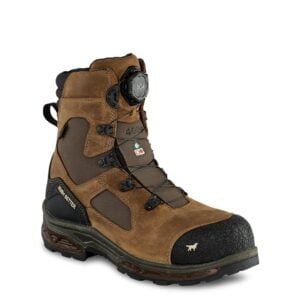
Irish Setter Kasota 8" BOA Insulated Waterproof Safety Toe Work Boot (83864)
BOA dial lacing you can work with gloves on, 400g insulation, UltraDry waterproofing and a NanoToe composite toe rated ASTM F2413-24 I/C EH PR SRO.
- Model: Kasota 8" (style 83864)
- Height: 8 in
- Closure: BOA Fit System
- Insulation: 400g
Our take
Tying frozen laces with cold fingers is one of winter's small miseries, and laces that loosen by noon let cold air and snow in. The Irish Setter Kasota 83864 replaces laces with a BOA Fit System: turn the dial to tighten, pull it to release. You can do it with gloves on, and it holds the same tension all day.
Irish Setter, a Red Wing brand, lines the Kasota with its UltraDry waterproofing system and 400 grams of insulation, a good match for active cold-weather work. The full-grain waterproof leather upper is 8 inches tall.
The safety toe is Irish Setter's NanoToe, a thin, non-metallic composite toe made with carbon nanotube technology. Irish Setter lists the boot as meeting ASTM F2413-24 I/C EH PR SRO, which means impact and compression protection, electrical hazard protection, a puncture-resistant plate and a slip-resistant outsole. It's also CSA Grade 1 approved with ESR and PR ratings, so it works on Canadian sites too. The puncture-resistant insole is a non-metallic Swen-Flex woven fiber plate.
It's direct-attach construction, which makes it lighter and more flexible than a welted boot and fully waterproof at the sole joint. Irish Setter lists the weight at 4 lb. Inside there's a removable memory foam and EVA footbed, and underneath is Irish Setter's TriTek outsole. It comes in medium and wide widths.
Who it's not for: anyone who doesn't trust a dial and cable on a jobsite, and anyone who needs more than 400g. If you want BOA with heavy insulation, Red Wing's Polar X uses the same idea with 1,600g (see our Also worth considering list).
Pros
- BOA dial works with gloves on
- NanoToe composite; ASTM F2413-24 I/C EH PR SRO
- CSA Grade 1 with puncture-resistant plate
- 400g insulation with UltraDry waterproofing
- Medium and wide widths
Cons
- BOA dial is one more thing that can break
- 400g only
| Brand | Irish Setter (Red Wing) |
|---|---|
| Model | Kasota 8" (style 83864) |
| Height | 8 in |
| Closure | BOA Fit System |
| Insulation | 400g |
| Waterproofing | UltraDry waterproofing system |
| Safety toe | NanoToe composite (non-metallic) |
| Standard | ASTM F2413-24 I/C EH PR SRO; CSA Grade 1, ESR, PR |
| Construction | Direct attach, not resoleable |
| Outsole | TriTek |
| Weight (manufacturer) | 4 lb |
| Widths | Medium, Wide |
Why we picked it: Tying frozen laces with cold fingers is miserable, and laces that loosen let snow in. The Kasota 83864 uses a BOA dial you can turn and release with gloves on. It also has 400g insulation, UltraDry waterproofing, a NanoToe composite toe and a puncture-resistant plate, with a full ASTM F2413-24 I/C EH PR SRO rating plus CSA Grade 1 approval for Canadian sites.
Who it’s for: Electricians, HVAC and service techs, inspectors and anyone who takes boots on and off several times a day, plus anyone who works on both sides of the border. It’s also a good match for people with hard-to-fit feet, because the BOA cable pulls evenly across the instep, and it comes in wide.
Watch-outs: A BOA dial and cable can be damaged, though replacement kits exist. With 400g, it’s an active-work boot, not one for standing in subzero cold.
Also worth considering
- Red Wing Polar X 3265. The heavy-duty version of the BOA idea. Red Wing lists 1,600g of insulation, a BOA Fit System, a non-metallic Fiber-Core toe rated ASTM F2413-24 I/C EH PR SRO, CSA Grade 1 approval and an IceAxe outsole, at $304.99. It’s sold through Red Wing stores rather than Amazon. See it at Red Wing.
- KEEN Utility Camden 8″ Insulated (Carbon Toe). KEEN’s welted, heavier-duty alternative to the Dover, with 600g insulation, KEEN.DRY and a carbon toe rated ASTM F2413-18 M I/75 C/75 EH. See it at KEEN.
How we chose
We started with the insulated and winter work boots that tradespeople actually buy, from Danner, Carhartt, KEEN, Rocky, Baffin, Muck, Georgia Boot, Irish Setter, Red Wing, Timberland PRO, Wolverine and Thorogood. We looked at what ranks in Google for “best winter work boots” and “insulated work boots,” what Google’s shopping carousels show, and what workers ask in forums. Then we narrowed the list on what matters in winter on a jobsite:
- Insulation: type and grams, or the manufacturer’s cold rating, matched to activity level.
- Waterproofing: membrane type, seam sealing and shaft height.
- Safety: safety toe material and the exact ASTM F2413 rating, plus EH, puncture and slip ratings.
- Traction: outsole compound, lug depth and heel design for snow, mud and ladders.
- Fit: available widths and room for winter socks.
- Durability: construction method and whether the boot can be resoled or recrafted.
- Owner feedback: recurring complaints and praise in owner reviews.
We did not lab test or field test these boots. Insulation, standards and other specs come from each manufacturer’s product page. Temperature ratings are manufacturer claims, and we say so where we quote them. Prices are list or sale prices on manufacturer sites when we checked in November 2026. We’ll update this guide as models change.
How to choose winter work boots
How much insulation do you need? 200g vs 400g vs 800g and up
Insulation in work boots is usually listed in grams, such as 400g Thinsulate. That number is the weight of the insulation per square meter of material, not the weight in your boot. More grams means a thicker, warmer layer. There’s no industry-standard temperature rating attached to those numbers, so use them as a guide and match them to how much you move.
The rule that matters most: the harder you work, the less insulation you need. A framer climbing all day makes a lot of heat. An operator sitting in a cold cab or a flagger standing on a road makes very little. Too much insulation makes your feet sweat, and wet socks get cold fast.
| Insulation | Best for | Our picks |
|---|---|---|
| 200g | Cool days, very active work, or as an all-season boot | None here; most general work boots |
| 400g | Most active winter construction work | Danner, Carhartt, Georgia, Irish Setter |
| 600–800g | Colder regions, mixed walking and standing | KEEN Dover |
| 1,000g and up | Low activity in deep cold, standing or operating equipment | Rocky Blizzard Stalker |
| Pac liner / neoprene | Subzero shifts, snow and slush | Baffin Derrick, Muck Arctic Sport |
Different brands use different insulation (3M Thinsulate, PrimaLoft, KEEN.WARM, Baffin’s multi-layer liners), so grams don’t always compare directly. Treat it as a starting point, then adjust with socks: a heavier wool sock can make a 400g boot feel like a 600g boot on a cold day.
Waterproof membranes vs breathability
Wet feet get cold far faster than dry feet, so every pick here is waterproof. Most leather winter boots use a waterproof, breathable membrane: GORE-TEX in the Danner and Georgia logger, Storm Defender in the Carhartt, KEEN.DRY in the KEEN and UltraDry in the Irish Setter. The membrane keeps liquid water out while letting some sweat vapor escape.
Breathability has limits. In cold weather, sweat can condense inside the boot before it escapes. That’s another reason not to over-insulate for active work. Rubber and neoprene boots like the Muck don’t breathe at all, so expect damp socks by the end of the day and carry a spare pair.
Height matters too. An 8-inch boot is fine for scraped sites and a few inches of snow. For deeper snow and slush, go to 10 inches or more, or a pull-on rubber boot, and wear your pant legs over the boot or add gaiters.
Composite vs steel toe in the cold
Steel conducts heat. In a cold boot, a steel toe cap can pull warmth away from your toes, especially if you’re standing on frozen ground or snow. Composite, carbon and other non-metallic toes don’t conduct cold the same way. Danner and Red Wing both make this point about their non-metallic toes. Composite toes are also lighter and won’t set off metal detectors.
In a well-insulated boot, the difference is smaller than many people think, and a steel toe is usually thinner, which can leave a little more room for your toes. But if you’re buying a boot specifically for winter, we’d pick composite or carbon when you have the choice. Either way, the toe must meet the same ASTM F2413 impact and compression test.
Safety standards: what ASTM F2413 and EH mean
ASTM F2413 is the U.S. standard for protective footwear. The label on the boot tells you what it was tested for:
- I/75 and C/75 (or I/C): the safety toe passed the standard’s impact and compression tests. This is the core rating for any safety toe boot. Older labels add M or F for men’s or women’s.
- EH (electrical hazard): the sole and heel provide secondary protection against accidental contact with live circuits, in dry conditions. EH protection drops when boots are wet or soles are worn through, which matters in winter.
- PR (puncture resistant): a plate in the sole resists nails and other sharp objects.
- SR or ASTM F3445: the outsole was tested for slip resistance. That test is done on wet or oily floors, not ice, so an SR rating doesn’t mean a boot grips ice.
The year after F2413 (such as -11, -18 or -24) is the version of the standard the boot was tested to. Boots certified to an earlier version are still compliant for most workplaces, but always check your site or employer rules. In Canada, look for CSA Z195 approval; the Irish Setter Kasota carries both.
Traction on ice and snow
Two things change in winter: rubber gets harder in the cold, and the surface gets slicker. A good winter outsole uses a rubber compound that stays soft in low temperatures and deep, widely spaced lugs that shed snow instead of packing with it. Some compounds are designed specifically for ice, such as Vibram’s Arctic Grip compounds.
No boot outsole grips glare ice reliably. If you walk on ice, add slip-on ice cleats or traction devices, take short steps with your weight over your feet, and keep your hands free. Take cleats off before climbing ladders or walking on finished floors, steel decks or inside buildings, where the studs can slip or cause damage.
For ladders, look for a defined heel. Loggers like the Georgia G9382 have a tall heel that locks onto rungs, and the Danner and KEEN both have 90° heels.
Fit with winter socks
Buy winter boots with the socks you’ll actually wear in them, ideally late in the day when your feet are largest. You want firm heel hold and room to wiggle your toes. A boot that’s snug in July can be painfully tight with a heavy wool sock in January, and tight boots restrict circulation, which makes your feet colder no matter how much insulation they have.
If you have wide feet, look for brands that make true wide widths. The Danner, KEEN, Carhartt, Georgia and Irish Setter picks all come in wide. Merino wool or wool-blend socks stay warmer when damp than cotton; see our guide to the best work socks for boots. A supportive insole can also add a layer between your foot and a cold sole; see our best insoles for work boots. Just make sure a thicker insole doesn’t make the boot too tight.
Drying your boots overnight
Every winter boot gets damp inside from sweat, even when it’s waterproof. Putting your feet into wet boots in the morning is the fastest way to cold toes. Each night:
- Pull the insoles out and open the boots wide. Pull out removable liners, like the Baffin’s, and dry them separately.
- Use a boot dryer on a low or no-heat setting, or stuff the boots with newspaper and change it once or twice.
- Keep boots away from heaters, wood stoves and open flames. High heat cracks leather and can weaken the adhesives that hold the sole on.
- If you can, own two pairs and rotate them, so each pair gets a full day to dry.
- Clean off salt and mud, then condition leather boots as the maker recommends. Road salt dries leather out fast.
Frostbite and trench foot: know the signs
Cold feet aren’t just uncomfortable. NIOSH, the CDC’s workplace safety institute, lists frostbite and trench foot among the main cold-related injuries for outdoor workers. Its cold stress fact sheet says early frostbite signs include numbness, tingling or stinging, and bluish or pale, waxy skin. Trench foot is an injury from prolonged cold and wet exposure that, according to NIOSH, can occur at temperatures as high as 60°F if the feet are constantly wet.
NIOSH recommends that boots be waterproof and insulated, and that you carry extra socks. If you suspect frostbite, get to a warm place, get medical help, and don’t walk on frostbitten feet unless you have to. See the CDC’s cold stress page for employer and worker guidance.
Templates and guides for this
Pair the right boots with the paperwork: these Essential Construction templates and guides cover foot protection and winter work on site.
- Toolbox Talk – Foot Protection (template)
- PPE Policy Template (template)
- Construction Footwear Required – Construction Sign Template (template)
- 8 Important Items To Include in Your Winter Protection Plan (guide)
- Toolbox Talk (glossary)
FAQ
What are the best winter work boots?
For most construction workers, the Danner Quarry USA 8″ 400G is the best winter work boot: GORE-TEX, 400g Thinsulate Ultra, a composite toe rated ASTM F2413-24 I/C EH and a recraftable build. The Carhartt Rugged Flex CMF8389 is the best value. For extreme cold, choose a 1,000g+ boot like the Rocky Blizzard Stalker or a pac boot like the Baffin Derrick.
Is 400g or 800g insulation better for work boots?
400g is better for active work, such as framing, walking a site or climbing, in temperatures from roughly the teens to the 40s. 800g and up is better for slower work or colder weather, such as operating equipment or standing in place. If you can only buy one pair and you move a lot, choose 400g and add heavier socks on the coldest days.
Are steel toe boots colder than composite toe boots?
They can be. Steel conducts heat, so a steel toe cap can feel colder, especially when you stand on frozen ground. Composite and carbon toes don’t conduct cold the same way and are lighter. In a well-insulated boot the difference is small, but for a dedicated winter boot, composite is the better choice. Both must pass the same ASTM F2413 tests.
Are insulated work boots worth it?
Yes, if you work outside when temperatures are near or below freezing. Cold, wet feet reduce dexterity and balance and raise the risk of frostbite and trench foot. Most people keep a lighter, non-insulated boot for warm months and an insulated pair for winter, which also makes both pairs last longer.
What is a pac boot?
A pac boot has a waterproof rubber or PU lower, a tall leather, nylon or neoprene upper, and a thick, usually removable felt or multi-layer liner. Pac boots are the warmest type of winter boot and the easiest to dry, because the liner comes out. The trade-off is weight and bulk. The Baffin Derrick is a pac boot with a safety toe and plate.
How do I keep my feet warm in work boots?
Wear boots with the right insulation for your activity, keep them dry, and don’t lace them so tight that they cut off circulation. Wear wool or synthetic socks, never cotton, and change them at lunch if they’re damp. Dry your boots and liners every night, and keep a spare pair of socks in your truck. Insulated insoles and heated socks can help on the coldest days.
Can I wear insulated work boots in summer?
You can wear 200g boots most of the year, but 400g and heavier boots get hot and sweaty in warm weather. Sweat breaks down linings and causes odor and blisters. A non-insulated boot is the better choice from late spring to early fall.
The bottom line
For most construction workers, the Danner Quarry USA 8″ 400G is the best winter work boot: GORE-TEX, 400g Thinsulate Ultra, a composite toe and a build that can be recrafted. The Carhartt Rugged Flex CMF8389 is the best value, and the KEEN Dover is the one for wide feet. For standing work in deep cold, get the Rocky Blizzard Stalker on a budget or the Baffin Derrick pac boot for subzero shifts. Slush and mud call for the Muck Arctic Sport Steel Toe, rough frozen ground for the Georgia Boot G9382 logger, and gloved hands for the Irish Setter Kasota BOA.
Browse all our winter work boot picks, and finish your cold-weather kit with our guides to the best work socks for boots, the best insoles for work boots and the best work boots for construction.
Own one of these boots? Rate it on its product page or tell us how it holds up in the comments.
Ask AI about this page: ChatGPT, Claude or PerplexityCopy as Markdown