
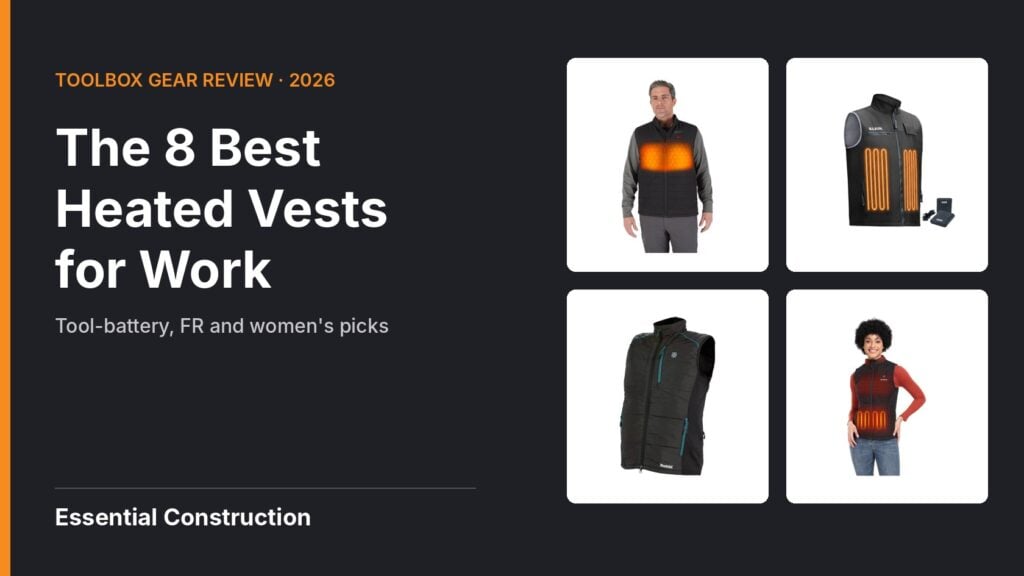

We may earn a commission when you buy through links on this page, as an Amazon Associate. Learn more.
The best heated vest for work is the Milwaukee M12 Heated AXIS Vest for anyone on M12 batteries: chest and back heat, up to 8 hours on low and a tough ripstop shell. No tool batteries? The ORORO Men's 4-Zone Heated Vest comes with its own pack and runs up to 10 hours on low.
A heated vest is the most flexible piece of heated gear you can buy. It keeps your core warm, leaves your arms free to swing a hammer or pull wire, and fits under the rain shell, hi-vis coat or duck jacket you already wear.
Below are our eight picks, including the best vests for Makita and DeWalt battery owners, a flame-resistant vest for electrical and utility crews, and a women’s-cut vest, plus a buying guide and answers to common questions. If you want heated sleeves too, see our best heated jackets for work.
Quick answer: tool battery or built-in battery?
Start with the battery, not the vest. Heated vests fall into two groups:
- Tool-battery vests run on the packs you already own: Milwaukee M12, Makita 18V LXT or DeWalt 20V MAX. Big packs mean long run times, and you can grab a fresh one from the tool bag. Our picks: Milwaukee AXIS Vest, Makita DCV202Z and DeWalt DCHV095.
- Self-contained vests come with their own small rechargeable pack that charges from USB. They cost less to get into and are lighter. Our picks: ORORO Men's, Klein 60954, Klein 60954FR, ORORO Women's and Venustas.
If you run one of those tool platforms, buy the vest that matches it. If you don’t, a self-contained vest is the cheaper way in.
Our top picks at a glance
| Pick | Heated vest | Battery | Run time on low* |
|---|---|---|---|
| Best overall | Milwaukee M12 Heated AXIS Vest | Milwaukee M12 (kit) | 8 h (CP2.0) |
| Best value (battery included) | ORORO Men's 4-Zone Heated Vest | ORORO 7.38V pack (included) | 10 h |
| Longest run time (Makita owners) | Makita DCV202Z | Makita 18V LXT (not included) | 35 h (6.0Ah) |
| Best for DeWalt owners | DeWalt DCHV095 Heated Puffer Vest Kit | DeWalt 20V MAX (kit) | Not published |
| Best base layer | Klein Tools 60954 | Klein 60957 pack (included) | 12 h |
| Best flame-resistant (FR) | Klein Tools 60954FR | 2 × Klein 60957 (included) | 12 h |
| Best for women | ORORO Women's Quilted Heated Vest | ORORO 7.38V pack (included) | 10 h |
| Best budget, most zones | Venustas Men's Heated Vest | Venustas 36 Wh pack (included) | 10 h |
*Manufacturer ratings on the lowest setting with the battery shown. Expect roughly a quarter to a third of that on high. Price guide: $ under $150, $$ $150–$230, $$$ over $230, based on typical listed prices. Prices change often, so check the current price.
The 8 best heated vests for work
1. Best overall: Milwaukee M12 Heated AXIS Vest
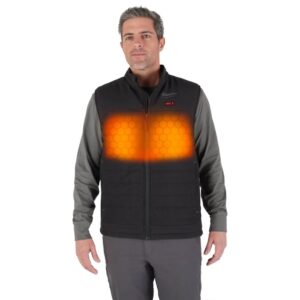
Milwaukee M12 Heated AXIS Vest Kit
Hexon heat at your chest and back in a light ripstop vest you can wear on its own or under a shell. Up to 8 hours on low with the included CP2.0 battery.
- Model: M300 (kit)
- Battery platform: M12 (12V)
- Battery included: Yes, CP2.0 battery and charger
- Heat zones: 2 (chest, back)
Our take
A heated vest is the most versatile piece of heated gear you can own. It keeps your core warm, leaves your arms free to move, and fits under a rain shell, a hi-vis jacket or a work coat you already like. The Milwaukee M12 Heated AXIS Vest is the one we'd pick for most tradespeople.
The current version (model M300) uses Milwaukee's Hexon Heat Technology with two zones, chest and back, each with high, medium and low settings. Milwaukee rates it for up to 8 hours on low, 4 on medium and 2 on high with the M12 REDLITHIUM CP2.0 battery that comes in the kit, along with a charger and power source. A larger M12 battery runs it longer.
The shell is Milwaukee's AXIS ripstop polyester, which stops small tears from spreading, with a DWR finish that makes it wind and water resistant. Milwaukee says it has "2X more insulation" to hold heat in. It's compressible and light enough to work as a mid-layer, but tough enough to wear as an outer layer on a dry day.
Like the jackets, the battery rides in a hidden pass-thru pocket that you can set up for front or back carry. There are four pockets in total and a drawcord waist to keep heat in. It's washer and dryer safe with the battery removed.
The Amazon listing for this version is newer and has only a handful of ratings so far. Milwaukee's vests have been popular for years, and "Milwaukee heated vest" is one of the most searched heated gear terms in the US.
Who it's not for: anyone who gets cold arms and hands first. Your sleeves aren't heated, so on the coldest days a full jacket like the TOUGHSHELL or the DeWalt heavy-duty coat will feel warmer.
Pros
- Kit includes CP2.0 battery and charger
- Up to 8 hours on low (manufacturer)
- Works as an outer layer or under a shell or hi-vis jacket
- Ripstop shell with DWR finish
- Washer and dryer safe
Cons
- Only two zones; arms aren't heated
- Shorter run time than the 12-hour jackets
- Few Amazon reviews on the newest version
| Brand | Milwaukee |
|---|---|
| Model | M300 (kit) |
| Battery platform | M12 (12V) |
| Battery included | Yes, CP2.0 battery and charger |
| Heat zones | 2 (chest, back) |
| Run time (manufacturer) | 8 h low / 4 h medium / 2 h high with CP2.0 |
| Shell | AXIS ripstop polyester, DWR finish |
| Weather rating | Wind and water resistant |
| Washing | Washer and dryer safe (battery removed) |
Why we picked it: Milwaukee’s current AXIS vest (M300) uses its Hexon heat system with two zones, chest and back, each with high, medium and low settings. Milwaukee rates it for 8 hours on low, 4 on medium and 2 on high with the CP2.0 battery in the kit. The AXIS ripstop polyester shell stops small tears from spreading and has a DWR finish for wind and light rain, so it works as an outer layer on a dry day as well as under a coat.
Who it’s for: Framers, electricians, plumbers and site supers who already run M12 tools. The hidden battery pass-thru pocket lets you carry the pack in front or back, which helps when a harness or tool belt is in the way.
Watch-outs: Only two zones, and no heat in the hand pockets. A larger M12 battery gives more run time but adds weight. Check that the listing is the M300 kit with battery and charger if you don’t already own M12 packs.
2. Best value (battery included): ORORO Men’s 4-Zone Heated Vest
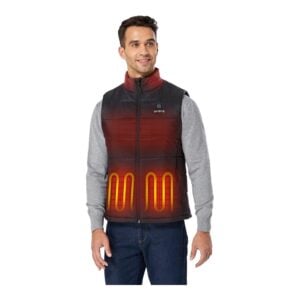
ORORO Men's Lightweight 4-Zone Heated Vest
A light puffer vest with its own USB-C rechargeable battery. Four zones heat the collar, mid-back and hand pockets for up to 10 hours on low.
- Battery platform: ORORO 7.38V pack (included)
- Battery: 7.38V 4,800 mAh (35.4 Wh), UL certified, USB-C charging
- Heat zones: 4 (collar, mid-back, 2 hand pockets)
- Heat settings: 3
Our take
The ORORO Men's Lightweight Heated Vest is the easiest way into heated gear if you don't run a cordless tool platform. The battery comes in the box, charges by USB-C, and you can wear the vest the same day.
ORORO puts four carbon fiber heating zones at the collar, the mid-back and both hand pockets, with three heat settings on one button. The 7.38V, 4,800 mAh battery is UL certified and rated for up to 10 hours on low. It also has a USB port, so it can top up your phone at lunch.
The shell is nylon with light insulation, and ORORO says it is water and wind resistant. It's thin enough to wear under a work jacket or a hi-vis coat. Take the battery out and it's machine washable; ORORO says the heating system is built for 50+ wash cycles.
Who it's not for: anyone who wants chest heat. The zones are collar, back and pockets, so it feels different from the Milwaukee and Klein vests that heat the front of your torso. The nylon shell also won't stand up to block, rebar and steel like a duck or ripstop work shell.
Pros
- Battery included, charges by USB-C
- Up to 10 hours on low (manufacturer)
- Collar and hand-pocket heat
- Thin enough to layer under a work coat
- Machine washable with battery removed
Cons
- No chest heating zones
- Nylon shell is less durable than work-brand fabrics
- Run time drops sharply on high
| Brand | ORORO |
|---|---|
| Battery platform | ORORO 7.38V pack (included) |
| Battery | 7.38V 4,800 mAh (35.4 Wh), UL certified, USB-C charging |
| Heat zones | 4 (collar, mid-back, 2 hand pockets) |
| Heat settings | 3 |
| Run time (manufacturer) | Up to 10 h on low |
| Shell | Nylon, water and wind resistant |
| Washing | Machine washable (battery removed) |
Why we picked it: It’s the simplest way to get heated gear if you don’t own a tool platform. The 7.38V, 4,800 mAh battery is in the box, charges by USB-C and is rated for up to 10 hours on low. Four zones heat the collar, mid-back and both hand pockets, and warm pockets are a big deal when your fingers go numb.
Who it’s for: Supervisors, inspectors, estimators, surveyors and drivers who split the day between the truck, the trailer and the site.
Watch-outs: No chest heat. The nylon shell is fine under a work coat but won’t last against block and steel if you wear it as your outer layer.
3. Longest run time (Makita owners): Makita 18V LXT Heated Vest (DCV202Z)
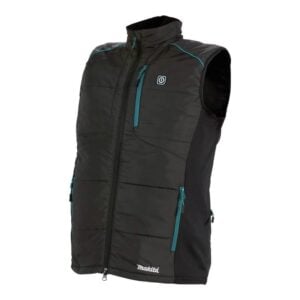
Makita 18V LXT Heated Vest (DCV202Z)
Four carbon fiber core zones on Makita 18V LXT batteries. Makita rates it for up to 35 hours on low with a 6.0Ah pack, the longest run time here.
- Model: DCV202Z
- Battery platform: Makita 18V LXT (also accepts 14.4V)
- Battery included: No (vest only)
- Heat zones: 4 carbon fiber core zones
Our take
If your truck is full of Makita 18V LXT tools, the DCV202Z is the heated vest to get. It runs on the batteries you already charge every night, and the big LXT packs give it far more run time than any self-contained vest.
Makita rates it for up to 35 hours of heat on low with a fully charged 6.0Ah LXT battery. It has four carbon fiber core heat zones and three color-coded settings (red, white, blue) with an LED indicator. The power source also accepts Makita 14.4V lithium-ion batteries and has a 2.4A USB port for charging a phone.
The battery rides in a holder with a belt clip on your waist belt rather than in a pocket. The shell is polyester with stretch polyurethane side panels, and an upgraded fleece lining keeps some warmth when the heat is off. There are four pockets: left chest, two side pockets and a back waist pocket.
It's machine washable and dryable once you remove the battery holder and battery. Note that it is sold as the vest only: the battery and charger are not included.
Pros
- Up to 35 hours on low with a 6.0Ah battery (manufacturer)
- Runs on Makita 18V LXT and 14.4V packs
- 4 carbon fiber core zones
- 2.4A USB port
- Machine washable and dryable
Cons
- Vest only: battery and charger sold separately
- Battery sits on your belt, which can catch on a harness or tool belt
- Pricier than self-contained vests
| Brand | Makita |
|---|---|
| Model | DCV202Z |
| Battery platform | Makita 18V LXT (also accepts 14.4V) |
| Battery included | No (vest only) |
| Heat zones | 4 carbon fiber core zones |
| Heat settings | 3, color coded |
| Run time (manufacturer) | Up to 35 h on low with 6.0Ah |
| Shell | Polyester, stretch polyurethane sides, fleece lining |
| Washing | Machine washable and dryable (battery holder removed) |
Why we picked it: Makita rates the DCV202Z for up to 35 hours on low with a 6.0Ah LXT battery, the longest rating of any vest here. It has four carbon fiber core zones, three color-coded settings and a 2.4A USB port. It’s machine washable and dryable with the battery holder removed.
Who it’s for: Makita 18V crews who want all-day heat without swapping packs. The power source also takes Makita 14.4V lithium-ion batteries.
Watch-outs: It’s sold vest only, so budget for a battery and charger if you don’t have them. The battery clips to your belt instead of sitting in a pocket, which can get in the way of a harness or a loaded tool belt.
4. Best for DeWalt owners: DeWalt DCHV095 Heated Puffer Vest Kit
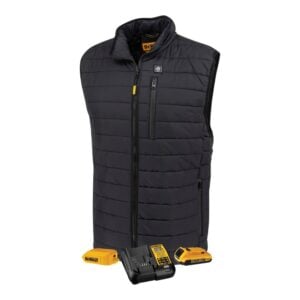
DeWalt DCHV095 Men's Heated Puffer Vest Kit
A quilted puffer vest that runs on DeWalt 20V batteries. The kit includes a battery, charger and adapter, and it zips into DeWalt's DRW21-3 hi-vis rain jacket.
- Model: DCHV095BD1 (kit)
- Battery platform: DeWalt 20V MAX
- Battery included: Yes, with charger and adapter
- Heat settings: 3
Our take
The DCHV095 is DeWalt's heated vest for people who already own DeWalt 20V MAX tools. It's a quilted puffer with three heat settings, and the kit comes with a DeWalt battery, charger and adapter, so you're ready to go out of the box.
DeWalt describes the shell as a wind-resistant quilted polyester that repels water. Pockets include a left chest vertical zip pocket and lower hand-warmer pockets, which DeWalt calls waterproof. The feature that makes it useful on site: it zips into the DeWalt DRW21-3 Class 3 rain jacket to make a hi-vis, heated system.
DeWalt's own page doesn't publish a run time. The Amazon listing says up to nine hours of continuous heat, but owner reviews are mixed on battery life, so plan on carrying a spare 20V pack for a full shift.
Watch-outs: the vest is made under license, and DeWalt lists a 90-day limited warranty, much shorter than you'd expect for a DeWalt tool. Buy it if you're committed to 20V MAX batteries; otherwise the Milwaukee or Klein vests are better bets.
Pros
- Kit includes DeWalt battery, charger and adapter
- Runs on DeWalt 20V MAX packs
- Zips into the DRW21-3 Class 3 rain jacket
- Water-repellent, wind-resistant quilted shell
Cons
- No run time published by DeWalt
- Only a 90-day limited warranty (licensed product)
- Mixed owner feedback on battery life
| Brand | DeWalt |
|---|---|
| Model | DCHV095BD1 (kit) |
| Battery platform | DeWalt 20V MAX |
| Battery included | Yes, with charger and adapter |
| Heat settings | 3 |
| Run time | Not published by DeWalt; Amazon listing says up to 9 h |
| Shell | Quilted polyester, wind resistant, water repellent |
| Warranty | 90-day limited (licensee) |
Why we picked it: It runs on DeWalt 20V MAX packs, the kit includes a battery, charger and adapter, and it zips into DeWalt’s DRW21-3 Class 3 rain jacket to make a hi-vis heated system. The quilted polyester shell is wind resistant and repels water.
Who it’s for: DeWalt 20V users who want one battery system for tools and heat, especially crews that already wear the DRW21-3 rain jacket.
Watch-outs: DeWalt’s page doesn’t publish a run time (the Amazon listing says up to nine hours), owner feedback on battery life is mixed, and the licensed product carries only a 90-day limited warranty. Carry a spare pack.
5. Best base layer: Klein Tools Heated Base Layer Vest (60954)
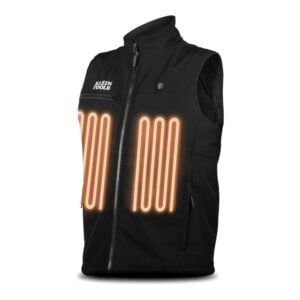
Klein Tools Heated Base Layer Vest (60954)
A slim softshell vest made to go under your outerwear. Four panels heat the left and right chest, upper back and lower back for up to 12 hours on low.
- Model: 60954 (size L; 60953–60956 by size)
- Battery platform: Klein 60957 battery (included)
- Heat zones: 4 (left chest, right chest, upper back, lower back)
- Heat settings: 3
Our take
Klein Tools built this vest as a base layer: a slim, low-profile insulated vest you wear under a work jacket, rain gear or a hi-vis coat. That makes it a good choice if you already like your outer layers and just want heat underneath.
It has four heating panels on the left chest, right chest, upper back and lower back, which covers more of your core than most vests at this price, including the lower back. Klein rates the three settings at 4 hours on high, 6 on medium and 12 on low.
The vest comes with one Klein battery (model 60957) and a USB-A to USB-C cable. Klein lists a recharge time of about 8 hours, so charge it overnight, and the battery can also charge small USB devices. Klein warns to use only its 60957 battery with the vest.
The shell is a weather-resistant softshell (96% polyester, 4% spandex) with four pockets and an adjustable waist cinch to hold heat in. It's machine washable after you remove the battery. If you work around energized equipment, look at the flame-resistant version, the 60954FR, instead.
Pros
- 4 panels including the lower back
- Up to 12 hours on low (manufacturer)
- Slim enough to layer under any outerwear
- Battery and USB-C cable included
- Machine washable
Cons
- About 8 hours to recharge the battery
- Uses Klein's own battery, not tool packs
- Not flame resistant (see the 60954FR)
| Brand | Klein Tools |
|---|---|
| Model | 60954 (size L; 60953–60956 by size) |
| Battery platform | Klein 60957 battery (included) |
| Heat zones | 4 (left chest, right chest, upper back, lower back) |
| Heat settings | 3 |
| Run time (manufacturer) | 12 h low / 6 h medium / 4 h high |
| Recharge time | About 8 h |
| Shell | Softshell, 96% polyester, 4% spandex |
| Washing | Machine washable (battery removed) |
Why we picked it: Klein designed it to go under your outerwear. It’s slim, and its four panels heat the left chest, right chest, upper back and lower back, so you get more core coverage than most vests, including the lower back. Klein rates it at 12 hours on low, 6 on medium and 4 on high.
Who it’s for: Anyone who already likes their outer layers and wants heat underneath: electricians, HVAC techs, inspectors and finishers working in cold buildings.
Watch-outs: Klein lists about 8 hours to recharge the battery, so charge it overnight, and use only Klein’s 60957 battery. It isn’t flame resistant; see the 60954FR below.
6. Best flame-resistant (FR): Klein Tools 60954FR
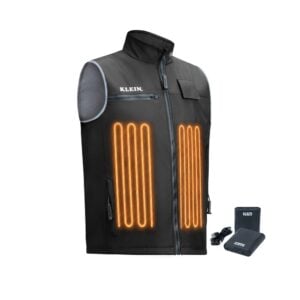
Klein Tools Flame-Resistant Heated Base Layer Vest (60954FR)
A heated base layer for electrical and utility work: ASTM F1506 FR liner, an arc rating of 11 cal/cm², four heat panels and two batteries in the box.
- Model: 60954FR (size L)
- FR standard: ASTM F1506 liner; ASTM F1891 shell (per Klein)
- Arc rating: 11 cal/cm² (per Klein)
- Battery: 2 × Klein 60957 (included)
Our take
Most heated vests are polyester or nylon, which you shouldn't wear where arc flash is a hazard. Klein's 60954FR is built for that work. Klein says the interior liner meets ASTM F1506 and the exterior shell meets ASTM F1891, and it lists an arc rating of 11 cal/cm².
Heat comes from four panels on the left chest, right chest, upper back and lower back, with the same run times as the standard vest: up to 12 hours on low, 6 on medium and 4 on high. The FR version comes with two batteries and two USB-A to USB-C cables, so one can charge while you wear the other.
Details are made for lineworkers and electricians: oversized zipper pulls that work with Class 2 rubber gloves, an adjustable waist cinch, and three pockets. The shell is an FR and antistatic multilayer laminate over a 100% FR cotton liner.
Important: wearing FR clothing doesn't replace an arc flash risk assessment or the PPE category your task requires. Check that the vest fits into your employer's FR/AR clothing program and your local regulations before you wear it on energized work. It's not widely sold on Amazon; buy it through Klein Tools dealers.
Pros
- ASTM F1506 FR liner, arc rating 11 cal/cm² (manufacturer)
- Two batteries included
- 4 panels including the lower back
- Zipper pulls sized for Class 2 gloves
Cons
- Not widely available on Amazon; buy through Klein dealers
- Base layer only: you still need an FR outer layer for weather
- About 8 hours to recharge each battery
| Brand | Klein Tools |
|---|---|
| Model | 60954FR (size L) |
| FR standard | ASTM F1506 liner; ASTM F1891 shell (per Klein) |
| Arc rating | 11 cal/cm² (per Klein) |
| Battery | 2 × Klein 60957 (included) |
| Heat zones | 4 (left chest, right chest, upper back, lower back) |
| Run time (manufacturer) | 12 h low / 6 h medium / 4 h high |
Why we picked it: It’s one of very few heated vests made for arc-flash environments. Klein says the liner meets ASTM F1506 and lists an arc rating of 11 cal/cm². It has the same four panels and 12-hour run time as the standard vest, comes with two batteries, and has zipper pulls big enough to use with Class 2 rubber gloves.
Who it’s for: Electricians, lineworkers and utility crews who have to wear FR clothing all day.
Watch-outs: FR clothing doesn’t replace an arc flash risk assessment or the PPE category your task needs. Check it fits your employer’s FR program and local regulations. It’s not widely sold on Amazon: find it through Klein Tools dealers via Klein’s product page.
7. Best for women: ORORO Women’s Quilted Heated Vest
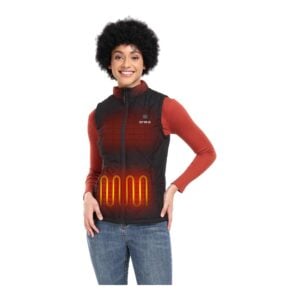
ORORO Women's Quilted Lightweight Heated Vest
A women's-cut diamond-quilted heated vest with the battery included. Four zones heat the collar, mid-back and hand pockets for up to 10 hours.
- Fit: Women's
- Battery: 7.38V 4,800 mAh (35.4 Wh), included
- Heat zones: 4 (collar, mid-back, 2 hand pockets)
- Run time (manufacturer): Up to 10 h
Our take
Most tool-brand heated vests come in men's sizes only, which leaves women on site with boxy fits and long hems. ORORO's women's quilted vest is cut for women and ships with its battery, so it's ready to wear.
It uses four carbon fiber heating zones at the collar, mid-back and hand pockets, controlled by one button. The 7.38V, 4,800 mAh (35.4 Wh) battery gives up to 10 hours of heat, according to ORORO.
The diamond-quilted shell is light enough to wear under a work coat or hi-vis jacket. Remove the battery and it's machine washable; ORORO says it holds up through 50+ wash cycles.
Watch-outs: like the men's ORORO vest, there's no chest heat, and the light shell is better under a work jacket than as your outer layer on a demolition or masonry job.
Pros
- Women's cut and sizing
- Battery included
- Up to 10 hours of heat (manufacturer)
- Collar and hand-pocket heat
- Machine washable
Cons
- No chest heating zones
- Light shell needs an outer layer for rough work
| Brand | ORORO |
|---|---|
| Fit | Women's |
| Battery | 7.38V 4,800 mAh (35.4 Wh), included |
| Heat zones | 4 (collar, mid-back, 2 hand pockets) |
| Run time (manufacturer) | Up to 10 h |
| Washing | Machine washable (battery removed) |
Why we picked it: Most tool-brand heated vests are sized for men. ORORO’s women’s quilted vest has a women’s cut, its own 7.38V, 4,800 mAh battery and up to 10 hours of heat from four zones at the collar, mid-back and hand pockets.
Who it’s for: Women on site, in the field or in cold trailers who are tired of boxy men’s sizing.
Watch-outs: No chest heat, and the light quilted shell is a layer, not a work coat. Wear it under something tougher on rough jobs.
8. Best budget, most zones: Venustas Men’s Heated Vest
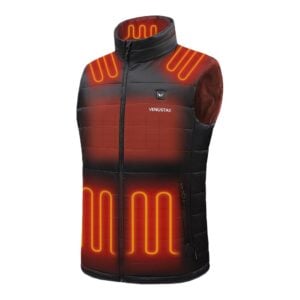
Venustas Men's Lightweight Quilted Heated Vest
Six heating zones and a 36 Wh battery pack in a light quilted vest. Up to 10 hours on low, and the battery doubles as a phone charger.
- Battery: 36 Wh pack (included, charger not included)
- Heat zones: 6
- Run time (manufacturer): 10 h low / 6 h medium / 3 h high
- Recharge time: About 2.5 h (listing)
Our take
Venustas is a popular heated vest on Amazon, and this lightweight quilted model gives you more heating zones than the ORORO for a similar price. It's a good budget pick for drivers, inspectors and anyone who moves between the truck and the site.
Venustas lists six heating zones and a 36 Wh battery pack, with up to 10 hours on low, 6 on medium and 3 on high on a single charge. The listing says the battery recharges in about 2.5 hours, much faster than the Klein pack, and its USB port can charge your phone.
The shell is water resistant, and the vest is washer safe. The package includes the vest, a battery pack and a carry bag, but no wall charger, so you'll need a USB charger.
Watch-outs: this is a general-purpose vest, not workwear. The shell is light and the vest isn't built for abrasion, so wear it under a work jacket.
Pros
- 6 heating zones
- Up to 10 hours on low (manufacturer)
- Fast 2.5-hour battery recharge (listing)
- Battery charges a phone
- Washer safe
Cons
- No charger in the box
- Light shell, not built for rough site work
| Brand | Venustas |
|---|---|
| Battery | 36 Wh pack (included, charger not included) |
| Heat zones | 6 |
| Run time (manufacturer) | 10 h low / 6 h medium / 3 h high |
| Recharge time | About 2.5 h (listing) |
| Washing | Washer safe (per listing) |
Why we picked it: It gives you six heating zones for a budget price. Venustas lists up to 10 hours on low, 6 on medium and 3 on high from a 36 Wh pack, and a recharge time of about 2.5 hours, a lot quicker than the Klein battery.
Who it’s for: Drivers, estimators and anyone who wants extra zones on a budget and will wear it under a work jacket.
Watch-outs: No wall charger in the box, and it’s general outdoor wear, not workwear, so the shell won’t take much abuse.
Also worth considering
- Milwaukee M12 Heated Hoodie or AXIS Hooded Jacket: if you want heated sleeves and a hood, see our heated jacket guide.
- Makita DCV200Z: Makita’s older fleece heated vest with two core zones (shoulders and back), rated up to 28 hours on low with a 5.0Ah battery. Fine if you find it cheaper, but the DCV202Z heats more of your core.
- ORORO 7-zone SureWarm vests: ORORO’s newer vests add more zones and separate core and pocket controls. Check the zone layout and battery before you buy, as ORORO sells several similar-looking models.
How we chose
We started with the heated vests tradespeople actually buy: the battery-tool brands (Milwaukee, Makita, DeWalt), the trade brand Klein Tools, and the best-selling self-contained vests on Amazon. Then we narrowed the list on what matters on a jobsite:
- Battery and real cost: which battery it uses, whether one is included and how long it takes to recharge.
- Heat coverage: how many zones, and where. Chest and lower-back zones matter more than a heated collar when you’re working.
- Run time: the manufacturer’s rating on each setting and the battery it was measured with.
- Fit under other layers: how slim the vest is and whether it works under a rain shell, hi-vis or FR outerwear.
- Safety and care: FR ratings where offered, washing instructions and warranty.
We did not lab test or field test these vests. Specs, run times and ratings come from each manufacturer’s product page or the retailer listing linked from the card, checked in November 2026. Where a maker doesn’t publish a number, we say so. We update this guide as models change.
How to choose a heated vest for work
1. Pick a battery system
A tool-battery vest makes sense if you already have chargers and spare packs on site. It’s usually sold vest-only or as a kit with one small battery, and larger packs give longer run times. A self-contained vest costs less up front and charges from any USB charger, but you’re limited to one brand’s pack, and a spare costs extra.
2. Put the heat where you lose it
Chest and back zones warm your core fastest. Lower-back heat (Klein) helps if you bend and kneel all day. Hand-pocket zones (ORORO) are great for warming your fingers between tasks but don’t do much while you’re working. More zones isn’t always better: more zones usually means shorter run time from the same battery.
3. Read run times carefully
Makers quote run time on the lowest setting with a specific battery. On high, expect roughly a quarter to a third of that. For a full 10-hour shift in hard cold, plan on a spare battery or a bigger pack.
4. Layer it right
A heated vest works best close to your body: over a base layer and under an insulated or shell jacket. The outer layer traps the heat and keeps wind off. Worn as your outer layer in the wind, a thin vest loses much of its heat.
5. Get the fit right
The heating panels need to sit against your torso to work well. Size so the vest is snug over a base layer, not over a hoodie. Women should look for a women’s cut, since men’s sizing leaves gaps at the chest and waist.
6. Electrical and utility work: go FR
If your job needs arc-rated or flame-resistant clothing, a regular polyester or nylon heated vest is the wrong layer: OSHA’s electric power standard (29 CFR 1910.269) bars clothing that could melt onto skin or keep burning when exposed to an arc. Choose an FR vest like the Klein 60954FR and make sure it fits your employer’s FR program. Check your local regulations and site-specific requirements.
7. Care for the battery and wiring
Always take the battery out before washing, follow the label, and use only the maker’s battery and charger. Don’t leave batteries charging unattended in a hot truck or trailer. If you fly to a job, the FAA says spare lithium batteries go in your carry-on bag, not checked luggage.
Templates and guides for this
Heated gear is one part of working safely in the cold. These Essential Construction templates and guides help you plan winter work and talk cold safety with your crew.
- PPE Policy Template (template)
- Weather Tracking Log Template (template)
- 8 Important Items To Include in Your Winter Protection Plan (guide)
- Toolbox Talk (glossary)
Heated vest FAQ
Are heated vests worth it for construction work?
Yes, for most outdoor trades in cold climates. A vest warms your core without bulky sleeves, so you can move freely, and it fits under the outerwear you already own. If you only buy one piece of heated gear, make it a vest.
How long does a heated vest battery last?
It depends on the battery and setting. Self-contained vests are usually rated around 10 to 12 hours on low. Tool-battery vests vary with pack size: Milwaukee rates its AXIS vest at 8 hours on low with a CP2.0, and Makita rates the DCV202Z at up to 35 hours on low with a 6.0Ah battery. High settings run much shorter.
Can you wash a heated vest?
Most can be machine washed after you remove the battery. Follow the label: Milwaukee and Makita say their vests can also go in the dryer, while others should air dry.
Is a heated vest or heated jacket better?
A vest is more versatile and works under any jacket. A heated jacket is warmer in real cold because it adds wind and water protection, and some heat the hand pockets or sleeves. Many workers start with a vest and add a jacket later.
Can I wear a heated vest under hi-vis or FR clothing?
Under a hi-vis vest or jacket, yes. Under FR outerwear, the vest itself should also be FR if your task requires flame-resistant clothing, because a non-FR layer can melt. Check your employer’s PPE program.
Can I use any battery with my heated vest?
No. Use the battery platform the vest is designed for. Klein, for example, warns against using anything but its own 60957 battery, and third-party adapters can void warranties and create a fire risk.
The bottom line
For most tradespeople, the Milwaukee M12 Heated AXIS Vest is the best heated vest for work: chest and back heat, 8 hours on low and a shell built for the site. If you don’t run tool batteries, the ORORO 4-Zone is the best value. Makita owners should get the DCV202Z for its huge run time, electrical crews the Klein 60954FR, and women the ORORO Women's Quilted Vest.
Round out your winter kit with the best winter work jackets, best work socks for boots and best hand warmers for outdoor work.
Own one of these? Rate it on its product page or tell us how it holds up in the comments.
Ask AI about this page: ChatGPT, Claude or PerplexityCopy as Markdown