

We may earn a commission when you buy through links on this page, as an Amazon Associate. Learn more.
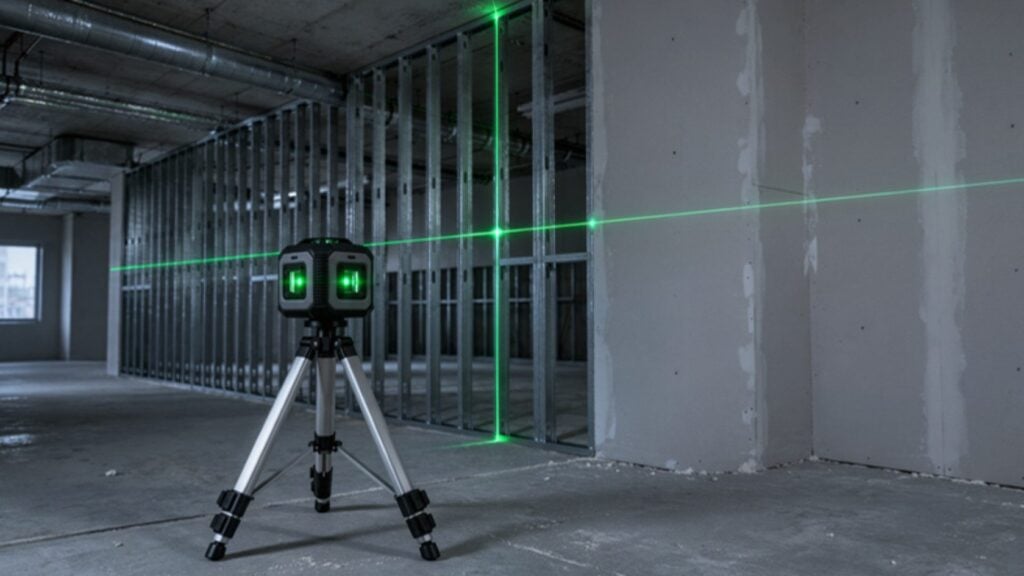
A good laser level pays for itself the first week. It replaces the water level, the long straightedge and the second person holding the end of the tape, and it puts a level or plumb line across an entire room in seconds. The best laser level for construction is the one that matches the work: a 360° line laser for interior layout, a dot laser for transferring points, or a rotary laser and receiver for site work and grading.
For most tradespeople, the best laser level is the DeWalt DW089LG 12V MAX 3 x 360. It throws three green 360° planes, is rated ±1/8 in at 30 ft, has an IP65 housing and runs on a 12V MAX battery. On a budget, the Huepar B03CG does the same basic job for under $100. If you set footings, forms or grade, skip line lasers and get a rotary like the Spectra Precision LL300N.
Below are our eight picks, a comparison table and a buying guide covering laser types, beam color, accuracy, detectors, calibration and laser safety.
Quick answer: our picks
- Best overall: DeWalt DW089LG 12V MAX 3 x 360
- Best budget 3 x 360: Huepar B03CG
- Best cross-line laser: DeWalt DW088K
- Best for tile and interior finish: Huepar S04CG 4D Kit
- Best dot laser for layout: Bosch GPL100-30G
- Best compact: Klein Tools 93CPLG
- Best rotary laser for site work: Spectra Precision LL300N
- Best value rotary kit: Johnson 99-027K
Short on time? Buy a green 3 x 360 line laser for interior work and a rotary for anything outside. Most framing, drywall, electrical, plumbing and finish crews only ever need the first one.
Best laser levels compared
| Pick | Laser level | Type | Accuracy* |
|---|---|---|---|
| Best overall | DeWalt DW089LG 12V MAX 3 x 360 | Green 3 x 360 line | ±1/8 in at 30 ft |
| Best budget 3 x 360 | Huepar B03CG | Green 3 x 360 line | ±1/9 in at 33 ft |
| Best cross-line laser | DeWalt DW088K | Red cross-line | ±1/8 in at 30 ft |
| Best for tile and interior finish | Huepar S04CG 4D Kit | Green 4 x 360 line | ±1/9 in at 33 ft |
| Best dot laser for layout | Bosch GPL100-30G | Green 3-point dot | ±1/8 in at 30 ft |
| Best compact | Klein Tools 93CPLG | Green 3 x 360 line | ±3 mm per 10 m |
| Best rotary laser for site work | Spectra Precision LL300N | Red rotary + receiver | ±3/32 in at 100 ft |
| Best value rotary kit | Johnson 99-027K | Red rotary + detector | ±3/16 in per 100 ft |
*Manufacturer accuracy ratings. Smaller is better, but check the distance: ±1/8 in at 30 ft is about four times tighter than ±1/8 in at 100 ft. Price guide: $ under $150, $$ $150–$400, $$$ over $400, based on typical listed prices.
The 8 best laser levels for construction
1. Best overall: DeWalt DW089LG 12V MAX 3 x 360
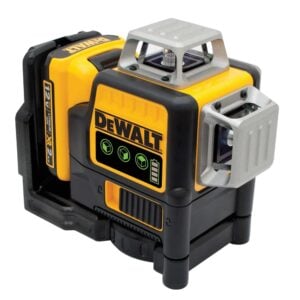
DeWalt 12V MAX Green 3 x 360 Line Laser Kit (DW089LG)
Three green 360° planes, an IP65 housing and a 12V MAX battery in one proven kit. Rated ±1/8 in at 30 ft, 100 ft visible and 165 ft with a detector.
- Model: DW089LG
- Laser type: 3 x 360° line laser (1 horizontal, 2 vertical)
- Beam color: Green
- Accuracy (manufacturer): ±1/8 in at 30 ft
Our take
The DW089LG has been on jobsites for years, and it's still the 3 x 360 laser we'd hand to most crews. It projects one horizontal and two vertical green planes, so a single setup gives you level all the way around the room, plumb on two walls and a square crossing on the floor and ceiling. That covers framing, track layout, drop ceilings, cabinets, trim and electrical rough-in from one spot.
DeWalt rates it at ±1/8 in at 30 ft, with a 100 ft working range by eye and up to 165 ft with the DW0892G detector (sold separately). The pulse mode is always on, so you don't have to remember to switch it before using a detector, and DeWalt says the lines stay at full brightness while it runs.
The housing is over-molded and rated IP65, which is one of the higher dust and water ratings you'll find on a line laser. A locking pendulum protects the internals when it rides in the truck. The integrated magnetic bracket has both 1/4 in and 5/8 in threads, so it goes on a camera-style tripod, a construction tripod or a steel stud without an adapter. The kit includes a 12V MAX battery, charger, extended ceiling bracket, target card and a hard case, and DeWalt backs it with a 3-year limited warranty.
Owners agree. It has more than 3,600 Amazon ratings averaging 4.6 stars, which is a strong record for a $500 tool. Common praise is line brightness indoors and how quickly it levels. Complaints are mostly about price and the extra cost of the detector.
Who it's not for: anyone working on the DeWalt 20V MAX platform only (look at the DCLE34031D1 instead), anyone who needs a dot laser for transferring points to the ceiling, and anyone doing outdoor grading, which is rotary laser work.
Pros
- Three green 360° planes cover a whole room from one setup
- ±1/8 in at 30 ft (manufacturer)
- IP65 rated with locking pendulum
- Always-on pulse mode for detector use
- Kit includes 12V MAX battery and charger; 3-year warranty
Cons
- Detector sold separately
- Expensive next to budget 3 x 360 lasers
- Runs on 12V MAX, not 20V MAX
| Brand | DeWalt |
|---|---|
| Model | DW089LG |
| Laser type | 3 x 360° line laser (1 horizontal, 2 vertical) |
| Beam color | Green |
| Accuracy (manufacturer) | ±1/8 in at 30 ft |
| Range (manufacturer) | 100 ft visible; 165 ft with detector |
| Detector | DW0892G, sold separately |
| Power | DeWalt 12V MAX battery (included) |
| IP rating | IP65 |
| Mount | Magnetic bracket, 1/4 in and 5/8 in threads |
| Warranty | 3-year limited |
Why we picked it: The DW089LG gets the things that matter right. Three green 360° planes cover a whole room from one setup. DeWalt rates it at ±1/8 in at 30 ft, 100 ft by eye and 165 ft with a detector, and the pulse mode is always on, so a detector just works. The IP65 rating is a step above the IP54 most line lasers carry, and the magnetic bracket takes both 1/4 in and 5/8 in threads. With more than 3,600 Amazon ratings averaging 4.6 stars and a 3-year warranty, it’s a safe buy.
Who it’s for: It suits framers, drywall and metal stud crews, ceiling installers, electricians and plumbers doing rough-in, and remodelers who lay out kitchens and baths. If you already run DeWalt 12V MAX tools, the battery is a bonus. If you’re on 20V MAX, DeWalt’s DCLE34031D1 is the same idea on the bigger battery (see Also worth considering).
Watch-outs: The detector isn’t included, and you’ll want one for long hallways, warehouses and anything outside. It’s a 12V MAX tool, so 20V packs won’t fit. And at around $500, it costs five or six times as much as the Huepar. You’re paying for brightness, durability, IP65 and DeWalt’s service network.
2. Best budget 3 x 360: Huepar B03CG
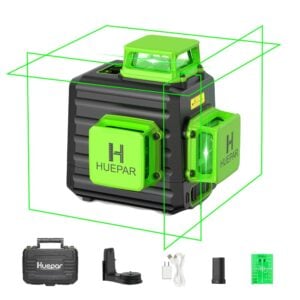
Huepar B03CG 3 x 360 Green Self-Leveling Laser Level
A full green 3 x 360 laser for well under $100. Rated ±1/9 in at 33 ft, 130 ft visible and 200 ft with a receiver, with a USB-C rechargeable battery.
- Model: B03CG
- Laser type: 3 x 360° line laser (1 horizontal, 2 vertical)
- Beam color: Green
- Accuracy (manufacturer): ±1/9 in at 33 ft
Our take
Five years ago a green 3 x 360 laser cost $400 or more. The Huepar B03CG does the same basic job for a fraction of that, and it's the laser we'd recommend to anyone who needs three planes but can't justify a pro-brand price. It's also a smart second laser for a crew that already owns a DeWalt or Bosch.
It projects one horizontal and two vertical 360° green planes, and you can switch them on separately. Huepar rates it at ±1/9 in at 33 ft, with a 130 ft working range and up to 200 ft in pulse mode with its LR-5RG or LR-6RG receiver (sold separately). The pendulum self-levels within ±4°, and the lines flash when the laser is set up beyond that, so you know it's out of level. Lock the pendulum and you can use it in manual mode for stairs and slopes.
Power comes from a 5,200 mAh lithium battery that Huepar rates for about 6 hours with all lines on. It charges by USB-C, and you can run the laser straight from a USB-C power source with the battery out. It's rated IP54 and comes with a magnetic pivoting base, target plate and hard case. Huepar's site lists a 5-year warranty.
Owners like it. It has more than 2,300 Amazon ratings averaging 4.5 stars. The most common complaints are that the lines get faint in bright rooms past 30 to 40 ft, and that the battery doesn't last a full shift with all three planes running.
Who it's not for: anyone who wants one battery for all their tools, crews who work in rain and heavy dust daily (IP54 is splash and dust resistant, not jetted water), and anyone who drops their tools often. A $500 pro laser has a tougher housing and better service support.
Pros
- Full 3 x 360 green coverage at a budget price
- ±1/9 in at 33 ft (manufacturer)
- USB-C charging; runs from USB-C power with battery out
- Pulse mode for a receiver (200 ft)
- Over 2,300 Amazon ratings at 4.5 stars
Cons
- About 6 hours with all lines on (manufacturer)
- IP54 only
- Receiver sold separately
| Brand | Huepar |
|---|---|
| Model | B03CG |
| Laser type | 3 x 360° line laser (1 horizontal, 2 vertical) |
| Beam color | Green |
| Accuracy (manufacturer) | ±1/9 in at 33 ft |
| Range (manufacturer) | 130 ft; 200 ft with Huepar receiver |
| Self-leveling range | ±4°, lines flash when out of level |
| Power | 5,200 mAh Li-ion (included), USB-C |
| Run time (manufacturer) | 6 h with all lines on |
| IP rating | IP54 |
| Laser class | Class 2 |
| Warranty | 5 years (per Huepar) |
Why we picked it: The B03CG proves you don’t need to spend $500 to get three green planes. Huepar rates it at ±1/9 in at 33 ft, which is on par with the pro tools, and it adds pulse mode for a receiver, USB-C charging and the option to run it from USB-C power with the battery out. More than 2,300 Amazon owners rate it 4.5 stars.
Who it’s for: It’s the right laser for a new contractor, a handyman business, a remodeler who only does layout a few times a week, or a crew that wants a second laser so two people can work at once. It’s also a good test run: if you find yourself using it every day, you’ll know it’s worth stepping up.
Watch-outs: Budget lasers save money on the housing, the optics and the battery. Expect dimmer lines than a DeWalt or Bosch in bright rooms, about 6 hours with all three planes on, and an IP54 rating instead of IP65. Treat it gently, and check its calibration more often than you would a pro tool.
3. Best cross-line laser: DeWalt DW088K
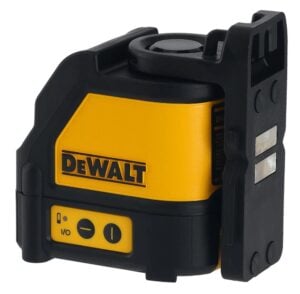
DeWalt DW088K Self-Leveling Red Cross-Line Laser
The simple cross-line laser half the trades already own. ±1/8 in at 30 ft, IP54, a magnetic bracket and three AA batteries. Over 9,000 Amazon ratings at 4.7 stars.
- Model: DW088K
- Laser type: Cross-line (1 horizontal, 1 vertical)
- Beam color: Red
- Accuracy (manufacturer): ±1/8 in at 30 ft
Our take
Not every job needs three planes. If you're hanging cabinets, setting a row of outlet boxes, installing a chair rail or checking a wall for plumb, a cross-line laser is all you need. The DW088K is the one we'd buy. It's simple, tough, cheap enough to keep in every truck, and it has more than 9,000 Amazon ratings averaging 4.7 stars.
It projects one horizontal and one vertical red line that cross. DeWalt rates it at ±1/8 in at 30 ft, with a working range of about 100 ft and up to 165 ft with a detector (sold separately). It self-levels, and the pendulum locks when you switch it off so it isn't damaged in transport. It's a Class 2 laser.
The housing is over-molded and rated IP54 for water and debris, and DeWalt says it survives a 1 m drop. The integrated magnetic bracket clamps to steel studs and track, and there's a 1/4-20 thread for a tripod. It runs on three AA batteries, which you can buy at any gas station, and DeWalt covers it with a 3-year limited warranty.
The trade-off is the red beam. Red is harder to see than green in bright rooms and almost invisible outdoors. Indoors, under normal light, you'll see it clearly to about 30 ft. Past that you'll want a detector or a green laser. Green versions exist (DW088CG), but they cost more and burn through AAs faster.
Who it's not for: anyone laying out a whole room at once (get a 3 x 360), anyone working in bright sun, and anyone who wants rechargeable power.
Pros
- Proven, simple and cheap
- ±1/8 in at 30 ft (manufacturer)
- IP54 housing with 1 m drop rating
- Magnetic bracket and 1/4-20 thread
- Runs on AA batteries; 3-year warranty
Cons
- Red beam is hard to see in bright light
- Only two lines, no 360° coverage
- Detector sold separately
| Brand | DeWalt |
|---|---|
| Model | DW088K |
| Laser type | Cross-line (1 horizontal, 1 vertical) |
| Beam color | Red |
| Accuracy (manufacturer) | ±1/8 in at 30 ft |
| Range (manufacturer) | 100 ft visible; 165 ft with detector |
| Power | 3 x AA (included) |
| IP rating | IP54 |
| Drop rating | 1 m |
| Laser class | Class 2 |
| Warranty | 3-year limited |
Why we picked it: A cross-line laser is all many jobs need, and the DW088K is the one with the longest track record. More than 9,000 Amazon ratings average 4.7 stars. DeWalt rates it at ±1/8 in at 30 ft, IP54 with a 1 m drop rating, and covers it with the same 3-year warranty as its $500 lasers. It runs on AA batteries you can buy anywhere.
Who it’s for: It’s ideal for cabinet installers, electricians setting box heights, painters and trim carpenters running chair rail or wainscot, and anyone who wants a laser in every truck without spending much. It’s also small and light enough to clamp to a stud or track.
Watch-outs: Red beams are harder to see. Indoors, in normal light, it’s fine to about 30 ft, but bright windows and outdoor work wash it out. A detector helps (165 ft), but if you work in bright spaces, the green DW088CG or a green 3 x 360 is a better choice. With only two lines, you’ll also be moving it around a room more than a 360° laser.
4. Best for tile and interior finish: Huepar S04CG 4D Kit
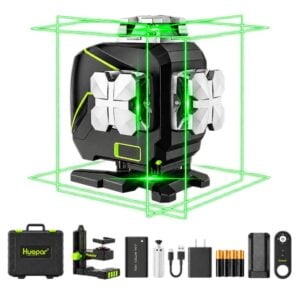
Huepar S04CG 4D Green Laser Level Kit with Receiver and Pole
Four green 360° planes, including a floor line for tile, with Bluetooth control, an LCD, a receiver and a 12 ft floor-to-ceiling pole in one kit.
- Model: S04CG (kit S04CG-LP36A)
- Laser type: 4 x 360° line laser (2 horizontal, 2 vertical)
- Beam color: Green
- Accuracy (manufacturer): ±1/9 in at 33 ft
Our take
Tile setters, flooring installers and finish carpenters need something a standard 3 x 360 laser doesn't give them: a level line right at floor height. The Huepar S04CG adds a second horizontal plane near the floor, on top of the usual top horizontal plane and two verticals. That's why Huepar calls it a 4D or 16-line laser.
The floor line is what makes it worth the money for tile. Huepar says a lifting base raises it from about 1 in to 3.54 in off the floor, so it can clear a lip, a pipe or a high spot. Combined with the two crossing verticals, you get a level reference for your first course and a square layout from one setup. The top plane handles ceiling grid, upper cabinets and backsplash lines.
Huepar rates it at ±1/9 in at 33 ft. It self-levels within ±3.5° and both beeps and flashes when it's outside that range. A backlit LCD shows battery, tilt angle and pendulum status. You can switch planes and pulse mode from the Bluetooth remote or Huepar's phone app, which saves a lot of walking. Pulse mode with the included LR-5RG receiver extends range to 200 ft, according to the listing.
This kit (model S04CG-LP36A) also includes a 12 ft floor-to-ceiling pole with fine adjustment, magnetic bracket, rechargeable battery, AA holder, USB-C charging and a bag. Huepar rates it IP54 with replaceable metal window covers and lists a 5-year warranty.
Who it's not for: anyone who only needs a basic cross-line, and anyone who wants a laser on a tool battery platform. Huepar's battery is rated for about 5 hours, so heavy users should keep the AA holder or a USB-C power bank handy.
Pros
- Second 360° horizontal at floor height for tile and flooring
- Bluetooth remote and app control
- LCD shows tilt, battery and pendulum status
- Kit includes receiver and 12 ft floor-to-ceiling pole
- Three power options: Li-ion, AA or USB-C
Cons
- About 5-hour battery (manufacturer)
- IP54 only
- More features than a framing crew needs
| Brand | Huepar |
|---|---|
| Model | S04CG (kit S04CG-LP36A) |
| Laser type | 4 x 360° line laser (2 horizontal, 2 vertical) |
| Beam color | Green |
| Accuracy (manufacturer) | ±1/9 in at 33 ft |
| Range (manufacturer) | Up to 200 ft with receiver in pulse mode |
| Self-leveling range | ±3.5°, beep and flash when out of level |
| Power | 2,600 mAh Li-ion, 4 x AA or USB-C |
| Connectivity | Bluetooth remote and Huepar app |
| Included | LR-5RG receiver, 12 ft LP36 pole, magnetic bracket, bag |
| IP rating | IP54 |
| Warranty | 5 years (per Huepar) |
Why we picked it: The S04CG adds a second 360° horizontal plane near the floor. For tile, that’s the line you actually use: a level reference for your first course and your layout lines, without setting up on a tripod. Huepar says the lifting base raises it from about 1 in to 3.54 in to clear lips and obstructions. The top plane still handles ceilings and cabinets.
Who it’s for: It’s built for tile setters, flooring installers, cabinet and countertop installers, and finish carpenters. The Bluetooth remote and app let you switch planes from where you’re working, the LCD shows tilt and pendulum status, and this kit adds a receiver and a 12 ft floor-to-ceiling pole, which is handy for upper cabinets and ceiling grid.
Watch-outs: Battery life is rated at about 5 hours, so keep the AA holder or a USB-C power bank in the bucket. It’s IP54, so protect it from slurry and the wet saw. And it’s more laser than a framing or rough-in crew needs.
5. Best dot laser for layout: Bosch GPL100-30G
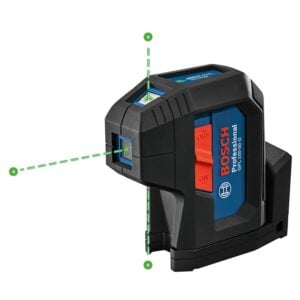
Bosch GPL100-30G Green-Beam Three-Point Self-Leveling Alignment Laser
A pocket-size green dot laser for transferring plumb, level and square points. ±1/8 in at 30 ft, IP65, 125 ft range and up to 8 hours on two AAs.
- Model: GPL100-30G
- Laser type: 3-point dot laser (up, down, forward)
- Beam color: Green
- Accuracy (manufacturer): ±1/8 in at 30 ft (down point ±1/4 in at 30 ft)
Our take
Line lasers are great for lines. For points, a dot laser is faster and more precise. The Bosch GPL100-30G projects three green dots: one straight up, one straight down and one forward. That lets one person transfer a point from the floor to the ceiling for a sprinkler head, light, can or wall track, or carry a level mark across a room.
Bosch rates it at ±1/8 in at 30 ft for the up and forward points, with a working range of up to 125 ft. The downward point is rated ±1/4 in at 30 ft. It self-levels within ±4° and tells you when it can't. When you switch it off, the pendulum locks for transport.
The build is a big part of the appeal. The full rubber over-mold works like a roll cage around the housing, and Bosch rates it IP65, the same dust and water rating as much more expensive lasers. It weighs only 0.77 lb. The built-in multipurpose mount has magnets and a 1/4-20 thread, so you can stick it to a stud, screw it to a tripod or pole, or set it on the floor.
It runs on two AA batteries, which Bosch rates for about 8 hours. That's not as convenient as a rechargeable pack, but you can buy AAs anywhere. The kit includes the batteries and a hard case. Bosch covers it for one year, plus a second year if you register it within eight weeks.
Owners are happy with it. It has more than 1,000 Amazon ratings averaging 4.7 stars. The usual complaint is the short warranty compared with DeWalt's three years.
Who it's not for: anyone who needs lines for tile, cabinets or ceiling grid. A dot laser shows points, not lines, so most crews pair it with a line laser.
Pros
- Fast floor-to-ceiling point transfers
- ±1/8 in at 30 ft (manufacturer)
- IP65 with rubber roll-cage over-mold
- Tiny and light at 0.77 lb
- Over 1,000 Amazon ratings at 4.7 stars
Cons
- Points only, no lines
- Downward point is ±1/4 in at 30 ft
- One-year warranty (two with registration)
| Brand | Bosch |
|---|---|
| Model | GPL100-30G |
| Laser type | 3-point dot laser (up, down, forward) |
| Beam color | Green |
| Accuracy (manufacturer) | ±1/8 in at 30 ft (down point ±1/4 in at 30 ft) |
| Range (manufacturer) | Up to 125 ft |
| Self-leveling range | ±4° |
| Power | 2 x AA (included) |
| Run time (manufacturer) | About 8 h |
| IP rating | IP65 |
| Laser class | Class 2 |
| Warranty | 1 year, +1 year with registration |
Why we picked it: A dot laser is the fastest way to transfer a point from floor to ceiling or carry a mark across a room. The GPL100-30G projects up, down and forward green dots, is rated ±1/8 in at 30 ft (the downward point ±1/4 in at 30 ft), and has a 125 ft range. Bosch rates it IP65 and wraps it in a rubber roll cage, and it has more than 1,000 Amazon ratings averaging 4.7 stars.
Who it’s for: It’s for anyone who lays out from points: electricians placing cans and boxes, plumbers and HVAC techs locating penetrations, sprinkler fitters, framers plumbing walls and setting bottom plate to top plate, and ceiling installers marking hanger locations.
Watch-outs: It shows points, not lines, so it won’t replace a line laser for tile or cabinets. Bosch’s warranty is one year, plus a second year if you register within eight weeks, which is shorter than DeWalt’s three years.
6. Best compact: Klein Tools 93CPLG
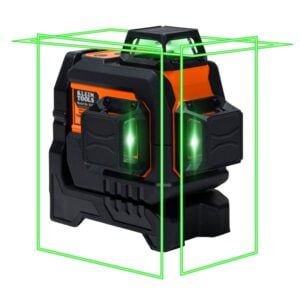
Klein Tools 93CPLG Compact Green Planar Self-Leveling Laser Level
Three green 360° planes in a body about 4 inches tall and 1.23 lb. Rechargeable, IP54 and drop-rated to 1 m. Built for tight spaces and tool bags.
- Model: 93CPLG
- Laser type: 3 x 360° line laser (1 horizontal, 2 vertical)
- Beam color: Green
- Accuracy (manufacturer): ±3 mm per 10 m (also quoted as 3/16 in at 30 ft)
Our take
Most 3 x 360 lasers are about the size of a brick. The Klein 93CPLG is closer to a coffee mug. Klein lists it at 4.2 x 4 x 3.2 in and 1.23 lb, which makes it the easiest three-plane laser to carry in a tool bag, set on a stepladder or hang inside a closet, mechanical room or bathroom.
It projects three green 360° planes, one horizontal and two vertical, so you still get a full room layout. Klein quotes a 100 ft working range and lists accuracy of ±3 mm per 10 m, roughly 1/8 in at 33 ft (Klein's own bullet points also mention 3/16 in at 30 ft, so we'd plan on the looser figure). It self-levels, and the lines flash when it's out of level. A tilt mode lets you lock the pendulum and project angled lines.
The built-in lithium-ion battery is rated for more than 6 hours with all three lasers on. The housing is over-molded, rated IP54 and drop-rated to 1 m. A magnetic mounting bracket threads into the 1/4-20 tripod mount, and it comes with a soft case. It's a Class 2 laser.
The big limitation is outdoor and long-range use. Klein lists no pulse mode and no receiver support, so once the lines wash out in bright light or past about 100 ft, there's nothing else you can do. Owners give it 4.4 stars from about 475 Amazon ratings and praise its size and brightness. Some mention the battery fuel gauge drops quickly near the end of a charge.
Who it's not for: anyone doing long runs in big open spaces, anyone working outside, and anyone who wants a laser that runs on their tool batteries. If you need range, the DeWalt DW089LG or Huepar B03CG are better buys.
Pros
- Very compact 3 x 360 at 1.23 lb
- Green planes with out-of-level warning
- Over 6 hours on the built-in battery (manufacturer)
- IP54 and 1 m drop rating
- Magnetic bracket included
Cons
- No pulse mode or receiver support
- Accuracy spec is looser than the pro lasers here
- Soft case only
| Brand | Klein Tools |
|---|---|
| Model | 93CPLG |
| Laser type | 3 x 360° line laser (1 horizontal, 2 vertical) |
| Beam color | Green |
| Accuracy (manufacturer) | ±3 mm per 10 m (also quoted as 3/16 in at 30 ft) |
| Range (manufacturer) | 100 ft indoor; no pulse mode |
| Power | Built-in Li-ion, rechargeable |
| Run time (manufacturer) | 6+ h with all lasers on |
| IP rating | IP54 |
| Drop rating | 1 m |
| Size and weight | 4.2 x 4 x 3.2 in, 1.23 lb |
| Laser class | Class 2 |
Why we picked it: The 93CPLG packs three green 360° planes into a body about 4 inches tall that weighs 1.23 lb. It fits in a tool bag, sits on a stepladder top, and hangs from its magnetic bracket in spaces where a full-size laser won’t fit. The built-in battery is rated for more than 6 hours with all three lasers on.
Who it’s for: It suits electricians, low-voltage installers, HVAC and plumbing service techs, and remodelers who work in bathrooms, closets, mechanical rooms and occupied homes.
Watch-outs: There’s no pulse mode, so you can’t add a receiver. Once the lines wash out in daylight or past about 100 ft, you’re done. Klein’s accuracy spec (±3 mm per 10 m, and 3/16 in at 30 ft in its bullet points) is also looser than the DeWalt’s. For big open floors, buy a full-size laser.
7. Best rotary laser for site work: Spectra Precision LL300N
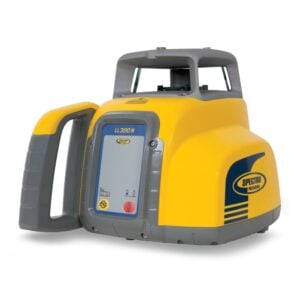
Spectra Precision LL300N Self-Leveling Rotary Laser with HL450 Receiver
The site-work standard: ±3/32 in at 100 ft, a 1,650 ft working diameter with the HL450 receiver, IP66 and a 5-year warranty.
- Model: LL300N with HL450 receiver
- Laser type: Self-leveling horizontal rotary laser
- Beam color: Red, 650 nm
- Accuracy (manufacturer): ±3/32 in at 100 ft (±2.2 mm at 30 m)
Our take
For footings, forms, slabs, excavation and site grading, you need a rotary laser and a receiver, not a line laser. The Spectra Precision LL300N, from Trimble's Spectra line, is the one you'll see on more concrete and excavation crews than any other, and it's our pick for site work.
Spectra rates it at ±3/32 in at 100 ft (±2.2 mm at 30 m), a tighter spec than any line laser here, with a working range of 1,650 ft in diameter using the receiver. It levels itself electronically within ±5°. If the laser gets bumped or the tripod settles, the Height of Instrument alert stops the rotor, shuts off the beam and flashes a red LED, so you don't keep shooting grades from a bad setup. That one feature has saved a lot of footings.
It's built for abuse. Spectra says it survives a 3 ft drop onto concrete and a 5 ft tripod tip-over, and it's rated IP66. It runs on four D-cells, rated for about 45 hours on rechargeable NiMH or 90 hours on alkaline. The optional RC601 remote adds single-axis manual slope matching for driveways and ramps.
This Amazon kit includes the HL450 receiver, which reads out elevation in feet, inches or millimeters and has a 1/16 in fine sensitivity setting, plus a clamp and a hard case. The tripod and grade rod are not included. Spectra warrants the laser for 5 years and the receiver for 3. It has 140 Amazon ratings averaging 4.6 stars.
Who it's not for: interior trades. A rotary is the wrong tool for cabinets, tile or wall layout. It's also not a dual-grade machine. If you set sloped pads or parking lots every week, look at a dual-slope rotary instead.
Pros
- ±3/32 in at 100 ft (manufacturer)
- 1,650 ft working diameter with receiver
- Height of Instrument alert stops bad readings
- IP66; survives 3 ft drop onto concrete
- 5-year laser warranty
Cons
- Expensive
- Tripod and grade rod not included in this kit
- Slope only with optional remote; no dual grade
| Brand | Spectra Precision (Trimble) |
|---|---|
| Model | LL300N with HL450 receiver |
| Laser type | Self-leveling horizontal rotary laser |
| Beam color | Red, 650 nm |
| Accuracy (manufacturer) | ±3/32 in at 100 ft (±2.2 mm at 30 m) |
| Range (manufacturer) | 1,650 ft diameter with receiver |
| Self-leveling range | ±5°, electronic |
| Out-of-level warning | Rotor stops, laser shuts off, LED flashes |
| Power | 4 x D-cell, NiMH or alkaline |
| Run time (manufacturer) | 45 h NiMH / 90 h alkaline |
| IP rating | IP66 |
| Laser class | Class 2 |
| Warranty | 5 years laser, 3 years receiver |
Why we picked it: For concrete and site work, accuracy at 100 ft and the ability to survive a jobsite matter more than anything else. Spectra rates the LL300N at ±3/32 in at 100 ft with a 1,650 ft working diameter, IP66, and a 3 ft drop onto concrete. The Height of Instrument alert stops the rotor if the laser or tripod gets bumped, so you don’t set a row of stakes from a bad setup. Spectra backs it for 5 years.
Who it’s for: It’s for concrete contractors, excavation and site prep crews, foundation and footing work, landscapers, and general contractors who check grades, forms and pads. One person with the HL450 receiver on a grade rod can shoot elevations across a big lot.
Watch-outs: This Amazon kit doesn’t include the tripod or grade rod. Budget for both, or buy a Spectra package from a survey dealer. It’s a level-only machine (slope on one axis needs the optional RC601 remote), so crews setting sloped parking lots or pads every day should look at a dual-grade rotary.
8. Best value rotary kit: Johnson 99-027K
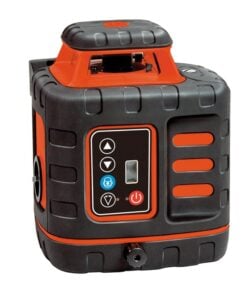
Johnson Level 99-027K Self-Leveling Rotary Laser System
A complete rotary kit with detector, tripod and 13 ft grade rod for about half the price of a Spectra. 2,000 ft working diameter with the detector and IP66.
- Model: 99-027K
- Laser type: Self-leveling horizontal rotary laser (manual vertical)
- Beam color: Red, 635 nm
- Accuracy (manufacturer): ±3/16 in per 100 ft
Our take
Not every contractor sets grade every day. If you pour a few slabs a year, build decks and fences, level piers or check drainage on a lot, the Johnson 99-027K gives you a working rotary laser setup in one case for a lot less than a Spectra or Topcon kit.
The kit is complete. Johnson includes the laser, four C batteries, a detector with clamp and 9V battery, tripod, 13 ft grade rod, magnetic target, tinted laser glasses and a hard case. The grade rod reads feet and tenths on one side and feet and inches on the other.
Johnson rates the working range at up to 2,000 ft in diameter with the detector, and 200 ft by eye indoors. Accuracy is ±3/16 in per 100 ft. That's half as tight as the Spectra LL300N, but fine for decks, fences, forms and general leveling. It self-levels with a pendulum within ±3.5° and gives visual and audible alarms when it's out of range. You can also set it on its side for manual vertical alignment, and there are four rotation speeds plus a 90° split beam for layout.
The housing is rated IP66, the same as the Spectra. Johnson rates battery life at 15 hours on the C cells, so plan to buy batteries in bulk or pick up its NiMH rechargeable pack. Johnson backs it with a 3-year warranty, and it has more than 600 Amazon ratings averaging 4.6 stars.
One safety note: this is a Class IIIa (3R) laser at up to 5 mW. That's a higher class than the line lasers on our list, so never look into the beam and keep it off eye-level setups where people walk.
Who it's not for: crews setting grade daily, anyone who needs slope, and anyone who wants rechargeable power in the box.
Pros
- Complete kit: detector, tripod and 13 ft grade rod included
- 2,000 ft working diameter with detector (manufacturer)
- IP66 housing
- 3-year warranty
- About half the price of a pro rotary kit
Cons
- ±3/16 in per 100 ft is looser than pro rotaries
- 15 hours on C batteries (manufacturer)
- Class IIIa beam needs more care
| Brand | Johnson Level & Tool |
|---|---|
| Model | 99-027K |
| Laser type | Self-leveling horizontal rotary laser (manual vertical) |
| Beam color | Red, 635 nm |
| Accuracy (manufacturer) | ±3/16 in per 100 ft |
| Range (manufacturer) | 200 ft diameter by eye; 2,000 ft diameter with detector |
| Self-leveling range | ±3.5°, audible and visual alarm |
| Power | 4 x C alkaline (included) |
| Run time (manufacturer) | 15 h |
| IP rating | IP66 |
| Laser class | Class IIIa, ≤5 mW |
| Included | Detector, tripod, 13 ft grade rod, target, glasses, hard case |
| Warranty | 3 years |
Why we picked it: The 99-027K is the cheapest way to get a complete, working rotary setup from a known brand. The case holds the laser, detector with clamp, tripod and a 13 ft grade rod, so you can level a slab or set fence posts the day it arrives. Johnson rates it at a 2,000 ft working diameter with the detector, IP66 and a 3-year warranty, and owners give it 4.6 stars from more than 600 Amazon ratings.
Who it’s for: It’s a good fit for deck and fence builders, remodelers who pour the odd slab or footing, landscapers and hardscapers, and anyone who needs to check drainage or level piers a few times a month.
Watch-outs: Accuracy is ±3/16 in per 100 ft, twice the Spectra’s tolerance. That’s fine for decks and fences but tight for structural concrete over long distances. It runs on C cells for about 15 hours. It’s a Class IIIa laser, so it needs more care around eyes than the Class 2 line lasers here.
Also worth considering
- Milwaukee M12 Green 360° 3-Plane Laser Kit (3632-21). The pick for M12 shops. Milwaukee rates it at ±1/8 in at 33 ft, 125 ft working range, 165 ft with a detector, ±4° self-leveling, IP54, and more than 15 hours of runtime with the included XC4.0 battery, with a 3-year warranty. We left it off the main list because Milwaukee doesn’t sell it on Amazon; buy it from a Milwaukee dealer. See it at Milwaukee.
- Bosch GLL3-330CG 12V Max Connected 3-Plane Laser. For Bosch 12V users. Three green 360° planes, Bluetooth control through the Bosch Leveling Remote app, ±4° self-leveling with an out-of-level warning, 200 ft working diameter (330 ft with the LR8 receiver in pulse mode), IP54, and a BM 1 positioning device in the kit. Amazon pricing was well above Bosch dealer prices when we checked, so shop around. See it at Bosch.
- DeWalt 20V MAX 3 x 360 Green Line Laser Kit (DCLE34031D1). The DW089LG’s idea on DeWalt’s 20V MAX battery. DeWalt rates it at ±1/8 in at 30 ft, 130 ft visible and up to 330 ft with the DW0892G detector, IP54, and 11 hours on the included 2Ah battery. Note DeWalt lists a 1-year warranty on this model. Check price on Amazon.
- Bosch GLL50-20G Green-Beam Cross-Line Laser. A low-cost green alternative to the DW088K for short-range indoor work, with more than 400 Amazon ratings averaging 4.5 stars. Check price on Amazon.
How we chose
We started with the laser levels tradespeople actually buy: the line, dot and rotary lasers from DeWalt, Milwaukee, Bosch, Klein, Spectra Precision, Johnson, Hilti and Huepar. We checked what ranks in Google for “best laser level” and related searches, what Google’s own AI summary recommends, and what pros recommend on trade forums. Then we narrowed the list on what matters on a jobsite:
- Accuracy: the manufacturer’s rating, converted to the same distance so you can compare.
- Visibility and range: beam color, working range by eye, and range with a detector or receiver.
- Leveling and warnings: self-leveling range, out-of-level alarms and pendulum locks.
- Durability: IP rating, drop ratings and housing design.
- Power: battery platform, run time and backup power options.
- Warranty and support: how long the manufacturer covers it and how easy it is to get serviced.
- Owner feedback: recurring praise and complaints across thousands of Amazon reviews.
We did not lab test or field test these lasers. Specs, accuracy figures and warranties come from each manufacturer’s product page or spec sheet, and rating counts come from Amazon at the time of writing. Where a spec is the manufacturer’s claim, we say so. We’ll update this guide as models change.
How to choose a laser level
Line vs dot vs rotary lasers
Laser levels come in three basic types, and picking the right type matters more than picking the brand.
- Line lasers project lines onto walls, floors and ceilings. A cross-line laser throws one horizontal and one vertical line in front of it. A 360° laser throws a full circle. These are the tools for interior layout: framing, drywall, ceilings, cabinets, tile, electrical and plumbing rough-in.
- Dot (point) lasers project bright dots, usually up, down and forward, sometimes left and right as well. They’re the fastest way to transfer a point from floor to ceiling, plumb a wall or square a corner. They don’t draw lines.
- Rotary lasers spin a beam 360° many times a second to create a level plane over hundreds of feet. You read it with a receiver on a grade rod. They’re for site work: footings, forms, slabs, excavation, grading, fences and large floors. Most can’t be seen by eye outdoors, so the receiver isn’t optional.
Combination lasers add plumb dots to a cross-line laser, which helps with framing and track layout.
What “3 x 360” means
A 3 x 360 laser (also called a 3-plane or 12-line laser) projects three full 360° planes: one horizontal and two vertical planes that cross at 90°. Set it in the middle of a room, and you get a level line on every wall, two plumb lines on every wall, and a square cross on the floor and ceiling. That means you can lay out walls, check ceilings for level and transfer points without moving the laser.
A 4 x 360 or “4D” laser like the Huepar S04CG adds a second horizontal plane near the floor, which is useful for tile and flooring. A 2 x 360 laser has one horizontal and one vertical plane, which saves money if you rarely need square.
Green vs red laser levels
Green beams look much brighter than red beams at the same power because the human eye is most sensitive to green light. Bosch and Huepar say their green beams are up to 4 times brighter than standard red, and Klein says up to 2 times. In practice, a green line is easier to see in bright rooms, on dark surfaces and at longer distances.
Red still has advantages. Red lasers cost less and run longer on the same batteries. With a detector, beam color matters much less, and most rotary lasers for site work are red because the receiver does the seeing. Our advice: buy green for interior line lasers, and don’t worry about color on a rotary.
Accuracy: what the specs mean
Accuracy is listed as a tolerance over a distance, such as ±1/8 in at 30 ft. That means the line can be up to 1/8 in high or low 30 ft from the laser. The error grows with distance, so at 60 ft the same laser could be off by 1/4 in.
Manufacturers use different distances, which makes comparisons tricky. Convert them to the same distance before you compare. For example, ±1/8 in at 30 ft is about the same as ±3 mm at 10 m, while the Spectra LL300N’s ±3/32 in at 100 ft is far tighter, roughly ±1/32 in at 30 ft. For most interior trades, anything rated ±1/8 in at 30 ft or better is plenty. For structural concrete and grading over long distances, a rotary with a tight spec is worth paying for.
Self-leveling range and out-of-level warnings
Most modern laser levels self-level with a pendulum or electronic system. If the laser is set up within its self-leveling range, usually ±3.5° to ±5°, it levels itself. If it’s outside that range, it should warn you by flashing the lines, beeping or stopping the rotor. Never buy a laser without an out-of-level warning, and never trust a line that’s flashing.
Look for a pendulum lock. It protects the mechanism in transport and usually doubles as a manual mode for projecting angled lines on stairs and ramps. Rotary lasers for site work should also have a height-of-instrument (HI) alert, which stops the laser if it’s bumped after setup.
Range, detectors and pulse mode
Every line laser has two range numbers: how far you can see the line, and how far a detector (receiver) can pick it up. Visible range depends heavily on light. A line you can see at 100 ft in a dim garage may disappear at 20 ft in a sunny room.
To use a detector with a line laser, the laser needs a pulse mode. Pulse mode flashes the beam faster than your eye can see, and the detector locks onto that flicker. Some lasers dim the line in pulse mode; the DW089LG keeps full brightness. Always check that the detector is the one the manufacturer specifies. A Huepar receiver won’t necessarily work with a DeWalt laser.
Rotary lasers are rated in diameter, not radius. The Spectra LL300N’s 1,650 ft diameter means about 825 ft in any direction from the laser.
IP ratings: dust and water resistance
The IP rating tells you how well the housing keeps out dust (first digit) and water (second digit). For laser levels, you’ll mostly see:
- IP54: dust protected and resistant to splashing water. Fine for interior work and the odd drizzle.
- IP65: dust tight and resistant to water jets. Better for dusty demo, concrete cutting and outdoor use.
- IP66 and IP67: dust tight and resistant to heavy water jets or brief immersion. Standard on good rotary lasers and receivers.
Drop ratings are separate. Spectra, for example, says the LL300N survives a 3 ft drop onto concrete.
Battery platform and power
If you already run DeWalt 12V MAX or 20V MAX, Milwaukee M12 or Bosch 12V tools, a laser on the same battery means one charger and a spare pack in every bag. That’s the main reason to choose a tool-brand laser over a budget one. Budget lasers usually have their own lithium pack and USB-C charging, which is fine as long as you remember to charge it.
Dual power (a lithium pack plus AAs or USB-C) is worth having. Check run time with all lines on, not just one.
Mounts, tripods and accessories
A laser is only as useful as where you can put it. Look for a magnetic bracket that clamps to steel studs and track, a ceiling clip for grid work, and standard threads. Most line lasers use 1/4-20 (camera tripod) threads, while construction tripods and rotary lasers use 5/8-11. A laser pole that jacks between floor and ceiling is the fastest way to set a line at any height.
Budget for a detector, tripod and, for rotaries, a grade rod. Kits that include them often cost less.
How to check a laser level’s calibration
Every laser can drift out of calibration after a drop or with age. Check yours when it’s new, after any hard knock, and before critical work like setting a long run of cabinets or a slab. The common two-wall check takes about ten minutes:
- Set the laser about halfway between two walls roughly 30 ft apart, and mark the horizontal line on both walls.
- Turn the laser 180° without changing its height and mark both walls again.
- Move the laser close to one wall, mark both walls, then turn it 180° and mark both walls again.
- Compare the differences between the marks on each wall. If they differ by more than the laser’s rated tolerance at that distance, it needs service.
Each manufacturer’s manual has its own version of this test with exact distances, and some lasers (including the Bosch GPL100-30G) include it in the instructions. Don’t try to adjust the laser yourself unless the manual says you can. Send it to an authorized service center.
Laser classes and eye safety (OSHA 1926.54)
Laser levels are sold by class. Most line and dot lasers are Class 2, at or below 1 mW of visible light. Your blink reflex normally protects you from a brief exposure, but you should never stare into the beam. Some rotary lasers, including the Johnson 99-027K, are Class 3R (IIIa), up to 5 mW. They’re safe with normal precautions but can injure your eyes if you look into the beam, especially through a level, transit or binoculars.
On construction sites, OSHA’s nonionizing radiation standard, 29 CFR 1926.54, applies to laser equipment. In plain English, it says:
- Only qualified, trained employees should install, adjust and operate laser equipment, and the operator should carry proof of qualification.
- Areas where lasers are used should be posted with standard laser warning placards.
- Lasers must not be pointed at employees. Where possible, set them up above head height.
- Turn the laser off or cap the beam when it’s not in use, and turn it off if it’s left unattended for a substantial time.
- Employees exposed to direct or reflected laser light above 5 mW must have anti-laser eye protection.
- Avoid laser work in rain, snow, dust or fog where practicable; otherwise keep workers out of the beam’s path.
One more note: the tinted “laser enhancement” glasses that come with many kits make the beam easier to see. They are not laser safety eyewear, and they are not impact-rated safety glasses. Wear your normal ANSI Z87.1 safety glasses on site, and check with your safety manager before running any Class 3R laser around other trades.
Laser level FAQ
What is the best laser level for construction?
For interior construction, a green 3 x 360 line laser from a tool brand, such as the DeWalt DW089LG, covers the most work. For outdoor site work, footings and grading, you need a rotary laser with a receiver, such as the Spectra Precision LL300N. Many contractors own one of each.
What is a good budget laser level?
The Huepar B03CG is the best budget 3 x 360 we found, at under $100 with ±1/9 in at 33 ft accuracy and pulse mode for a receiver. If you only need two lines, the DeWalt DW088K cross-line laser is around $130 and has a 3-year warranty.
Is a green or red laser level better?
Green is better for most interior work because it looks much brighter to the human eye, especially in bright rooms and at distance. Red costs less and runs longer on batteries. With a detector or on a rotary laser, the color matters much less.
How accurate should a laser level be?
For framing, drywall, ceilings, cabinets and tile, look for ±1/8 in at 30 ft (±3 mm at 10 m) or better. For long concrete and grading work, look for a rotary rated around ±1/16 in to ±3/32 in at 100 ft. Whatever the spec, check calibration regularly and after any drop.
Who makes the most accurate laser level?
Among the lasers on our list, the Spectra Precision LL300N has the tightest rating at ±3/32 in at 100 ft. Survey-grade rotary lasers from Spectra, Topcon, Leica and Trimble are generally the most accurate tools for site work. For line lasers, the major tool brands and Huepar all quote similar specs, around ±1/8 in at 30 ft.
Can you use a laser level outside?
Yes, but you’ll need a detector. Line lasers are hard or impossible to see in daylight past a few feet, so use one with pulse mode and a matching detector. For grading, forms and long distances, a rotary laser with a receiver is the right tool.
How far can a laser level reach?
Line lasers typically reach 50 to 130 ft by eye indoors, and 165 to 330 ft with a detector. Rotary lasers with a receiver reach much farther: the Johnson 99-027K is rated at 2,000 ft in diameter and the Spectra LL300N at 1,650 ft diameter.
The bottom line
For most tradespeople, the DeWalt DW089LG 12V MAX 3 x 360 is the best laser level: three green planes, ±1/8 in at 30 ft, IP65 and a 3-year warranty. The Huepar B03CG is the best value, and the DeWalt DW088K is the cross-line laser to keep in every truck. Tile and finish installers should look at the Huepar S04CG kit, point-transfer trades at the Bosch GPL100-30G, and anyone who works on ladders all day at the Klein 93CPLG. For site work, buy the Spectra LL300N, or the Johnson 99-027K if you only set grade now and then.
Browse all our laser level picks, and keep the rest of your kit up to standard with our guides to the best hard hats for construction and the best work gloves for construction.
Own one of these lasers? Rate it on its product page or tell us how it holds up in the comments.
Ask AI about this page: ChatGPT, Claude or PerplexityCopy as Markdown