

We may earn a commission when you buy through links on this page, as an Amazon Associate. Learn more.
Hand injuries are among the most common injuries in construction, and the wrong glove is a big part of the problem. A cheap pair of dipped knit gloves is fine for carrying conduit. It won’t stop a sheet metal edge, and it won’t keep your fingers working at 20°F.
Our short answer: for most construction work, the Mechanix Wear M-Pact is the best all-round work glove. It protects your knuckles and palm, it’s thin enough for screws and touchscreens, and it goes in the washing machine. If you handle sharp metal, get the Ironclad Command Impact Cut A6, which adds an ANSI A6 cut liner and certified impact armor. For cold weather, the Kinco 1927KW is the warm, tough, inexpensive classic.
Below are our eight picks for the best work gloves for construction, covering cut, impact, winter, leather and high-dexterity gloves. After the reviews, we explain the ratings printed on the cuff (ANSI/ISEA 105 cut levels, EN 388 and ANSI/ISEA 138 impact) so you can match a glove to the hazards on your site.
Quick picks
- Best overall: Mechanix Wear M-Pact. Impact padding and knuckle armor without losing dexterity.
- Best budget multi-pack: DEX FIT FN330. Three pairs of grippy foam nitrile gloves for about $5 a pair.
- Best cut-resistant: Ironclad Command Impact Cut A6. ANSI A6 cut liner around the whole hand plus ANSI 138 Level 2 impact.
- Best insulated impact gloves: Mechanix ColdWork M-Pact. 60 grams of Thinsulate and ANSI 138 Level 2 armor.
- Best winter work gloves: Kinco 1927KW. Lined pigskin with top-level abrasion resistance for about $25.
- Best waterproof winter gloves: Carhartt A511. A waterproof insert and wicking lining for wet, cold days.
- Best leather work gloves: Wells Lamont HydraHyde. Cowhide that resists water and stays soft.
- Best for dexterity: Mechanix Wear The Original. Thin, flexible and touchscreen capable.
Compare the best construction work gloves
| Pick | Glove | Key protection | Best for |
|---|---|---|---|
| Best overall | Mechanix Wear M-Pact | TPR knuckles, D3O palm | General construction, tools |
| Best budget multi-pack | DEX FIT FN330 (3 pairs) | Foam nitrile grip, EN 388 4142 | Handling, rough-in, cleanup |
| Best cut-resistant | Ironclad Command Impact Cut A6 | ANSI A6 cut, ANSI 138 Level 2 | Sheet metal, HVAC, metal studs |
| Best insulated impact gloves | Mechanix ColdWork M-Pact | ANSI 138 Level 2, 60 g Thinsulate | Cold-weather tool work |
| Best winter work gloves | Kinco 1927KW | ANSI A2, abrasion 6, insulated | Cold, dry outdoor work |
| Best waterproof winter gloves | Carhartt A511 | Waterproof insert, insulated | Wet snow, slush, site walks |
| Best leather work gloves | Wells Lamont HydraHyde | Water-resistant cowhide palm | Framing, demo, lumber |
| Best for dexterity | Mechanix Wear The Original | Thin 0.8 mm palm, touchscreen | Finish, electrical, layout |
Ratings are the manufacturers’ published figures. ANSI cut levels run from A1 (lowest) to A9 (highest); ANSI 138 impact runs from Level 1 to Level 3 (highest).
The 8 best work gloves for construction
1. Best overall: Mechanix Wear M-Pact
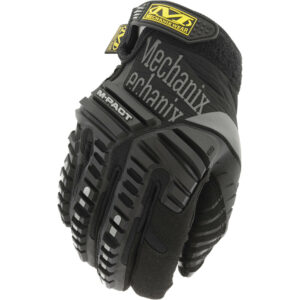
Mechanix Wear M-Pact Work Gloves
The glove you see on more job sites than any other: a thin synthetic leather palm with D3O padding and welded rubber knuckle armor that still lets you pick up a screw or use your phone.
- Model: MPT-58
- Palm: 0.8 mm synthetic leather with 2 mm D3O padding
- Impact protection: Welded TPR knuckles; EN 388 impact pass (P)
- EN 388: 2121XP
Our take
Walk any commercial job site and count the black-and-grey gloves sticking out of back pockets. A lot of them will be Mechanix M-Pacts. They've earned that spot because they get the balance right: real impact protection for your knuckles and palm, in a glove thin enough to run a drill, drive screws and work a touchscreen without taking it off.
The back of the hand is covered in welded thermoplastic rubber (TPR) over the knuckles and fingers. Mechanix redesigned the armor to bend more easily, and it passes the EN 388 knuckle impact test (the "P" in its 2121XP rating). The palm uses 0.8 mm touchscreen-capable synthetic leather with 2 mm of D3O padding wrapped around the side and heel of the hand. D3O is a soft material that stiffens on impact, so it takes the sting out of hammer blows, hand-nailing and vibration from tools.
Mechanix lists ANSI/ISEA 105 abrasion level 3. There's no cut rating worth relying on (EN 388 cut level 1), and it is not certified to ANSI/ISEA 138, the North American impact standard. If your site requires ANSI 138 or a minimum cut level, look at the Ironclad Command Impact Cut A6 instead.
Other details are well thought out. The back of the hand is ripstop fabric that repels water and resists snagging in tight spaces. The thumb has a welded Lock Ring panel instead of stitching where gloves usually fail first. The hook-and-loop wrist closure is long enough to keep debris out, and the whole glove goes in the washing machine.
Who it's not for: anyone handling sheet metal, glass or anything sharp, since the cut protection is minimal. It's also not a winter glove; the ColdWork version below adds insulation. Mechanix gloves tend to fit snug, so check the size chart before ordering.
Pros
- TPR knuckle armor and 2 mm D3O palm padding
- Thin enough for screws, fasteners and touchscreens
- Snag-resistant, water-repellent ripstop back
- Machine washable
- Huge number of positive owner reviews
Cons
- Minimal cut protection (EN 388 cut level 1)
- Not certified to ANSI/ISEA 138 impact
- Not insulated; runs snug, so check sizing
| Brand | Mechanix Wear |
|---|---|
| Model | MPT-58 |
| Palm | 0.8 mm synthetic leather with 2 mm D3O padding |
| Impact protection | Welded TPR knuckles; EN 388 impact pass (P) |
| EN 388 | 2121XP |
| ANSI/ISEA 105 abrasion | Level 3 |
| Touchscreen | Yes |
| Washable | Yes |
Why we picked it: The M-Pact covers the injuries that happen most on a typical site: smashed knuckles, pinched fingers, and sore palms from hammering and running tools. Welded TPR armor protects the back of the hand, and 2 mm of D3O padding in the palm absorbs strikes and vibration. Yet the palm is still a thin 0.8 mm synthetic leather, so you can drive screws, handle fittings and use your phone. Few gloves combine that much protection with that much feel.
Who it’s for: carpenters, laborers, equipment operators, mechanics and anyone who wants one glove for most of the day. With thousands of Amazon reviews averaging 4.5 stars, it’s a proven choice.
Watch out for: the cut protection is minimal (EN 388 cut level 1), and the impact armor passes the European EN 388 knuckle test but isn’t certified to ANSI/ISEA 138. If your site or GC requires ANSI-rated cut or impact protection, choose the Ironclad below. Mechanix gloves run snug, so if you’re between sizes, size up.
2. Best budget multi-pack: DEX FIT FN330 (3 pairs)
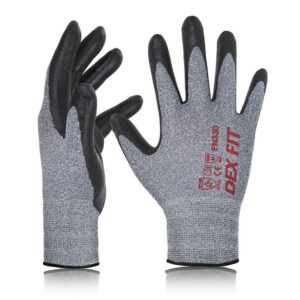
DEX FIT FN330 Nitrile Work Gloves (3 Pairs)
Three pairs of thin, foam nitrile-dipped knit gloves for about the price of one pair of leather gloves. Grippy, breathable and touchscreen friendly, they're the pack to keep in the truck.
- Model: FN330
- Shell: Seamless knit
- Coating: Water-based foam nitrile, palm and fingers
- EN 388: 4142
Our take
Most of the gloves a crew goes through in a year aren't expensive specialty gloves. They're thin dipped knit gloves that get worn through, lost, or left on a pallet. The DEX FIT FN330 is one of the best-reviewed options in that category, with more than 21,000 Amazon ratings, and it usually costs around $5 a pair in a three-pack.
The shell is a seamless knit that fits close to the hand, and the palm and fingers are dipped in a water-based foam nitrile coating. Foam nitrile works like a sponge on oily or damp surfaces, so it grips pipe, conduit, lumber and boxes better than plain latex. The back of the hand is left uncoated, which keeps your hands cooler on hot days.
DEX FIT rates it EN 388 4142: the top abrasion score (4), cut level 1, tear level 4 and puncture level 2. The coating also works on touchscreens, so you can answer the phone or work a tablet without pulling them off. They come in six sizes from XS to XXL and can go in the washing machine.
This is the glove for general handling, framing hardware, electrical rough-in, stocking material and site cleanup. The thin build gives you real fingertip feel for small fasteners.
Who it's not for: anyone who needs protection. Cut level 1 won't stop sheet metal or glass, there's no impact armor, and a thin knit glove gives almost no warmth. Expect to replace them often under hard use; thin dipped gloves usually wear through at the fingertips first. That's the trade-off at this price, and why buying in multi-packs makes sense.
Pros
- About $5 a pair in a 3-pack
- Foam nitrile grips well on oily and damp surfaces
- Top EN 388 abrasion score (4)
- Touchscreen friendly and breathable
- Six sizes, XS to XXL
Cons
- Cut level 1 only; no impact protection
- No warmth for cold weather
- Thin coating wears through faster than leather
| Brand | DEX FIT |
|---|---|
| Model | FN330 |
| Shell | Seamless knit |
| Coating | Water-based foam nitrile, palm and fingers |
| EN 388 | 4142 |
| Touchscreen | Yes |
| Pack size | 3 pairs (12-pair packs also sold) |
| Sizes | XS–XXL |
Why we picked it: A lot of construction glove use is general handling: rough-in, stocking material, moving boxes and cleanup. For that, a thin dipped knit glove beats leather on comfort and dexterity, and you want enough pairs to keep spares in the truck. The DEX FIT FN330 has more than 21,000 Amazon ratings, an EN 388 abrasion score of 4 (the maximum), and a foam nitrile coating that grips oily pipe and damp lumber.
Who it’s for: electricians and plumbers doing rough-in, general laborers, and crew leads who buy gloves by the dozen. The touchscreen-friendly coating is handy for anyone who checks plans on a phone or tablet.
Watch out for: it’s a light-duty glove. Cut level 1 won’t protect you from sheet metal or glass, there’s no padding or armor, and the thin coating wears through faster than leather. Treat them as consumables.
3. Best cut-resistant: Ironclad Command Impact Cut A6
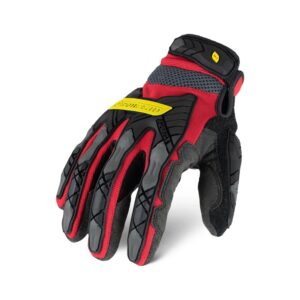
Ironclad Command Impact Cut A6 Work Gloves
A full cut-resistant liner rated ANSI A6, plus ANSI/ISEA 138 Level 2 impact armor, in a mechanic-style glove that still works your phone. The most protection per dollar on this list.
- Model: IEX-MIGR5 (Command Impact Cut A6)
- ANSI/ISEA 105 cut: A6 (3,131 g)
- ANSI/ISEA 138 impact: Level 2
- EN 388: 3X43FP
Our take
Many gloves sold as cut resistant only protect the palm. The Ironclad Command Impact Cut A6 puts an HPPE-blend cut-resistant liner around the whole hand, palm and back, which matters when you're reaching past sharp edges, not just gripping them. Ironclad rates it ANSI/ISEA 105 cut level A6, with a tested score of 3,131 grams.
It also has impact protection that's actually certified. Flexible TPR guards cover the fingers, thumb and knuckles, and Ironclad rates the glove ANSI/ISEA 138 Level 2. The palm is padded synthetic suede, reinforced at the thumb saddle, with a terry cloth sweat wipe on the thumb.
The full rating sheet from Ironclad: EN 388 3X43FP, ANSI cut A6, ANSI abrasion level 3, ANSI puncture level 4 and ANSI impact Level 2. In plain terms, it's built for jobs where your hands meet sheet metal, ductwork, rebar ties, metal studs, glass and pinch points in the same day. Ironclad lists construction, electrical and mechanical contractors, pipe fitters and HVAC as best uses.
The palm and fingertips are touchscreen compatible, and the hook-and-loop closure gives a secure fit. Sizes run from XS to 4XL, which helps people with large hands who usually struggle to find cut-rated gloves.
One note: older Amazon listings and packaging call this the Command Impact 360 Cut A5. It's the same part number (IEX-MIGR5); Ironclad's current spec sheet lists it as A6.
Who it's not for: anyone who needs maximum dexterity for small parts. The liner and armor add bulk compared with a thin dipped glove. It isn't insulated or waterproof, and no cut-resistant glove is cut-proof, especially against a moving blade.
Pros
- 360-degree HPPE liner rated ANSI A6 (3,131 g)
- ANSI/ISEA 138 Level 2 impact rating
- ANSI puncture level 4
- Touchscreen compatible
- Sizes XS to 4XL
Cons
- Bulkier than thin dipped gloves
- Not insulated or waterproof
- Some listings still say A5, which can confuse buyers
| Brand | Ironclad |
|---|---|
| Model | IEX-MIGR5 (Command Impact Cut A6) |
| ANSI/ISEA 105 cut | A6 (3,131 g) |
| ANSI/ISEA 138 impact | Level 2 |
| EN 388 | 3X43FP |
| ANSI puncture | Level 4 |
| Palm | Padded synthetic suede |
| Touchscreen | Yes |
| Sizes | XS–4XL |
Why we picked it: This is the glove we’d hand to anyone working with metal. Ironclad lists an ANSI/ISEA 105 cut level of A6 (3,131 grams), and the HPPE-blend liner wraps the whole hand, so the back of your hand and fingers are protected too. It’s also rated ANSI/ISEA 138 Level 2 for impact and ANSI puncture level 4. That’s a lot of certified protection for about $30.
Who it’s for: HVAC installers, sheet metal workers, ironworkers, metal stud framers, glaziers and electricians pulling wire through sharp knockouts. It’s also a good default on sites that require a minimum cut level, often A4 or higher.
Watch out for: the liner and armor make it bulkier than a thin dipped glove, and it isn’t insulated. Amazon still lists it as the “Command Impact 360 Cut A5” under the same part number; Ironclad’s current spec sheet says A6. Remember that cut-resistant doesn’t mean cut-proof, and no glove will stop a saw blade or grinder.
4. Best insulated impact gloves: Mechanix ColdWork M-Pact
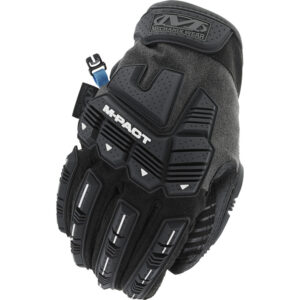
Mechanix Wear ColdWork M-Pact Insulated Gloves
An insulated M-Pact with 60 grams of Thinsulate, a wind barrier and TPR armor certified to ANSI/ISEA 138 Level 2. The impact glove to wear when it's below freezing.
- Model: CWKMP-58
- Insulation: 60 g 3M Thinsulate Eco
- ANSI/ISEA 138 impact: Level 2
- EN 388: 2121XP
Our take
Cold hands are clumsy hands, and clumsy hands get hurt. Most winter gloves force you to choose between warmth and protection. The ColdWork M-Pact is Mechanix's answer for people who swing hammers, run tools and handle steel through the winter.
Under the shell is 60 grams of 3M Thinsulate Eco insulation and a laminated wind barrier. The back of the hand is a water-resistant E-Suede, so light snow and drizzle bead off. Sixty grams is a light-to-mid weight of insulation: enough for active work in freezing temperatures without turning the glove into a ski mitt.
The armor is the main reason to buy it. A TPR exoskeleton over the knuckles and fingers meets ANSI/ISEA 138 Level 2, according to Mechanix, and the palm has D3O padding to absorb impact and vibration. It also carries an EN 388 rating of 2121XP and an EN 511 cold rating of 11X, which means it passed the basic convective and contact cold tests but was not tested for water penetration.
The palm is touchscreen-capable synthetic leather with Armortex reinforcement at the palm and thumb saddle, plus a dual-layer fingertip on the index finger and thumb. A TPR wrist closure keeps it snug, and a spring clip keeps the pair together on your belt or harness.
Who it's not for: anyone working in standing water or wet concrete. It's water resistant, not waterproof, and there's no waterproof insert. It also isn't built for extreme cold; for long stretches below about 10°F, a heavier insulated glove or a liner underneath will serve you better. And like the regular M-Pact, cut protection is minimal.
Pros
- ANSI/ISEA 138 Level 2 TPR impact armor
- 60 g Thinsulate Eco plus wind barrier
- D3O palm padding
- Touchscreen-capable palm
- Keeps decent dexterity for an insulated glove
Cons
- Water resistant, not waterproof
- Light insulation for extreme cold
- Minimal cut protection; expensive
| Brand | Mechanix Wear |
|---|---|
| Model | CWKMP-58 |
| Insulation | 60 g 3M Thinsulate Eco |
| ANSI/ISEA 138 impact | Level 2 |
| EN 388 | 2121XP |
| EN 511 (cold) | 11X |
| Waterproof | No (water-resistant back) |
| Touchscreen | Yes |
Why we picked it: Most insulated gloves drop impact protection, and most impact gloves aren’t warm. The ColdWork M-Pact does both. Mechanix says its TPR armor meets ANSI/ISEA 138 Level 2, and it adds 60 grams of 3M Thinsulate Eco, a wind barrier, a water-resistant back and D3O palm padding. The palm is still touchscreen capable.
Who it’s for: framers, ironworkers, riggers, equipment mechanics and anyone running tools outside in winter. Sixty grams of insulation suits active work around freezing.
Watch out for: it’s water resistant, not waterproof, so it isn’t the glove for slush or wet concrete. For long days well below freezing, add a thin liner or choose a heavier glove. At around $37, it’s also the most expensive pick here.
5. Best winter work gloves: Kinco 1927KW
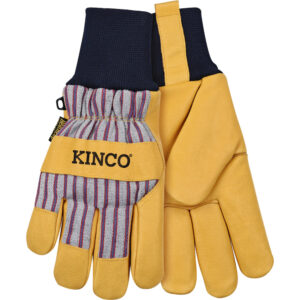
Kinco 1927KW Lined Pigskin Work Gloves
The striped-back winter glove you've seen on framers, ranchers and ski patrollers for decades. Grain pigskin palm, Heatkeep insulation and a knit wrist, for about $25.
- Model: 1927KW
- Palm: Premium grain pigskin
- Back: Otto striped cotton-blend canvas
- Insulation: Heatkeep thermal
Our take
Kinco has been making gloves since 1975, and the 1927KW, with its golden pigskin palm and striped canvas back, is the one most people recognize. It's a favorite on cold job sites because it's warm, tough and cheap enough that losing one doesn't ruin your week.
The palm, knuckle strap and fingertips are premium grain pigskin. Pigskin is porous, so it breathes and, as Kinco points out, stays soft and flexible after it gets wet instead of drying stiff like cheap cowhide. The back is Kinco's Otto striped cotton-blend canvas. Inside is Kinco's Heatkeep thermal insulation laminated to a soft lining.
The construction is better than the price suggests. A Gunn cut pattern reduces seams between the fingers, the wing thumb has no seam between the palm and thumb, and leather welts reinforce the thumb crotch and the base of the middle and ring fingers. A knit wrist keeps warmth in and snow and sawdust out, and a leather pull-tab stops the knit from stretching.
Kinco's ANSI/ISEA 105 ratings are cut level A2, abrasion level 6 (the top of the scale) and puncture level 4. That's a lot of abrasion and puncture resistance for a glove at this price.
Who it's not for: anyone working in rain, slush or wet concrete. The canvas back soaks through, and the glove isn't waterproof out of the box. Many owners treat the leather with a wax or sealant to help it shed water, but that won't make the canvas waterproof. It's also bulky for fine work, and there's no touchscreen capability. Expect a short break-in while the leather softens.
Pros
- Warm Heatkeep insulation at a low price
- Grain pigskin stays soft after getting wet
- ANSI abrasion level 6 and puncture level 4
- Knit wrist keeps out snow and debris
- Sizes XS to XXL
Cons
- Canvas back isn't waterproof
- Too bulky for fine work; no touchscreen
- Short break-in period
| Brand | Kinco |
|---|---|
| Model | 1927KW |
| Palm | Premium grain pigskin |
| Back | Otto striped cotton-blend canvas |
| Insulation | Heatkeep thermal |
| ANSI/ISEA 105 | Cut A2, abrasion 6, puncture 4 |
| Cuff | Knit wrist |
| Waterproof | No |
Why we picked it: Winter work gloves get abused, lost and left on the dash to dry. The Kinco 1927KW is warm, durable and cheap enough to own two pairs. Kinco rates it ANSI/ISEA 105 abrasion level 6, the highest on the scale, plus puncture level 4 and cut level A2. The grain pigskin palm stays soft after it gets wet, and the Heatkeep insulation and knit wrist keep the cold out.
Who it’s for: framers, roofers, concrete form crews, landscapers and anyone handling lumber, block or rebar in cold, dry weather.
Watch out for: the canvas back isn’t waterproof, so it’ll soak through in rain or slush. It’s also too bulky for small fasteners and doesn’t work with touchscreens. Plan on a few days of break-in while the leather softens.
6. Best waterproof winter gloves: Carhartt A511
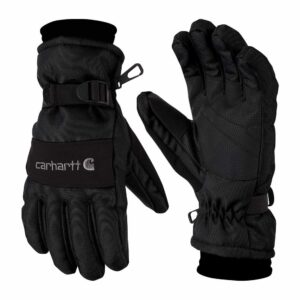
Carhartt A511 Waterproof Insulated Gloves
A simple, warm, waterproof winter glove with a grippy palm and a fleece cuff. With more than 37,000 Amazon ratings, it's the most popular winter work glove you can buy.
- Model: A511 (GL0511-M)
- Shell: Polytex
- Waterproof: Yes (waterproof insert)
- Lining: FastDry moisture-wicking
Our take
The Carhartt A511 isn't fancy, and it doesn't carry any cut or impact ratings. What it does is keep your hands warm and dry on wet winter days, which is why it has more than 37,000 Amazon ratings and is one of the most common winter gloves on job sites.
The shell is a durable polytex fabric. Inside is a waterproof insert, so slush, rain and melting snow don't soak through, plus insulation and Carhartt's FastDry lining to wick sweat away from your skin. Wet-from-the-inside is the most common reason "warm" gloves go cold by mid-morning, so the wicking lining matters as much as the insulation.
The palm has a textured grip surface, with extra grip on the fingers and thumb. A soft fleece cuff with an adjustable wrist strap seals out snow and wind. A clip keeps the pair together, and there's a soft nose wipe.
It's a good choice for snow removal, site supervision, layout, deliveries, equipment operation and any work where you're outside in wet cold but not handling sharp or heavy material all day.
Who it's not for: anyone who needs protection or precision. There's no cut, puncture or impact rating, and the bulk makes it hard to handle screws, nails or small fittings. The fabric shell won't stand up to rough masonry, rebar or demolition the way leather does. It also isn't touchscreen compatible. If you need impact protection in the cold, choose the Mechanix ColdWork M-Pact. If you need durable leather, choose the Kinco 1927KW.
For the price, though, few gloves keep your hands this warm and dry, and the huge number of owner reviews shows it holds up for most people.
Pros
- Waterproof insert keeps hands dry
- FastDry lining wicks sweat
- Fleece cuff with adjustable strap seals out snow
- Grippy palm and fingers
- More than 37,000 Amazon ratings
Cons
- No cut, puncture or impact ratings
- Too bulky for small fasteners
- Fabric shell wears faster than leather on rough work
| Brand | Carhartt |
|---|---|
| Model | A511 (GL0511-M) |
| Shell | Polytex |
| Waterproof | Yes (waterproof insert) |
| Lining | FastDry moisture-wicking |
| Cuff | Fleece with adjustable strap |
| Safety ratings | None listed |
Why we picked it: Wet cold is harder on hands than dry cold. The Carhartt A511 has a waterproof insert, insulation and a FastDry lining that wicks sweat, and it’s the most-reviewed winter work glove on Amazon by a wide margin, with more than 37,000 ratings.
Who it’s for: snow and slush days, site supervision, layout, deliveries, flagging and equipment operation, where you need warm, dry hands more than protection from sharp material.
Watch out for: it has no cut, puncture or impact ratings, and it’s too bulky for fine work. The fabric shell also wears faster than leather on block and rebar. Pair it with a rated glove for hands-on tasks.
7. Best leather work gloves: Wells Lamont HydraHyde
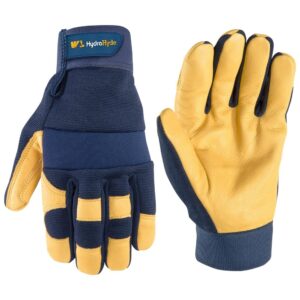
Wells Lamont HydraHyde Leather Hybrid Work Gloves
A cowhide palm treated to resist water and stay soft, with a stretchy spandex back for dexterity. An affordable all-round leather glove for framing, demo and material handling.
- Model: 3207
- Palm: HydraHyde water-resistant cowhide
- Back: Spandex
- Knuckles: Lightly padded neoprene
Our take
Leather is still the default for rough work: lumber, block, rebar, demolition debris and anything with splinters. Its weakness is water. Ordinary leather gloves soak up rain and sweat, then dry hard and cracked. Wells Lamont's HydraHyde leather is tanned to be water resistant and breathable, so it stays soft over the life of the glove. That's the main reason to choose this one.
This version (Wells Lamont style 3207) is a hybrid. The palm and fingertips are HydraHyde cowhide, reinforced at the fingertips, and the back is a form-fitting spandex for flexibility. Lightly padded neoprene knuckles give a little protection from bumps and scrapes. A Comfort Closure adjustable hook-and-loop wrist keeps the fit snug.
The result is a leather glove that moves more like a mechanic's glove. It's a good all-rounder for framing, form work, hauling and general labor, and with more than 3,300 Amazon ratings, it's a proven choice for around $16.
Wells Lamont doesn't publish ANSI or EN 388 ratings for this glove, so treat it as a general-purpose leather glove, not rated protection. The neoprene knuckle padding is for comfort, not certified impact protection.
Who it's not for: anyone who needs cut or impact ratings, warmth or full waterproofing. Water resistant leather sheds rain and sweat, but the spandex back will still get wet. If you work around welding, use a proper welding glove; a spandex back is not flame resistant. If you need a full leather glove for heavy material handling, Wells Lamont sells HydraHyde in full-leather styles too.
Pros
- HydraHyde leather resists water and stays soft
- Flexible spandex back for dexterity
- Padded neoprene knuckles
- Reinforced leather fingertips
- Low price for a leather glove
Cons
- No published ANSI or EN 388 ratings
- Spandex back isn't water resistant or flame resistant
- Not insulated
| Brand | Wells Lamont |
|---|---|
| Model | 3207 |
| Palm | HydraHyde water-resistant cowhide |
| Back | Spandex |
| Knuckles | Lightly padded neoprene |
| Closure | Adjustable hook and loop |
| Safety ratings | None published |
Why we picked it: Leather is still the best material for splinters, rough lumber, block and demolition debris. Wells Lamont’s HydraHyde leather is tanned to resist water and stay soft, so it doesn’t dry stiff after a wet day. This hybrid version adds a spandex back for dexterity and padded neoprene knuckles, for around $16.
Who it’s for: framers, demo crews, laborers and anyone who wants an affordable everyday leather glove that moves more like a mechanic’s glove.
Watch out for: Wells Lamont doesn’t publish ANSI or EN 388 ratings for it, so don’t count on cut or impact protection. The spandex back isn’t water resistant or flame resistant. Use a proper welding glove around hot work.
8. Best for dexterity: Mechanix Wear The Original
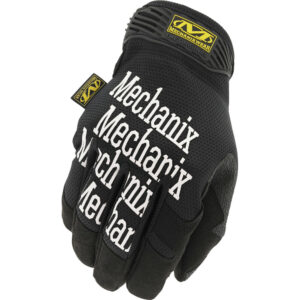
Mechanix Wear The Original Work Gloves
The thin synthetic leather glove that started Mechanix. Best for finish work, electrical trim, layout and any job where you need fingertip feel and a touchscreen.
- Model: MG-05
- Palm: 0.8 mm synthetic leather
- Back: CoolPlus woven mesh
- EN 388: 2121X
Our take
Mechanix built its name on this glove more than 30 years ago, and with more than 14,000 Amazon ratings on the black version alone, it's still one of the best-selling work gloves around. It's the glove for jobs where you need to feel what you're doing.
The palm is 0.8 mm touchscreen-capable synthetic leather, the same thickness as the M-Pact's, but without the armor and thick padding. That makes it noticeably more flexible. You can thread a nut, strip wire, pick up a single screw, run a tape and work a phone or laser level without taking it off.
The latest version has a CoolPlus woven-mesh back that cuts heat buildup, and a single-panel back that reduces seams and snags. The Freedom-Flex cuff stops material from bunching on the back of your hand. A welded Lock Ring panel reinforces the thumb saddle, welded finger coverings add abrasion resistance, and vented padding at the heel of the palm takes the edge off light strikes and vibration. It's machine washable.
Mechanix rates it EN 388 2121X and ANSI/ISEA 105 abrasion level 3. In other words, it's a dexterity glove, not a protective one.
Who it's not for: anyone handling sharp metal, glass or heavy, rough material all day. There's almost no cut protection, no impact armor, and synthetic leather won't last as long as real leather on block, concrete or rebar. It's also not warm. If you like the fit but want knuckle protection, step up to the M-Pact.
For electricians, finish carpenters, low-voltage techs, superintendents and anyone who keeps pulling their gloves off to do fiddly work, this is the one to try first.
Pros
- Excellent fingertip feel and flexibility
- Touchscreen-capable 0.8 mm synthetic leather palm
- Breathable CoolPlus mesh back
- Reinforced thumb saddle and fingertips
- Machine washable
Cons
- Minimal cut protection (EN 388 cut level 1)
- No impact armor
- Not as durable as leather on rough material
| Brand | Mechanix Wear |
|---|---|
| Model | MG-05 |
| Palm | 0.8 mm synthetic leather |
| Back | CoolPlus woven mesh |
| EN 388 | 2121X |
| ANSI/ISEA 105 abrasion | Level 3 |
| Touchscreen | Yes |
| Washable | Yes |
Why we picked it: Sometimes the most important feature is being able to feel what you’re doing. The Original has the same thin 0.8 mm touchscreen-capable palm as the M-Pact, without the armor and padding, so it’s noticeably more flexible. It has more than 14,000 Amazon ratings on the black version alone and has been a trade staple for over 30 years.
Who it’s for: electricians on trim-out, finish carpenters, low-voltage and controls techs, surveyors and superintendents who keep pulling their gloves off for fiddly work.
Watch out for: it’s a dexterity glove, not a protective one. EN 388 cut level 1 and no armor mean it’s the wrong glove for sharp metal or heavy material. If you want the same fit with knuckle protection, buy the M-Pact.
Also worth considering
- Showa Temres 282. A fully coated, waterproof and insulated glove that Showa markets as breathable. It’s a good fit for wet, cold work like concrete and utility jobs, where a fabric glove would soak through. Check price on Amazon.
- Showa Atlas 300. The crinkle-finish natural rubber latex glove on a cotton-poly knit that masons and landscapers often buy in 12-pair packs. Great grip on block and stone. Skip it if you have a latex allergy. Check price on Amazon.
- Mechanix Wear Hi-Viz M-Pact D5. A fluorescent yellow M-Pact with an ANSI A5 cut liner and ANSI/ISEA 138 Level 2 impact rating, according to Mechanix. A good choice for riggers and signal workers who need their hands seen. Check price on Amazon.
- Heated gloves. Battery-heated gloves from tool brands and outdoor brands can keep fingers working on long, very cold days. They’re bulky, expensive and need charging, so most people keep them for sub-zero work rather than every day.
How we chose
To find the best work gloves for construction, we compared specs and owner feedback rather than lab-testing or field-testing the gloves ourselves. We started with the gloves tradespeople recommend most in forums and on job sites, plus the best-selling and most-reviewed construction work gloves on Amazon. Then we compared them on what matters on a construction site:
- Certified protection: published ANSI/ISEA 105 cut, abrasion and puncture levels, ANSI/ISEA 138 impact levels, and EN 388 and EN 511 ratings, taken from each manufacturer’s product page or spec sheet.
- Dexterity and fit: palm thickness, liner and coating type, closure and size range.
- Conditions: insulation, waterproofing and breathability for winter and wet work.
- Owner feedback: rating averages and recurring complaints across thousands of Amazon reviews, especially about durability, sizing and warmth.
- Value: price per pair, and whether a glove is worth buying in bulk.
Where we quote a rating, it’s the manufacturer’s figure at the time of writing. Glove makers update models and re-test gloves, so always check the rating printed on the glove or its tag before relying on it.
How to choose construction work gloves
1. Start with the hazard, not the glove
There’s no single best work glove for every job, which is why many tradespeople carry two or three pairs. Before you buy, think about what’s most likely to hurt your hands on a normal day:
- Sharp edges (sheet metal, ductwork, metal studs, glass, rebar ties): choose a cut-rated glove, usually ANSI A4 or higher.
- Impact and pinch points (hammering, rigging, demo, moving steel or forms): choose TPR back-of-hand armor, ideally ANSI/ISEA 138 rated.
- Abrasion and splinters (lumber, block, stone, concrete forms): choose leather or a heavy coated glove with a high abrasion rating.
- Cold and wet (winter work, concrete, slush): choose insulation and, for wet work, a waterproof insert or full coating.
- Fine work (fasteners, wiring, layout, phones): choose a thin palm and a touchscreen-capable coating.
Employers are responsible for choosing hand protection based on the hazards of the task, under OSHA’s hand protection standard (29 CFR 1910.138). If your company or general contractor sets a minimum cut level, that rule comes first.
2. Understand ANSI/ISEA 105 cut levels (A1 to A9)
In North America, cut resistance is rated under ANSI/ISEA 105. Since the 2016 update, gloves are tested on a machine (the TDM-100, using the ASTM F2992 method) that measures how much weight it takes for a straight blade to cut through the material. The result in grams sets the level:
| Level | Grams to cut | Typical construction tasks |
|---|---|---|
| A1 | 200–499 | General handling, light assembly |
| A2 | 500–999 | Material handling, light-duty work |
| A3 | 1,000–1,499 | Rough lumber, light sheet goods |
| A4 | 1,500–2,199 | Drywall, electrical rough-in, light metal |
| A5 | 2,200–2,999 | Metal studs, HVAC duct, sheet metal |
| A6 | 3,000–3,999 | Heavy sheet metal, glass, rebar |
| A7 | 4,000–4,999 | Glazing, heavy metal fabrication |
| A8 | 5,000–5,999 | Very sharp, heavy material |
| A9 | 6,000+ | Extreme cut hazards, blade handling |
Task suggestions are general guidance; your company’s hazard assessment decides the level you need. A few things to keep in mind:
- Higher cut levels usually mean thicker, stiffer and warmer gloves. Don’t buy A9 if A4 covers your work.
- Check where the cut protection is. Many gloves only protect the palm; a “360” liner also protects the back of the hand.
- Cut resistance isn’t puncture resistance. A glove that resists a slicing edge may not stop a nail, wire or needle. Check the separate ANSI puncture level (0 to 5).
- Old ratings (the 2005 levels 1 to 5) are not the same as today’s A-levels. Look for the A.
3. Read the EN 388 shield
Many gloves sold in the US also carry the European EN 388 rating, shown as a shield with up to six characters, for example 3X43FP. In order, they mean:
- Abrasion resistance, 0 to 4.
- Cut resistance by coup test, 0 to 5. An X means not tested, common for high-cut gloves that dull the test blade.
- Tear resistance, 0 to 4.
- Puncture resistance, 0 to 4.
- Cut resistance by TDM test (ISO 13997), A to F. This is similar in method to the ANSI test; F is the highest.
- Impact protection. A P means the glove passed the knuckle impact test. No letter means it wasn’t tested or didn’t pass.
So the Ironclad’s 3X43FP means good abrasion, top tear and good puncture resistance, the highest TDM cut letter, and a pass on impact. Winter gloves may also carry EN 511, which rates cold protection with three digits: convective cold, contact cold and water penetration.
4. Know what ANSI/ISEA 138 impact levels mean
ANSI/ISEA 138 is the North American standard for back-of-hand impact protection. Labs strike the knuckles and fingers and measure how much force gets through. Less force transmitted means a higher level:
- Level 1: the lowest level of protection.
- Level 2: transmits less force; a good target for most construction, rigging and demo work.
- Level 3: the highest level, for heavy impact hazards like oil and gas, mining and heavy steel.
Many gloves have rubber armor on the back but aren’t tested to ANSI 138. Armor still helps, but if your site requires impact-rated gloves, look for the ANSI 138 level on the tag or spec sheet. Two of our picks are rated Level 2: the Ironclad Command Impact Cut A6 and the Mechanix ColdWork M-Pact.
5. Choose the right material
- Cowhide leather: tough and abrasion resistant, the classic choice for framing, demo and material handling. Grain leather (the smooth outer layer) is more supple; split leather is rougher and cheaper.
- Pigskin: breathes well and stays soft after getting wet, which makes it popular for winter gloves.
- Goatskin: thin, soft and strong, used for higher-dexterity leather gloves.
- Synthetic leather: thin, consistent and washable. Great for dexterity, but it wears faster than real leather on rough material.
- Nitrile coatings: good abrasion resistance and grip on oily surfaces. Foam nitrile grips better on wet and oily parts; sandy nitrile is more textured.
- Latex coatings: excellent grip on dry, rough surfaces like block and stone, but not for people with latex allergies.
- Polyurethane (PU) coatings: very thin and flexible, best for fine, dry work.
6. Winter gloves: insulation, waterproofing and layers
For the best winter work gloves, look at three things. First, insulation weight: 40 to 100 grams of synthetic insulation suits active work around freezing, while heavier insulation is for standing still or deep cold. Second, waterproofing: a waterproof insert or full coating matters more than insulation if you work in slush, rain or wet concrete. Third, dexterity: the warmest glove is useless if you keep taking it off to do your job.
Many tradespeople use a two-glove system: a thin insulated or dipped glove for tool work, and a warm outer glove or mitt for breaks and standing around. Keep a dry spare pair in the truck. Wet gloves lose most of their warmth, and drying them overnight on a boot dryer or near (not on) a heater makes the next morning a lot easier.
7. Get the size right
A glove that’s too big snags, slips and reduces grip. One that’s too tight cuts off circulation and wears out faster. To find your size, measure around your dominant hand at the widest part of the palm, just below the knuckles, not including the thumb. Then measure from the tip of your middle finger to the base of your palm. Compare both to the maker’s size chart, because sizes vary between brands. Mechanix gloves, for example, tend to run snug.
Insulated gloves need a little room at the fingertips. If you plan to wear a liner underneath, size up.
8. Care and replacement
- Wash synthetic gloves like the Mechanix models on a gentle cycle and let them air dry. High heat breaks down coatings and glue.
- Let leather dry slowly at room temperature, then work it with your hands or a leather conditioner so it stays supple.
- Replace gloves when they have holes, worn-through coatings, torn seams, cracked leather or damaged armor. A cut-resistant glove with a hole in it is no longer cut resistant.
- Keep spares, especially in winter, and rotate pairs so each one dries out fully.
Construction work gloves FAQ
What gloves are best for construction?
For general construction, a mechanic-style glove with knuckle armor and a padded palm, like the Mechanix M-Pact, covers most tasks. Add a cut-rated glove (ANSI A4 or higher) for sheet metal and glass, a leather glove for lumber and demo, and an insulated glove for winter. Most tradespeople keep at least two types on hand.
What type of gloves are good for electrical work?
Regular work gloves, including leather and cut-resistant gloves, do not protect you from electric shock. Work on or near energized conductors requires rubber insulating gloves rated to ASTM D120 (Classes 00 through 4, chosen by voltage) worn with leather protectors, and they must be inspected and tested regularly. For de-energized rough-in and trim work, a thin dexterity glove like the Mechanix Original or a cut-resistant glove works well.
What is the highest cut-resistant glove level?
Under ANSI/ISEA 105, A9 is the highest cut level. It means the material withstood at least 6,000 grams of force in the TDM cut test. In Europe’s EN 388, the highest TDM rating is F. Gloves at these levels are usually thicker and less flexible.
Do cut-resistant gloves work?
Yes, against slicing cuts from sharp edges, which cause most hand lacerations on job sites. But cut-resistant isn’t cut-proof. They won’t stop a saw blade, grinder or other powered cutting tool, and most give limited protection from punctures.
When should you not use nitrile gloves?
Thin nitrile-coated gloves aren’t made for sharp metal, heat, welding or heavy impact. Nitrile also holds up poorly against some solvents, such as acetone. And no glove should be worn near rotating equipment, like a drill press or lathe, where it can catch and pull your hand in.
What are the best winter work gloves for construction?
For cold, dry work with lumber and tools, the Kinco 1927KW is warm, tough and inexpensive. If you need impact protection in the cold, the Mechanix ColdWork M-Pact is rated ANSI/ISEA 138 Level 2. For slush, rain and wet snow, choose a glove with a waterproof insert, like the Carhartt A511.
Who makes the best quality work gloves?
Mechanix Wear, Ironclad, Kinco, Wells Lamont, Carhartt, HexArmor, Ansell and Showa all make well-regarded work gloves. The best brand matters less than choosing the right glove for the hazard and checking its published ratings.
How often should you replace work gloves?
It depends on the work. Thin dipped gloves may last a week or two of heavy use. Good leather or armored gloves can last months. Replace any glove with holes, torn seams, worn-through coating or damaged armor, since it no longer protects you as rated.
The bottom line
If you buy one pair of construction work gloves, make it the Mechanix Wear M-Pact: real knuckle and palm protection with enough dexterity for everyday tool work. Working with sharp metal? Get the Ironclad Command Impact Cut A6. For winter, the Kinco 1927KW is the best value, and the ColdWork M-Pact adds certified impact protection. And keep a DEX FIT multi-pack in the truck for everything else.
Browse all our hand protection picks, and round out your kit with our guides to the best hard hats for construction, the best safety glasses for construction, the best work boots and the best insoles for work boots.
Wear one of these gloves? Rate it on its product page or tell us what you think in the comments.
Ask AI about this page: ChatGPT, Claude or PerplexityCopy as Markdown