

We may earn a commission when you buy through links on this page, as an Amazon Associate. Learn more.
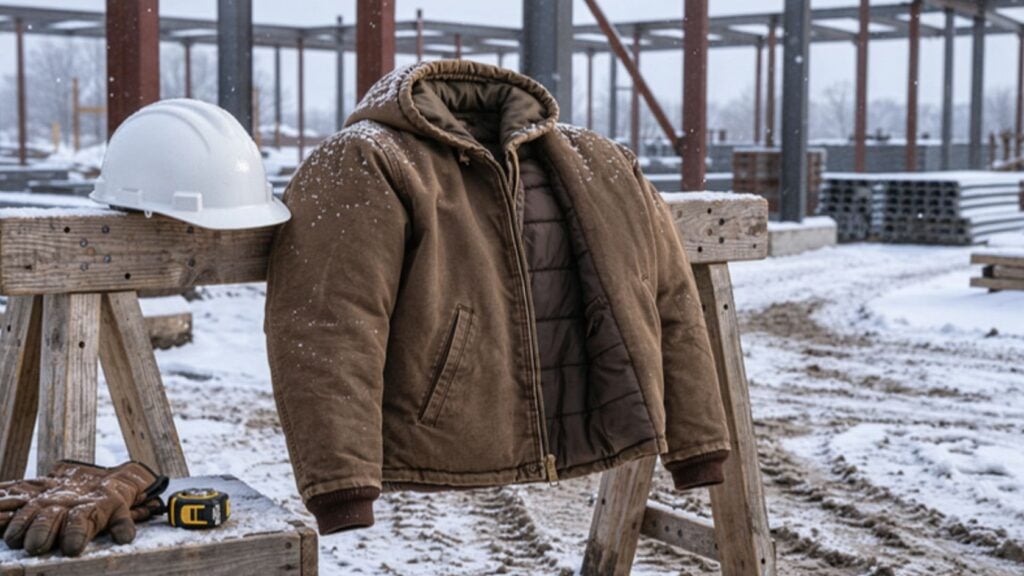
The best winter work jacket keeps you warm without stopping you from working. It has to block wind on an open deck, survive rebar and block, leave room to swing a hammer, and fit under a harness or over a hoodie. And it should match the job: a flagger standing at a lane closure needs a very different jacket from a framer who’s moving all day.
For most tradespeople, our pick is the Carhartt Washed Duck Insulated Active Jac, the updated version of the famous J130. It’s warm, tough, fairly priced and has more owner reviews than almost any work jacket. If you work in real deep cold, step up to the Carhartt Yukon Extremes Active Jac. If you work in rain and sleet, get a truly waterproof jacket like the Helly Hansen Kensington. And if you work near traffic or around arc flash, your jacket has to be hi-vis or flame resistant.
All eight picks here are insulated, not heated. If you’d rather have battery-powered heat, see our guide to the best heated jackets for work. Below the picks, we compare Carhartt’s winter jackets by model number and explain warmth ratings, insulation, waterproofing, hoods under hard hats, layering, hi-vis and FR.
Quick picks
- Best overall: Carhartt Washed Duck Insulated Active Jac (104050). The updated J130: 12 oz washed duck, 80g Thinsulate, Level 3 warmth.
- Best for extreme cold: Carhartt Yukon Extremes Insulated Active Jac (104458). Carhartt’s warmest rating, with a 500-denier Cordura shell.
- Best waterproof: Helly Hansen Kensington Winter Jacket (71345). A waterproof membrane, taped seams and EN 343 Class 4 certification.
- Best budget: Berne Heritage Duck Hooded Active Work Jacket (HJ51). The classic hooded duck jacket for about $85.
- Best hi-vis winter jacket: Ergodyne GloWear 8384. ANSI/ISEA 107 Type R Class 3 with 160g insulation and fleece.
- Best FR insulated jacket: Carhartt FR Duck Traditional Coat (101618). NFPA 2112 and NFPA 70E, labeled CAT 4.
- Best parka for standing work: RefrigiWear Iron-Tuff Ice Parka. Thigh length with a -50°F comfort rating.
- Best lightweight layer for active work: Carhartt Gilliam Jacket (102208). Light, windproof and easy to layer.
Compare the best winter work jackets
| Pick | Jacket | Shell / insulation | Weather protection |
|---|---|---|---|
| Best overall | Carhartt Washed Duck Insulated Active Jac (104050) | 12 oz duck / 80g Thinsulate | Wind-resistant |
| Best for extreme cold | Carhartt Yukon Extremes Active Jac (104458) | 500D Cordura / 150g Thinsulate | Windproof, DWR |
| Best waterproof | Helly Hansen Kensington Winter Jacket | Polyester membrane / 100 g/m² PrimaLoft blend | Waterproof, taped seams |
| Best budget | Berne Heritage Duck Hooded Active (HJ51) | Cotton duck / polyester fill | Water-repellent |
| Best hi-vis (ANSI Class 3) | Ergodyne GloWear 8384 Parka | 300D polyester / 160g + fleece | Water-resistant |
| Best FR insulated | Carhartt FR Duck Traditional Coat (101618) | 13 oz FR duck / FR modacrylic | Wind-resistant |
| Best parka for standing work | RefrigiWear Iron-Tuff Ice Parka | 400D nylon / 11.25 oz fill | Water-repellent |
| Best lightweight layer for active work | Carhartt Gilliam Jacket (102208) | Cordura nylon / 100g | Windproof, DWR |
Specs are from each manufacturer. “DWR” is a durable water-repellent finish, which sheds light rain but isn’t waterproof. Price guide: $ under $110, $$ $110–$180, $$$ over $180, based on typical listed prices.
The 8 best winter work jackets
1. Best overall: Carhartt Washed Duck Insulated Active Jac (104050)
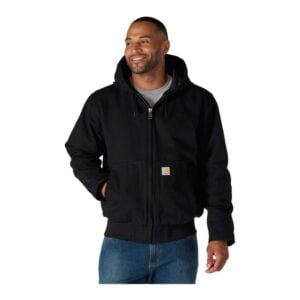
Carhartt Washed Duck Insulated Active Jac (104050, formerly J130)
The updated version of Carhartt's famous J130: a 12 oz washed duck hooded jacket with 80g 3M Thinsulate, rated Level 3 (Warmest) on Carhartt's warmth scale.
- Model: 104050 (updated J130)
- Warmth rating (manufacturer): Level 3 - Warmest
- Shell: 12 oz 100% ring-spun washed cotton duck
- Insulation: 80g 3M Thinsulate featherless insulation
Our take
If you picture a construction worker in a brown hooded canvas jacket, you're probably picturing a Carhartt Active Jac. This is the current version of the J130, the best-selling insulated model in that family. Carhartt now sells it as the Washed Duck Insulated Active Jac, model 104050, and says it was redesigned using feedback from workers who wear it on the job.
The shell is 12-ounce, 100% ring-spun cotton duck that's been washed, so it feels softer and more broken in from day one than Carhartt's firm duck. Inside, a quilted nylon lining makes it easy to slide on over a hoodie, and 80g 3M Thinsulate insulation adds warmth without much bulk. Carhartt rates it Level 3, "Warmest," which it describes as built for high warmth in severely cold conditions. Only the Yukon Extremes line sits above it.
The details are what make it a work jacket rather than a fashion piece. The main seams are triple-stitched. The sleeve hems are reinforced with Cordura, which is where duck jackets usually fray first. Internal rib-knit storm cuffs seal your wrists, elbow pleats add room to swing a hammer, and the attached hood has an inner drawcord and cord lock. You get two lined front pockets (one with a pen stall) and two inside pockets.
The fit is Carhartt's Loose Fit, with room in the chest and shoulders for layering. Many owners size down if they wear only a T-shirt underneath.
Duck canvas is water-repellent at best. In steady rain it will soak through and get heavy, so pair it with a rain shell on wet days. It's also hip-length, so it won't cover your backside like a coat or parka.
Who it's not for: anyone working in steady rain or snowmelt, crews below about 0°F for long stretches, and workers who need hi-vis or FR clothing.
Pros
- Rated Level 3 (Warmest) by Carhartt
- 12 oz washed duck that's soft from day one
- 80g 3M Thinsulate with quilted nylon lining
- Cordura-reinforced cuffs and triple-stitched seams
Cons
- Water-repellent, not waterproof
- Hip length leaves your lower back exposed when bending
- Loose fit runs large
| Brand | Carhartt |
|---|---|
| Model | 104050 (updated J130) |
| Warmth rating (manufacturer) | Level 3 - Warmest |
| Shell | 12 oz 100% ring-spun washed cotton duck |
| Insulation | 80g 3M Thinsulate featherless insulation |
| Lining | Quilted nylon |
| Hood | Attached, inner drawcord and cord lock |
| Fit | Loose fit |
| Weather protection | Wind-resistant duck; not waterproof |
| Back length | 28.5 in (Regular M), 30.5 in (Tall M) |
Why we picked it: It’s the jacket that defines the category, and the current version is better than the one most of us grew up with. Carhartt kept the 12 oz duck shell and attached hood, then added 80g 3M Thinsulate, Cordura-reinforced cuffs, elbow pleats and extra inside pockets. It earns a Level 3 (Warmest) rating, and more than 8,000 Amazon owners average 4.8 stars, which makes it Amazon’s top-ranked men’s work outerwear item at the time of writing. It’s also our pick for the best Carhartt winter jacket for most people.
Who it’s for: Framers, carpenters, laborers, plumbers, electricians on new construction, and anyone who works outside in typical northern winters. It’s warm enough for most days in the teens and 20s (°F) with a hoodie underneath, and tough enough to wear every day.
Watch-outs: Duck canvas soaks through in steady rain, so keep a shell in the truck. It’s hip-length, so your lower back can get cold when you bend over. The loose fit runs big; if you only wear a T-shirt under it, consider one size down.
2. Best for extreme cold: Carhartt Yukon Extremes Active Jac (104458)
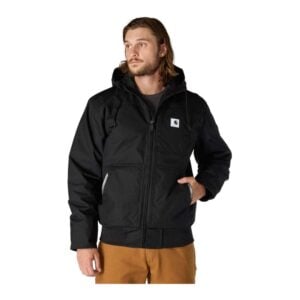
Carhartt Yukon Extremes Loose Fit Insulated Active Jac (104458)
Carhartt's warmest hooded work jacket: a 500-denier Cordura nylon shell over 150g 3M Thinsulate, rated Level 4 (Extreme Warmth), with Wind Fighter and Rain Defender.
- Model: 104458
- Warmth rating (manufacturer): Level 4 - Extreme Warmth
- Shell: 6.5 oz, 500-denier Cordura nylon
- Insulation: 150g 3M Thinsulate featherless insulation
Our take
When the Active Jac isn't warm enough, this is where Carhartt sends you. The Yukon Extremes line is the top of Carhartt's warmth scale, Level 4 "Extreme Warmth," and the Yukon Extremes Insulated Active Jac (model 104458) is the hooded jacket version.
The big change from the classic duck Active Jac is the shell. Instead of cotton canvas, it uses 6.5-ounce, 500-denier Cordura nylon. Cordura is known for abrasion resistance, and nylon doesn't soak up water the way cotton does. Carhartt adds its Wind Fighter technology to block wind and its Rain Defender durable water repellent (DWR) finish to shed light rain and snow. The seams are triple-stitched.
Inside is 150g 3M Thinsulate in the body, sleeves and the attached hood. That's nearly twice the insulation weight of the 104050, and Carhartt says it's designed to be warmer and lighter than its older heavy coats while staying flexible. Rib-knit storm cuffs and waistband keep heat in. Reflective 3M Scotchlite Carbon Black taping on the back yoke and front pockets helps you get seen in low light, though this is not a certified hi-vis garment.
Storage is good: two lower-front pockets, a zippered left-chest map pocket, and inner zip and hook-and-loop pockets. It's a loose fit with room for a hoodie underneath.
Owners give it 4.7 stars across more than 1,700 Amazon ratings, and the most common praise is warmth on open, windy sites. The trade-offs: it costs about $60 more than the duck Active Jac, the nylon shell is noisier and shinier than canvas, and DWR is not the same as waterproof. In sustained rain you still need a shell.
Who it's not for: anyone who moves hard all day in mild cold (you'll overheat), and workers who prefer the feel of cotton canvas.
Pros
- Level 4 (Extreme Warmth), Carhartt's highest rating
- 500-denier Cordura nylon shell
- 150g 3M Thinsulate in body, sleeves and hood
- Wind Fighter plus Rain Defender DWR
- Reflective taping front and back
Cons
- Expensive
- DWR is water-repellent, not waterproof
- Too warm for hard work in mild cold
| Brand | Carhartt |
|---|---|
| Model | 104458 |
| Warmth rating (manufacturer) | Level 4 - Extreme Warmth |
| Shell | 6.5 oz, 500-denier Cordura nylon |
| Insulation | 150g 3M Thinsulate featherless insulation |
| Weather protection | Wind Fighter, Rain Defender DWR (water-repellent) |
| Hood | Attached, insulated, drawcord |
| Reflective | 3M Scotchlite Carbon Black taping (not ANSI-certified) |
| Fit | Loose fit |
| Back length | 28.25 in (Regular L) |
Why we picked it: The Yukon Extremes is Carhartt’s top-rated line (Level 4, Extreme Warmth), and this hooded Active Jac version keeps the familiar shape while swapping duck for 500-denier Cordura nylon and nearly doubling the insulation to 150g 3M Thinsulate. Wind Fighter and Rain Defender DWR help it hold up on open, exposed sites, and it has reflective taping front and back.
Who it’s for: Ironworkers, roofers, utility and pipeline crews, and anyone working on exposed decks, bridges or open ground through the coldest part of the winter. It’s the jacket for days when the duck Active Jac leaves you shivering.
Watch-outs: At around $190 it costs about $60 more than the duck version. It’s too warm for hard physical work above freezing. The reflective trim is not ANSI-certified hi-vis, and DWR still isn’t waterproof.
3. Best waterproof: Helly Hansen Kensington Winter Jacket
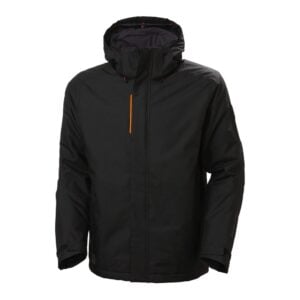
Helly Hansen Workwear Kensington Winter Insulated Jacket (71345)
A truly waterproof insulated work jacket: Helly Tech Professional membrane, fully taped seams, LifaLoft and PrimaLoft insulation, and EN 343 Class 4 waterproof certification.
- Model: Kensington Winter Insulated Jacket 71345
- Shell: 100% polyester, 215 g/m², Helly Tech Professional membrane
- Waterproofing: Waterproof, fully taped seams; EN 343:2019 Class 4,1
- Cold protection: EN 14058:2017 Class 3
Our take
Most insulated work jackets, including every duck canvas jacket on this list, are water-repellent. The Helly Hansen Workwear Kensington Winter Jacket (style 71345) is actually waterproof, and it's certified to prove it.
The shell is 215 g/m² polyester with Helly Hansen's Helly Tech Professional membrane, which the company describes as waterproof, windproof and breathable. Every seam is taped. Helly Hansen certifies the jacket to EN 343:2019 Class 4,1, the European standard for protective clothing against rain. Class 4 is the highest waterproofing class in that standard. It's also certified to EN 14058:2017 Class 3 for protection against cool environments.
Insulation is a blend of Helly Hansen's LifaLoft, made with PrimaLoft, and PrimaLoft Black Eco, at 100 g/m². Synthetic insulation like this keeps much of its warmth when it gets damp, which is why it's used in wet-weather gear instead of down.
It's built like technical outdoor gear rather than a canvas coat. You get a detachable hood with vertical and horizontal adjustment, a padded collar, articulated sleeves, no shoulder seams (so a pack or harness strap doesn't sit on a seam), wrist gaiters and adjustable cuffs, an extended back, and zippered underarm vents to dump heat when you're working hard. YKK zippers are used throughout, and the Life Pocket is designed to slow battery drain on your phone in the cold.
It's expensive at around $285, and with about 40 Amazon ratings averaging 4.3 stars, it has a much smaller review base than the Carhartts. The polyester shell won't take abuse from rebar and block like 500-denier Cordura or heavy duck. Helly Hansen sizes it as a closer, European-style fit, so check the size chart.
Who it's not for: buyers on a budget, and workers doing heavy demolition or masonry who need maximum abrasion resistance.
Pros
- Waterproof: Helly Tech Professional membrane, fully taped seams
- Certified EN 343 Class 4,1 and EN 14058 Class 3
- Synthetic LifaLoft/PrimaLoft insulation stays warm when damp
- Underarm vents, articulated sleeves, detachable hood
- Phone-friendly Life Pocket
Cons
- Expensive
- Polyester shell is less abrasion-resistant than Cordura or duck
- Small review base; trimmer fit
| Brand | Helly Hansen Workwear |
|---|---|
| Model | Kensington Winter Insulated Jacket 71345 |
| Shell | 100% polyester, 215 g/m², Helly Tech Professional membrane |
| Waterproofing | Waterproof, fully taped seams; EN 343:2019 Class 4,1 |
| Cold protection | EN 14058:2017 Class 3 |
| Insulation | LifaLoft by PrimaLoft + PrimaLoft Black Eco, 100 g/m² |
| Hood | Detachable, adjustable |
| Venting | Zippered underarm vents |
| Zippers | YKK |
Why we picked it: It’s the only jacket here that is fully waterproof. A Helly Tech Professional membrane, taped seams and EN 343:2019 Class 4,1 certification mean it keeps out steady rain and wet snow, while synthetic LifaLoft and PrimaLoft insulation stays warm when damp. Underarm vents let you dump heat, and the detachable hood adjusts to fit.
Who it’s for: Crews in wet, cold climates like the Pacific Northwest and the Great Lakes, and anyone who spends winter days in sleet and slush rather than dry cold.
Watch-outs: It’s the most expensive pick, and it has a small review base (about 40 Amazon ratings). The polyester shell is more delicate than duck or Cordura, so it’s not the jacket for demolition or masonry. Helly Hansen uses a trimmer European fit, so check the size chart before you order.
4. Best budget: Berne Heritage Duck Hooded Active (HJ51)
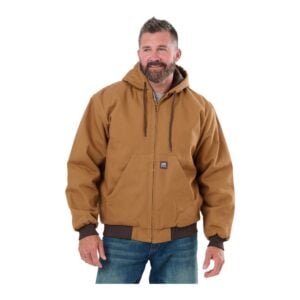
Berne Heritage Duck Hooded Active Work Jacket (HJ51)
Berne's answer to the Carhartt Active Jac for less money: a cotton duck hooded jacket with polyester insulation, a water-repellent finish, pleated elbows and an action back.
- Model: HJ51 Heritage Duck Hooded Active Work Jacket
- Shell: 100% cotton duck, water-repellent finish
- Insulation: 100% polyester fill (weight not published)
- Lining: 100% polyester
Our take
If you want the classic hooded duck work jacket but don't want to pay Carhartt prices, the Berne Heritage Duck Hooded Active Work Jacket (HJ51) is the one to look at. It usually sells for around $85, roughly $45 less than our top pick, and it has one of the largest owner review bases in this category: more than 5,500 Amazon ratings averaging 4.7 stars.
Berne has been family owned since 1915, when it started making overalls in Berne, Indiana, and the HJ51 is a straight-up working jacket. The shell is 100% cotton duck with a water-repellent finish. The lining and fill are polyester. The three-piece hood is insulated and has a drawstring, and knit storm cuffs and a knit waistband keep the cold from coming up your back and down your sleeves.
For movement, Berne uses pleated elbows and an action back, which adds fabric across the shoulders so the jacket doesn't ride up when you reach overhead. The front zipper is heavy-duty brass and the main seams are triple-needle stitched. Storage covers the basics: two front patch pockets and three inside pockets, the left one zippered.
Berne doesn't publish an insulation weight or a warmth rating for this jacket, so it's harder to compare on paper than the Carhartts. Owners generally describe it as warm enough for typical northern winter work with a hoodie underneath, but not a deep-cold jacket. Like any duck jacket, it's water-repellent rather than waterproof.
The most common complaints are about sizing consistency and the stiffness of new duck, which softens with wear and washing.
Who it's not for: anyone working in extreme cold, standing still for long periods, or in steady rain. Also skip it if you need published insulation specs for a company PPE program.
Pros
- Classic hooded duck design for much less than Carhartt
- 5,500+ owner ratings averaging 4.7 stars
- Insulated three-piece hood, knit cuffs and waistband
- Pleated elbows and action back for reach
- Heavy-duty brass zipper, triple-needle seams
Cons
- No published insulation weight or warmth rating
- Water-repellent, not waterproof
- Stiff when new; sizing can vary
| Brand | Berne |
|---|---|
| Model | HJ51 Heritage Duck Hooded Active Work Jacket |
| Shell | 100% cotton duck, water-repellent finish |
| Insulation | 100% polyester fill (weight not published) |
| Lining | 100% polyester |
| Hood | Three-piece insulated hood with drawstring |
| Mobility | Pleated elbows, action back |
| Zipper | Heavy-duty brass |
| Pockets | 2 front patch, 3 inside (1 zippered) |
Why we picked it: It gives you the same basic recipe as the Carhartt Active Jac (cotton duck shell, insulated hood, knit cuffs and waistband) for about $85. Pleated elbows and an action back add reach, and the brass zipper is heavy-duty.
Who it’s for: Apprentices, crew buys, second jackets for the truck, and anyone who wants a hooded duck jacket without paying Carhartt prices.
Watch-outs: Berne doesn’t publish the insulation weight or a warmth rating, so it’s hard to compare on paper. Owners say it’s warm enough for typical winter work with layers, but it isn’t a deep-cold jacket. New duck is stiff, and some owners report inconsistent sizing.
5. Best hi-vis (ANSI Class 3): Ergodyne GloWear 8384 Parka
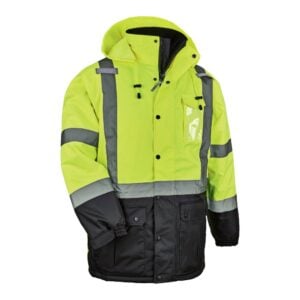
Ergodyne GloWear 8384 Type R Class 3 Hi-Vis Winter Parka
An ANSI/ISEA 107-2020 Type R Class 3 insulated parka with 160g insulation plus fleece, a PU-coated 300D shell and a -55°F temperature rating from Ergodyne.
- Model: GloWear 8384
- Hi-vis standard: ANSI/ISEA 107-2020 Type R, Class 3
- Shell: 300D oxford polyester with PU coating
- Insulation: 160g polyester fill, fleece lined
Our take
If you work near traffic or moving equipment in winter, your jacket has to be your hi-vis. Layering a vest over a bulky coat works, but vests ride up, snag and get left in the truck. The Ergodyne GloWear 8384 puts Class 3 visibility and real insulation in one garment for well under $110.
Ergodyne certifies it as Type R, Class 3 under ANSI/ISEA 107-2020, the current US high-visibility standard. Type R means it's designed for roadway and temporary traffic control work, and Class 3 is the highest level, with the most fluorescent background material and full sleeves. It uses 2-inch reflective stripes. Black panels on the bottom and cuffs hide dirt, which keeps the jacket looking compliant longer.
The shell is 300-denier oxford polyester with a PU coating that Ergodyne says resists wind and water. Inside, 160g quilted polyester insulation plus a fleece lining runs through the body and sleeves. Ergodyne publishes a CLO value of 2.68 and a temperature rating of -55°F at a moderate work level. Those are Ergodyne's own ratings, but it's one of the few brands that explains how it calculates them.
It's thigh-length, which helps when you're standing at a flagging station. There's a tuck-away hood with drawstring, an internal waist cord, hook-and-loop cuffs, a chest pocket with an ID holder, a pen pocket on the arm and two mic tabs for a radio.
Owners rate it 4.6 stars across more than 4,500 Amazon ratings. The main trade-off is durability: polyester oxford doesn't hold up to heavy abrasion like duck or Cordura. It's water-resistant, not fully waterproof.
Who it's not for: anyone who needs FR hi-vis (this jacket is not flame resistant) and workers who don't need hi-vis at all.
Pros
- ANSI/ISEA 107-2020 Type R, Class 3
- 160g insulation plus fleece lining
- Published CLO 2.68 and -55°F rating (manufacturer)
- Thigh length with black dirt-hiding panels
- Mic tabs, ID holder and pen pocket
Cons
- Water-resistant, not waterproof
- Polyester shell is less tough than duck or Cordura
- Not flame resistant
| Brand | Ergodyne |
|---|---|
| Model | GloWear 8384 |
| Hi-vis standard | ANSI/ISEA 107-2020 Type R, Class 3 |
| Shell | 300D oxford polyester with PU coating |
| Insulation | 160g polyester fill, fleece lined |
| CLO value (manufacturer) | 2.68 |
| Temperature rating (manufacturer) | -55°F at moderate work level |
| Length | Thigh length |
| Hood | Tuck-away, drawstring |
| Reflective tape | 2 in, sewn on |
Why we picked it: If you work near traffic, the jacket itself should be your hi-vis. The 8384 is certified ANSI/ISEA 107-2020 Type R, Class 3, the highest class, and it’s genuinely warm: 160g insulation plus fleece, a PU-coated 300D shell, and a published CLO value of 2.68. Ergodyne rates it to -55°F at a moderate work level. At well under $110, with more than 4,500 Amazon ratings averaging 4.6 stars, it’s also one of the best values on this list.
Who it’s for: Flaggers, road and bridge crews, utility workers, surveyors, site logistics, and anyone working around moving equipment in winter.
Watch-outs: It’s water-resistant, not waterproof, and polyester oxford won’t take as much abuse as duck. It isn’t flame resistant. For more hi-vis options, see our best safety vests guide.
6. Best FR insulated: Carhartt FR Duck Traditional Coat (101618)
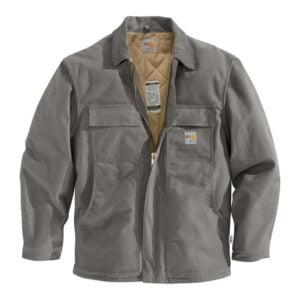
Carhartt FR Duck Traditional Insulated Coat (101618)
A flame-resistant 13 oz cotton duck coat with FR quilted lining and modacrylic insulation, UL classified to NFPA 2112 and labeled Arc Rating CAT 4 under NFPA 70E.
- Model: 101618 (0C0003-FR)
- FR standards: UL classified to NFPA 2112; meets NFPA 70E
- Arc rating category: CAT 4 (label on chest pocket)
- Warmth rating (manufacturer): Level 3 - Warmest
Our take
Electricians, welders, pipefitters and oil and gas crews can't just throw a regular duck jacket over their FR clothing. A standard cotton or nylon outer layer can ignite or melt and defeat the FR layers underneath. If your outer layer has to be FR, the Carhartt FR Duck Traditional Coat (model 101618) is one of the warmest options from a major workwear brand.
The shell is heavyweight 13-ounce, 100% cotton FR duck. Inside is an 11.5-ounce FR quilted twill lining with 100% flame-resistant modacrylic insulation. Carhartt rates it Level 3, "Warmest." The coat is UL classified to NFPA 2112 (flash fire protection) and meets the performance requirements of NFPA 70E (electrical arc flash). Carhartt sews an NFPA 2112 and CAT 4 label on the left-chest pocket. Under NFPA 70E, Arc Rating PPE Category 4 means an arc rating of at least 40 cal/cm².
Every detail is built around arc flash. The two-way brass zipper uses Nomex FR zipper tape, and inner and outer storm flaps close with hook-and-loop to cover the zipper. There are two chest pockets and two inner patch pockets with FR hook-and-loop closures. It has a spread collar, shoulder straps for a radio, and under-collar snaps for an optional FR hood, which is sold separately.
It's a coat, not a jacket, at 31.5 inches of back length (Large Regular), so it covers your lower back and hips. That length is great for cold and wind, but it can get in the way when you're kneeling or climbing.
It's expensive at around $260, and it has a smaller review base (about 115 Amazon ratings, 4.6 stars). FR cotton is also heavier than regular duck.
Who it's not for: anyone who doesn't need FR (you're paying a lot for protection you don't use), and workers who want an attached hood.
Pros
- UL classified to NFPA 2112; meets NFPA 70E
- CAT 4 label (arc rating of at least 40 cal/cm²)
- 13 oz FR duck with FR quilted lining and modacrylic insulation
- Nomex FR zipper tape and double storm flaps
- Rated Level 3 (Warmest) by Carhartt
Cons
- Expensive
- Hood sold separately
- Long, heavy coat can get in the way when climbing
| Brand | Carhartt |
|---|---|
| Model | 101618 (0C0003-FR) |
| FR standards | UL classified to NFPA 2112; meets NFPA 70E |
| Arc rating category | CAT 4 (label on chest pocket) |
| Warmth rating (manufacturer) | Level 3 - Warmest |
| Shell | 13 oz 100% cotton FR duck |
| Lining / insulation | 11.5 oz FR quilted twill; FR modacrylic insulation |
| Closure | Two-way brass zipper with Nomex FR tape, hook-and-loop storm flaps |
| Hood | Optional FR hood (snaps under collar) |
| Back length | 31.5 in (Large Regular) |
Why we picked it: If you need FR outerwear, the outer layer has to be FR too, and this coat checks every box: 13 oz FR cotton duck, an FR quilted lining with modacrylic insulation, UL classification to NFPA 2112, NFPA 70E compliance and a CAT 4 label. Nomex FR zipper tape and double storm flaps cover the zipper, and Carhartt still rates it Level 3 (Warmest).
Who it’s for: Electricians and linemen working near energized equipment, welders, and oil, gas and chemical plant workers whose employer requires FR outerwear.
Watch-outs: It’s expensive at about $260, the hood is sold separately, and the long coat cut can get in the way when you’re climbing or kneeling. Always check your employer’s arc-rating requirement before you buy.
7. Best parka for standing work: RefrigiWear Iron-Tuff Ice Parka
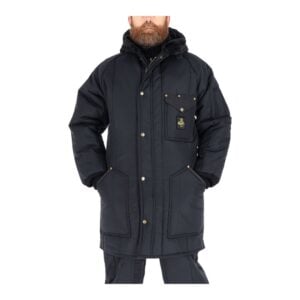
RefrigiWear Iron-Tuff Ice Parka (0360)
A thigh-length parka with 11.25 oz of RefrigiFill insulation, a 400-denier nylon shell and a sewn-on fleece-lined hood. RefrigiWear gives it a -50°F comfort rating.
- Model: Iron-Tuff Ice Parka 0360
- Comfort rating (manufacturer): -50°F
- Shell: 400-denier nylon, water-repellent, wind-tight finish
- Insulation: 11.25 oz RefrigiFill polyester
Our take
Some jobs keep you moving and some keep you standing. Equipment operators, flaggers, inspectors, surveyors, and anyone running a pump or a heater all night lose heat fast because they aren't generating much of their own. For that kind of work, a hip-length jacket isn't enough. The RefrigiWear Iron-Tuff Ice Parka (style 0360) is the warmest garment on this list.
RefrigiWear has been making cold-storage and extreme-cold workwear for decades, and it says the Iron-Tuff line has been used from the Alaska Pipeline to food distribution freezers. The Ice Parka has 11.25 ounces of RefrigiFill polyester insulation under a tear- and abrasion-resistant 400-denier nylon shell with a water-repellent, wind-tight finish. RefrigiWear gives it a comfort rating of -50°F. That's the manufacturer's own rating, and it assumes you're dressed properly underneath.
It's the only Iron-Tuff coat with a sewn-on hood, and the hood is fleece-lined with a knit wind seal around the face. The body is thigh-length, with raglan sleeves, an elastic back band to seal out drafts, brass rivets at stress points and a heavy-duty brass zipper with a storm flap. Pockets include two oversized insulated front pockets, a chest pocket and a two-stall pencil pocket on the sleeve.
The downsides are bulk and mobility. A parka this warm is not something you want to frame a wall in or climb a ladder in all day. The sewn-on hood won't fit over a hard hat. Wear the hard hat over it, or use a liner. Owners rate it 4.4 stars across about 230 Amazon ratings, and some mention it runs large.
Who it's not for: active trades who move all day, and anyone who has to wear a fall-protection harness (the length and bulk get in the way).
Pros
- Warmest pick here: -50°F comfort rating (manufacturer)
- 11.25 oz RefrigiFill insulation
- 400-denier nylon shell, wind-tight and water-repellent
- Thigh length with sewn-on fleece-lined hood
- Oversized insulated pockets
Cons
- Bulky; limits mobility for active work
- Hood won't fit over a hard hat
- Water-repellent, not waterproof
| Brand | RefrigiWear |
|---|---|
| Model | Iron-Tuff Ice Parka 0360 |
| Comfort rating (manufacturer) | -50°F |
| Shell | 400-denier nylon, water-repellent, wind-tight finish |
| Insulation | 11.25 oz RefrigiFill polyester |
| Hood | Sewn-on, fleece-lined, knit wind seal |
| Length | Thigh length |
| Closure | Heavy-duty brass zipper with storm flap |
| Pockets | 2 oversized insulated front, chest, 2-stall pencil pocket |
Why we picked it: This is the warmest garment here. It has 11.25 oz of RefrigiFill insulation, a 400-denier nylon shell and a sewn-on, fleece-lined hood, and it’s thigh-length to cover your hips and the top of your legs. RefrigiWear gives it a -50°F comfort rating and has been building cold-storage and extreme-cold gear for decades.
Who it’s for: Equipment operators, crane and loader operators who step out of the cab, flaggers in brutal cold, inspectors, surveyors, security and fire watch, and anyone doing low-activity work for long shifts in sub-zero weather.
Watch-outs: It’s bulky. You won’t want to frame or climb in it, and the length interferes with a fall-protection harness. The hood doesn’t fit over a hard hat. And it isn’t hi-vis, so it’s not the answer for roadway work.
8. Best lightweight layer for active work: Carhartt Gilliam Jacket (102208)
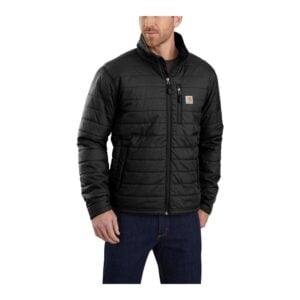
Carhartt Gilliam Insulated Jacket (102208)
A light, packable puffer-style work jacket with a Cordura nylon shell, 100g insulation, Rain Defender DWR and Wind Fighter. Carhartt rates it Level 2 (Warmer).
- Model: 102208
- Warmth rating (manufacturer): Level 2 - Warmer
- Shell: 1.75 oz 100% nylon Cordura
- Insulation: 100g polyester, quilted
Our take
Heavy duck jackets are great until you start sweating. If you're framing, roofing, hanging steel or doing anything that keeps you moving, a lighter insulated jacket is often warmer in practice because you stay dry. The Carhartt Gilliam Jacket (model 102208) is the layer we'd pick for active work in the cold.
It's a quilted, puffer-style jacket with a 1.75-ounce, 100% nylon Cordura shell, which is much lighter than duck but still tougher than a typical outdoor puffer. The insulation is 100 grams of polyester, quilted to both the shell and the nylon lining. Carhartt rates it Level 2, "Warmer," for midrange warmth in moderately cold conditions.
Carhartt's Wind Fighter technology blocks the wind, and the durable water repellent finish makes rain and snow bead up and roll off. It has a mock-neck collar with no hood, which means nothing bunches up under a hard hat or a hood from another layer. Other details: a left-chest map pocket, two lower-front pockets with hidden snaps, two inside pockets (one zippered), adjustable hook-and-loop cuffs, a drawcord hem and a drop tail to cover your lower back when you bend.
This is a layering piece. On a 35°F day it can be your outer jacket over a hoodie. On a colder day, wear it under a waterproof shell or a larger jacket. It also works as a warmer liner under a Class 3 rain jacket. Owners give it 4.7 stars across more than 3,600 Amazon ratings.
The trade-off is toughness and warmth. A 1.75 oz nylon shell won't survive the abuse duck or 500D Cordura will, and it isn't warm enough by itself for deep cold. If you want a hood, Carhartt's Gilliam Active Jac adds one with 120g insulation.
Who it's not for: anyone standing still in sub-freezing temperatures, and demolition or masonry crews who need a heavy shell.
Pros
- Light and easy to move in
- 100g insulation with Cordura nylon shell
- Wind Fighter and Rain Defender DWR
- No hood to fight with under a hard hat
- 3,600+ owner ratings averaging 4.7 stars
Cons
- Level 2 warmth: not for deep cold on its own
- Thin shell is less abrasion-resistant
- No hood
| Brand | Carhartt |
|---|---|
| Model | 102208 |
| Warmth rating (manufacturer) | Level 2 - Warmer |
| Shell | 1.75 oz 100% nylon Cordura |
| Insulation | 100g polyester, quilted |
| Weather protection | Wind Fighter, DWR (water-repellent) |
| Collar | Mock neck, no hood |
| Fit | Relaxed fit |
| Back length | 29 in (Regular M), 31 in (Tall M) |
Why we picked it: Heavy insulation makes you sweat, and sweat makes you cold. The Gilliam is a light quilted jacket with a 1.75 oz Cordura nylon shell, 100g insulation, Wind Fighter and DWR. It moves well, packs easily and works on its own on milder days or as a midlayer under a shell on cold ones.
Who it’s for: Framers, roofers, ironworkers, carpenters and anyone climbing ladders, working at height or doing hard physical work in temperatures from the 20s to the 40s (°F). It also fits under a harness and a hi-vis vest better than a bulky duck jacket.
Watch-outs: Carhartt rates it Level 2 (Warmer), so it’s not enough for deep cold on its own. The thin shell can tear on sharp edges. There’s no hood; the Gilliam Active Jac (106543) adds one, with 120g insulation and a Level 3 rating.
Which Carhartt winter jacket should you buy?
Carhartt is the default winter jacket on most US job sites, and its lineup is confusing. Model names change, and older numbers like J130, J140 and C003 still get searched more than the new ones. The easiest way to compare is Carhartt’s own warmth rating, which runs from Level 1 (Warm) to Level 4 (Extreme Warmth). Here are the main insulated men’s jackets and coats, with the warmth level and specs Carhartt publishes for each.
| Model | Warmth | Shell / insulation | Best for |
|---|---|---|---|
| Washed Duck Insulated Active Jac (104050, formerly J130) | Level 3 | 12 oz washed duck / 80g Thinsulate, quilted nylon lining | All-round hooded work jacket |
| Iconic J140 Firm Duck Active Jac (106673) | Level 3 | 12 oz firm duck / quilted flannel body, quilted nylon sleeves | Classic flannel-lined feel |
| Firm Duck Insulated Traditional Coat (106674, formerly C003) | Level 3 | 12 oz firm duck / Arctic-weight polyester | Collared coat with more length |
| Washed Duck Bartlett Jacket (103826) | Level 2 | 12 oz washed duck / sherpa body, quilted nylon sleeves | Sherpa-lined comfort in moderate cold |
| Yukon Extremes Insulated Active Jac (104458) | Level 4 | 500D Cordura nylon / 150g Thinsulate | Hooded jacket for extreme cold |
| Yukon Extremes Traditional Coat (104460) | Level 4 | 500D Cordura nylon / 150g Thinsulate, Full Swing | Longest, warmest Carhartt work coat |
| Livingston Jacket (107082) | Level 4 | 4.5 oz nylon / synthetic down, sherpa upper-body lining | Puffer-style warmth with a hood |
| Gilliam Jacket (102208) | Level 2 | 1.75 oz Cordura nylon / 100g | Light layer for active work |
J130 vs. J140: both are Level 3 hooded Active Jacs. The J130 (now the 104050) uses softer washed duck and Thinsulate insulation. The J140 (now 106673) uses stiffer firm duck that takes longer to break in, with a quilted flannel lining in the body and hood. Choose the J130 if you want it comfortable from day one; choose the J140 if you like the flannel lining and want a jacket that breaks in to you.
Sherpa-lined vs. insulated: the Bartlett is one of Carhartt’s most popular jackets (more than 13,000 Amazon ratings), but Carhartt rates it only Level 2. Sherpa feels warm and cozy, but it’s bulkier for the warmth it gives than Thinsulate or quilted synthetic fill. It’s great for moderate cold and errands. For a long day on a cold deck, the 104050 or a Yukon Extremes will keep you warmer.
Also worth considering
- Carhartt HV Sherwood Class 3 Jacket (106694). A hi-vis jacket that is also waterproof, with a waterproof membrane, fully taped seams, ANSI Class 3 certification and a Level 4 warmth rating. It costs about twice as much as the Ergodyne 8384 and has far fewer reviews (about 150 on Amazon, 4.6 stars), but it’s the one to get if you flag in the rain. Check price on Amazon.
- Carhartt Shoreline Jacket (104670). Not insulated, but a good waterproof storm shell to wear over a Gilliam or a hoodie. Storm Defender membrane, fully taped seams and a 10K/10K waterproof breathability rating. Check price on Amazon.
- Carhartt Washed Duck Bartlett Jacket (103826). The sherpa-lined pick for moderate cold, with a pleated bi-swing back, an adjustable hood and a droptail hem. Level 2 warmth. Check price on Amazon.
How we chose
We started with the jackets tradespeople actually wear on US job sites: Carhartt, Berne, Dickies, Helly Hansen Workwear, Ergodyne, RefrigiWear, Wrangler RIGGS, Duluth Trading, TRUEWERK and Milwaukee’s non-heated workwear. We read what top-ranking guides, trade forums and Reddit threads recommend, then narrowed the list on what matters at work:
- Published warmth: insulation type and weight, and any warmth rating, CLO value or temperature rating the manufacturer publishes.
- Shell toughness: duck weight in ounces or nylon denier, reinforcements and seam construction.
- Weather protection: whether a jacket is truly waterproof (membrane, taped seams, a certification) or only water-repellent.
- Mobility and fit: pleated or stretch backs, gussets, length and room for layers.
- Safety standards: ANSI/ISEA 107 for hi-vis, NFPA 2112 and NFPA 70E for FR.
- Owner feedback: thousands of Amazon and retailer reviews, read for patterns on warmth, sizing and durability.
- Availability: each pick had to be in stock on Amazon from the brand’s own store at the time of writing.
We did not lab test or field test these jackets ourselves. Specs, warmth levels and temperature ratings come from each manufacturer, and we say so when a number is a manufacturer claim. Helly Hansen’s website blocked our requests, so we confirmed the Kensington’s specs from Helly Hansen’s product copy as published by its Amazon store and authorized dealers. Ratings and review counts come from Amazon at the time of writing. Some brands didn’t make the list for practical reasons: Duluth Trading sells its Fire Hose jackets only through its own stores, and we couldn’t verify current specs for TRUEWERK or Wrangler RIGGS jackets from the manufacturers.
How to choose a winter work jacket
1. Match warmth to your activity, not just the thermometer
The same jacket can be too hot for a framer and too cold for an equipment operator on the same morning. As a rule:
- Active work (framing, roofing, carrying, digging): a lighter jacket like the Gilliam, plus layers you can strip off.
- Mixed work (most trades): a mid-to-heavy insulated jacket like the Carhartt 104050 or the Berne HJ51.
- Low activity (operating, flagging, inspecting, fire watch): the warmest jacket or parka you can wear, like the Yukon Extremes or the Iron-Tuff Ice Parka.
Brands describe warmth in different ways. Carhartt uses Levels 1 to 4 (Warm, Warmer, Warmest, Extreme Warmth) without temperatures. Ergodyne publishes a CLO value (a lab measure of insulation) and a temperature rating at a given activity level. RefrigiWear publishes a comfort rating, like -50°F. None of these use the same test, so compare within a brand and treat cross-brand temperature claims as rough guides.
2. Understand insulation types and weights
- Thinsulate and other synthetic sheets: measured in grams per square meter. Around 60–100g is light to midweight for active work; 150g and up is heavy. Thin for its warmth and keeps working when damp.
- Polyester fill (polyfill, “Arctic-weight”): the traditional quilted insulation in duck coats. Warm and cheap, but bulkier than Thinsulate.
- Synthetic down (PrimaLoft and similar): lofty like down, but it doesn’t collapse when wet. Common in puffer-style work jackets like the Livingston and the Helly Hansen Kensington.
- Sherpa and flannel linings: comfortable, but heavy for the warmth they give.
- Down: the warmest for its weight, but it loses warmth when wet and burns or melts badly. It’s rarely a good choice on a construction site.
3. Choose a shell fabric: duck canvas vs. nylon
Cotton duck canvas is the traditional choice. It’s measured in ounces per square yard: 12 oz is heavyweight, and FR duck is often 13 oz. Firm duck is stiff when new and breaks in over months; washed duck is pre-softened. Duck resists sparks, snags and abrasion, but once it’s wet it stays wet and gets heavy.
Nylon is measured in denier. A 500-denier Cordura shell like the Yukon Extremes is very abrasion-resistant and doesn’t absorb water. Lighter nylons like the Gilliam’s are light and windproof but tear more easily. Nylon and polyester melt when they meet sparks or flame, so they’re a poor choice for welding and hot work.
4. Waterproof vs. water-resistant
Most work jackets are water-repellent. A DWR finish (Carhartt calls its version Rain Defender) makes light rain bead up and roll off, but water gets through seams and soaks into the fabric in steady rain. A waterproof jacket has a membrane or coating that blocks water and taped seams so it can’t leak through the stitching. Look for:
- A named membrane (Helly Tech, Storm Defender and similar) and fully taped seams.
- A waterproof rating, such as 10,000 mm (10K), or a certification like EN 343 Class 4, the top waterproofing class in the European standard.
- Breathability, because a waterproof jacket that traps sweat will make you cold and damp from the inside. Pit zips help.
5. Get the fit and range of motion right
- Try it on with your layers. Wear the hoodie or fleece you’ll wear on site. Reach overhead, cross your arms and bend over. The hem shouldn’t ride up past your belt, and the cuffs shouldn’t pull back past your gloves.
- Look for mobility features: pleated or bi-swing backs, underarm gussets, elbow pleats and stretch panels (Carhartt Full Swing, Berne action back).
- Pick a length: hip-length jackets are easiest to work in and fit under a harness. Coats with a droptail or extra length cover your lower back when you bend. Thigh-length parkas are warmest but limit climbing and kneeling.
- Check the brand’s fit: Carhartt Loose Fit and Berne run roomy; European workwear like Helly Hansen runs trimmer.
If you wear a fall-protection harness, check that the jacket’s length and bulk don’t interfere with leg straps and the dorsal D-ring. A lighter insulated jacket under the harness and a larger shell over it is a common solution.
6. Hoods and hard hats
Most jacket hoods aren’t designed to fit over a hard hat, and wearing a thick hood under one can push the shell off the suspension and reduce protection. Hard hat makers generally say not to put anything bulky between your head and the suspension. Your options:
- Use a winter liner made for your hard hat, or a thin balaclava, and leave the jacket hood down.
- Choose a jacket with a detachable hood (like the Helly Hansen Kensington) so it doesn’t bunch at your neck.
- Look for an oversized hood marketed as helmet-compatible if you want to wear it over the hard hat.
For more on fit and liners, see our guide to the best hard hats for construction.
7. Build a layering system
No single jacket covers every winter day. A simple system does:
- Base layer: synthetic or merino, never cotton. Cotton holds sweat against your skin.
- Mid layer: a fleece, a heavyweight hoodie or a light insulated jacket like the Gilliam.
- Outer layer: your insulated work jacket, or a waterproof shell on wet days.
- Legs: insulated bibs and coveralls keep your core and legs warm and stop snow getting in at the waist.
- Hands and feet: insulated work gloves and good work socks matter as much as the jacket.
8. Hi-vis requirements
If you work near traffic or moving equipment, OSHA and the MUTCD point to ANSI/ISEA 107 high-visibility apparel. The standard has three types (O for off-road, R for roadway, P for public safety) and three performance classes. Class 3 requires the most fluorescent and reflective material, including sleeves, and is recommended for higher-speed roads and poor visibility. Many employers require Class 3 in winter because of short days and bad weather.
A Class 2 vest over a dark jacket may be compliant, but vests ride up and get covered by straps. A certified Class 3 jacket like the Ergodyne 8384 solves that. Check the label for the ANSI/ISEA 107 type and class, and don’t count reflective trim on a regular work jacket as hi-vis. Our best safety vests guide explains the classes in more detail.
9. FR requirements
If your job requires flame-resistant clothing, your winter outerwear must be FR as well. A standard cotton jacket can ignite, and nylon or polyester can melt onto the FR clothing underneath. Look for:
- NFPA 2112 certification for flash fire hazards (oil, gas and chemical plants).
- NFPA 70E compliance and an arc rating (ATPV or EBT, in cal/cm²) for electrical work. The PPE category on the label tells you the minimum: CAT 2 is at least 8 cal/cm², CAT 3 is 25 and CAT 4 is 40.
- FR components: FR zipper tape, FR thread and storm flaps over the zipper. A non-FR hood or liner can defeat the jacket.
Your employer’s hazard assessment sets the arc rating you need. Buy to that number, not to the warmest jacket you can find.
10. Insulated vs. heated
A heated jacket uses batteries to warm your core and is great for low-activity work, but it adds cost, weight and charging. An insulated jacket works all day with no batteries and handles abuse better. Many tradespeople run both: an insulated jacket as the daily driver and a heated layer for the coldest days. See the best heated jackets for work for Milwaukee, DeWalt, Makita and ORORO options.
11. Care and storage
- Follow the label. Most duck and Thinsulate jackets can be machine-washed cold on a gentle cycle and dried on low.
- Don’t use fabric softener or bleach on FR clothing. Softeners can leave a flammable residue, and bleach can damage FR fibers. Follow the FR maker’s care instructions exactly.
- Wash hi-vis often. Dirt reduces visibility. Replace hi-vis gear when it fades, the reflective tape cracks or the maker’s wash limit is reached.
- Refresh DWR. When water stops beading, wash the jacket and apply a spray-on or wash-in DWR treatment.
- Dry it overnight. Hang a wet jacket somewhere warm, not on a heater or in front of a torpedo heater, which can melt nylon and damage membranes.
Templates and guides for this
A good jacket is one part of a cold-weather plan. These Essential Construction templates and guides help you plan winter work and talk cold safety with your crew.
- PPE Policy Template (template)
- Weather Tracking Log Template (template)
- 8 Important Items To Include in Your Winter Protection Plan (guide)
- Toolbox Talk (glossary)
Winter work jacket FAQ
What is the best winter work jacket?
For most tradespeople, the Carhartt Washed Duck Insulated Active Jac (104050) is the best winter work jacket. It’s warm (Carhartt Level 3), tough, fairly priced and widely available.
Are Carhartt jackets good for cold winters?
Yes, if you pick the right model. Carhartt’s insulated jackets range from Level 1 to Level 4. The Level 3 Active Jacs and Traditional Coat handle most northern winters with layers, and the Level 4 Yukon Extremes and Livingston are built for extreme cold. Level 1 and 2 jackets are better for fall, spring and milder winter days.
What is the warmest Carhartt jacket?
Carhartt’s warmest jackets carry its Level 4 (Extreme Warmth) rating: the Yukon Extremes Insulated Active Jac (104458), the Yukon Extremes Traditional Coat (104460) and the Livingston Jacket (107082). The Yukon Extremes pieces use a 500-denier Cordura shell and 150g 3M Thinsulate.
What’s the difference between the Carhartt J130 and J140?
Both are Level 3 hooded Active Jacs. The J130 (now sold as the 104050) uses pre-softened washed duck with 80g Thinsulate. The J140 (now 106673) uses stiffer firm duck with a quilted flannel lining in the body and hood. The J130 is comfortable sooner; the J140 takes longer to break in.
Is there a 100% waterproof work jacket?
Yes. Look for a waterproof membrane, fully taped seams and a rating or certification, such as EN 343 Class 4 or a 10K waterproof rating. The Helly Hansen Kensington Winter Jacket and Carhartt’s HV Sherwood and Shoreline jackets are waterproof. Duck canvas jackets, even with a DWR finish, are only water-repellent.
What jacket is best for extreme cold?
For active work in extreme cold, a jacket with heavy synthetic insulation and a windproof shell, like the Carhartt Yukon Extremes, plus good layers underneath. For standing work in sub-zero weather, a thigh-length parka like the RefrigiWear Iron-Tuff Ice Parka, which carries a -50°F comfort rating from the manufacturer.
Can you wear a hoodie or jacket hood under a hard hat?
Not a thick one. Bulky hoods can keep the hard hat suspension from sitting correctly. Use a winter liner designed for your hard hat or a thin balaclava, and keep the jacket hood down or detach it.
The bottom line
Buy the Carhartt Washed Duck Insulated Active Jac if you want one jacket that does most winter jobs well. Step up to the Yukon Extremes for deep cold, choose the Helly Hansen Kensington if you work in rain and sleet, and save with the Berne HJ51. If your job requires hi-vis or FR, get the Ergodyne 8384 or the Carhartt FR Duck Traditional Coat. For long hours standing in sub-zero weather, the Iron-Tuff Ice Parka is the warmest option, and for hard, active work the Gilliam keeps you warm without making you sweat.
Browse all our winter jacket picks, and finish your cold-weather kit with the best heated jackets for work, the best work gloves for construction, the best work socks and the best work boots for men.
Own one of these jackets? Rate it on its product page or tell us how it’s held up in the comments.
Ask AI about this page: ChatGPT, Claude or PerplexityCopy as Markdown