

We may earn a commission when you buy through links on this page, as an Amazon Associate. Learn more.
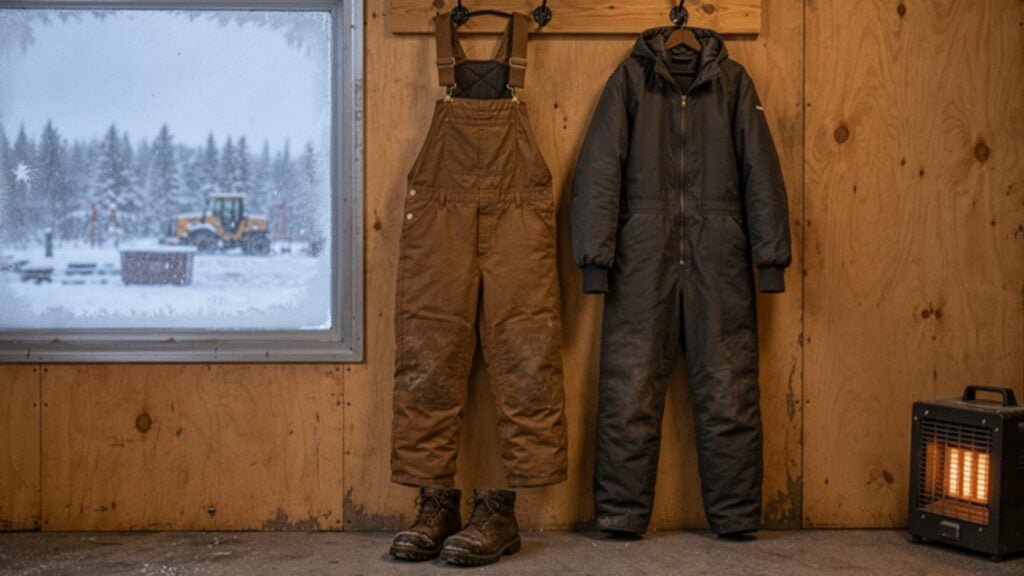
Insulated bibs and coveralls are what let you keep working when it’s 10°F and the wind is coming across an open slab. The best insulated bibs combine a tough shell, the right amount of insulation for how hard you work, leg zippers that open over boots, and double knees that take knee pads. Coveralls add warmth over your back and chest, and specialty versions add hi-vis, waterproofing or flame resistance.
For most tradespeople, the best insulated bib is the Carhartt Washed Duck Insulated Bib (104031). It’s 12 oz cotton duck with 80g of 3M Thinsulate, Carhartt’s Level 3 warmth rating and a full-knee double front for about $130. For brutal cold, step up to the Carhartt Yukon Extremes Biberall. If you’d rather have a one-piece, the Berne Heritage Duck Insulated Coverall is our pick for the best insulated coverall, and the Dickies TB839 is the budget buy at about $70.
Below are our eight picks, Carhartt’s insulated bibs compared by model, and a buying guide.
Quick answer: our picks
- Best overall: Carhartt Washed Duck Insulated Bib (104031)
- Best for extreme cold: Carhartt Yukon Extremes Biberall (104461)
- Best insulated coverall: Berne Heritage Duck Insulated Coverall (I417)
- Best budget: Dickies Duck Insulated Bib (TB839)
- Best hi-vis: Ergodyne GloWear 8928
- Best waterproof: Viking Insulated Journeyman 300D (3907FRWP)
- Best flame-resistant: Carhartt FR Duck Insulated Bib (101626)
- Best for women: Carhartt Women’s Washed Duck Insulated Bib (104049)
Short on time? Buy a 12 oz duck bib with Thinsulate, and only pay more if your job needs Level 4 warmth, a waterproof shell, ANSI Class E hi-vis or FR protection.
Best insulated bibs and coveralls compared
| Pick | Bib or coverall | Shell / insulation | Warmth or rating* |
|---|---|---|---|
| Best overall | Carhartt Washed Duck Insulated Bib (104031) | 12 oz cotton duck / 80g Thinsulate | Carhartt Level 3 |
| Best for extreme cold | Carhartt Yukon Extremes Biberall (104461) | 500D Cordura nylon / 150g Thinsulate | Carhartt Level 4 |
| Best insulated coverall | Berne Heritage Duck Insulated Coverall (I417) | 10 oz cotton duck / quilted poly | Berne Warmest |
| Best budget | Dickies Duck Insulated Bib (TB839) | Cotton duck, DWR / insulated lining | Zip-to-waist legs |
| Best hi-vis | Ergodyne GloWear 8928 | 300D ripstop poly / 160g | ANSI 107 Class E, -15°F |
| Best waterproof | Viking Insulated Journeyman 300D (3907FRWP) | PU-backed 300D ripstop / 125 gsm | Waterproof, -22°F |
| Best flame-resistant | Carhartt FR Duck Insulated Bib (101626) | 13 oz FR duck / FR modacrylic | NFPA 2112, 70E CAT 4 |
| Best for women | Carhartt Women’s Washed Duck Insulated Bib (104049) | 12 oz cotton duck / Thinsulate | Carhartt Level 3 |
*Warmth ratings and temperature ratings are each manufacturer’s own scale or claim, so compare them within a brand, not across brands. Price guide: $ under $100, $$ $100–$200, $$$ over $200, based on typical listed prices.
The 8 best insulated bibs and coveralls
1. Best overall: Carhartt Washed Duck Insulated Bib (104031)
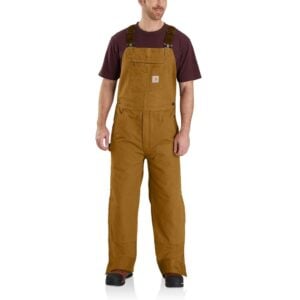
Carhartt Men's Washed Duck Insulated Bib Overall (104031)
Carhartt's best all-round insulated bib: 12 oz washed cotton duck, 80g 3M Thinsulate through the legs, a full-knee double front and a Level 3 (Warmest) rating, for about $130.
- Model: 104031 (OR4031-M)
- Type: Insulated bib overall, loose fit
- Shell: 12 oz 100% ring-spun washed cotton duck
- Insulation: 80g 3M Thinsulate through the legs
Our take
If you only buy one pair of insulated bibs for winter construction work, make it these. The 104031 is Carhartt's update to the old R27 quilt-lined bib, and it gets the basics right: tough canvas, enough insulation for real cold, and a cut that leaves room for layers and knee pads.
The shell is 12 oz, 100% ring-spun cotton duck. It's washed, so it's softer out of the bag than Carhartt's firm duck, but it's the same weight. Carhartt puts 80g of 3M Thinsulate through the legs and gives the bib its Level 3 "Warmest" rating, which it describes as gear for severely cold conditions. Carhartt insulates the legs, not the upper bib, so your jacket does the work up top. That's normal for bibs and helps you dump heat when you're working hard.
The details are built for the jobsite. The double front now runs longer and covers the whole knee, with openings for Carhartt knee pads and for cleaning out debris. Cordura kick panels protect the cuffs from boot heels and rebar. Main seams are triple-stitched. Ankle-to-knee leg zippers let you pull the bibs on over boots, a side button closure with a stretch panel tightens the fit, and the bib pocket zips shut for your phone.
Owners like it. It has more than 2,900 Amazon ratings averaging 4.6 stars. Owners mostly comment on warmth on cold mornings. Some say it runs a little big. That's useful if you layer underneath, but check Carhartt's size chart before you order. It comes in S to 5XL with short, regular and tall lengths.
Who it's not for: anyone who wants ankle-to-thigh zips for big pac boots (the Firm Duck bib has them), anyone working in steady rain (cotton duck isn't waterproof), and anyone who needs flame-resistant clothing for electrical or hot work.
Pros
- 12 oz cotton duck with Cordura kick panels
- 80g 3M Thinsulate through the legs; Level 3 (Warmest)
- Longer double knee with knee pad openings
- Stretch side panel and zip bib pocket
- Over 2,900 Amazon ratings at 4.6 stars
Cons
- Leg zips run ankle to knee, not to the thigh
- Upper bib isn't insulated
- Cotton duck soaks through in steady rain
| Brand | Carhartt |
|---|---|
| Model | 104031 (OR4031-M) |
| Type | Insulated bib overall, loose fit |
| Shell | 12 oz 100% ring-spun washed cotton duck |
| Insulation | 80g 3M Thinsulate through the legs |
| Carhartt warmth rating | Level 3 - Warmest |
| Water resistance | None stated (cotton duck) |
| Leg zippers | Ankle to knee |
| Knees | Double front covering entire knee, knee pad openings |
| Sizes | S-5XL; short, regular and tall |
| Colors | Black, Carhartt Brown, Dark Brown |
Why we picked it: It does the most things well for the money. The 12 oz washed duck is as tough as Carhartt’s firm duck but breaks in faster. The 80g Thinsulate in the legs earns Carhartt’s Level 3 “Warmest” rating, which is the right warmth for most winter construction where you’re moving all day. The double front now covers the whole knee and takes knee pads, the Cordura kick panels protect the cuffs, and the stretch side panel helps the fit. With more than 2,900 Amazon ratings at 4.6 stars, it’s a safe buy.
Who it’s for: Framers, concrete and masonry crews, roofers in shoulder season, plumbers and electricians doing exterior rough-in, landscapers and snow-removal crews. Anyone in the northern half of the country who works outside from November to March will get years out of a pair.
Watch-outs: The leg zippers stop at the knee. That’s fine for most work boots but tight over big pac boots; the Firm Duck bib (106672) has ankle-to-thigh zips. Only the legs are insulated, so wear a warm jacket. Cotton duck isn’t waterproof, and it gets heavy when it’s soaked. Some owners say it runs a little big.
2. Best for extreme cold: Carhartt Yukon Extremes Biberall (104461)
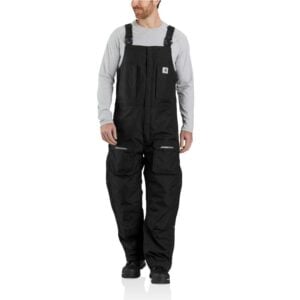
Carhartt Men's Yukon Extremes Loose Fit Insulated Biberall (104461)
Carhartt's warmest bib: a 500-denier Cordura nylon shell, 150g 3M Thinsulate, wind and light-rain protection and ankle-to-thigh zips. Level 4 (Extreme Warmth).
- Model: 104461 (OR4461-M)
- Type: Insulated biberall, loose fit
- Shell: 6.5 oz 500-denier Cordura nylon
- Insulation: 150g 3M Thinsulate
Our take
When the forecast drops below zero and you're still pouring, framing or running equipment, the Yukon Extremes Biberall is the bib to have. It carries Carhartt's Level 4 "Extreme Warmth" rating, the highest it gives, and it's built differently from the cotton duck bibs most people picture.
The shell is 6.5 oz, 500-denier Cordura nylon. It's lighter than 12 oz duck, it doesn't absorb water the way cotton does, and it resists abrasion well. Carhartt adds its Wind Fighter wind-blocking technology and a Rain Defender durable water-repellent (DWR) finish, which it says keeps you dry in light rain. Inside is 150g of 3M Thinsulate, nearly twice the 80g in the Washed Duck bib.
Carhartt calls it a biberall because it has a two-way front zipper, so getting in and out is easier than with a standard bib. The ankle-to-thigh leg zippers have storm flaps and snaps, which makes it easy to pull on over big insulated boots and lets you vent heat on the move. The double-layer knees take knee pads. There are ledge hand pockets, cargo pockets, secure back pockets, a hammer loop and a zip chest pocket. 3M Scotchlite reflective taping on the back and the double front adds a little visibility in low light, but it isn't a hi-vis garment.
It has more than 1,100 Amazon ratings averaging 4.7 stars. Owners say it's warm and still easy to move in. If you'd rather have a one-piece, Carhartt makes the matching Yukon Extremes Insulated Coverall (104464) with the same shell and insulation, plus storm cuffs and snaps for a hood.
Who it's not for: anyone doing hard physical work in mild cold, because 150g of insulation can be too warm when you're working hard in moderate cold. It's also black only, sizes stop at 4XL, and DWR isn't waterproof in steady rain.
Pros
- Level 4 (Extreme Warmth), Carhartt's highest rating
- 150g 3M Thinsulate insulation
- 500D Cordura nylon with Wind Fighter and Rain Defender DWR
- Ankle-to-thigh leg zips and two-way front zip
- Over 1,100 Amazon ratings at 4.7 stars
Cons
- Too warm for active work in mild cold
- About $210
- Black only; S-4XL
| Brand | Carhartt |
|---|---|
| Model | 104461 (OR4461-M) |
| Type | Insulated biberall, loose fit |
| Shell | 6.5 oz 500-denier Cordura nylon |
| Insulation | 150g 3M Thinsulate |
| Carhartt warmth rating | Level 4 - Extreme Warmth |
| Water resistance | Rain Defender DWR (light rain); Wind Fighter |
| Leg zippers | Ankle to thigh, storm flaps and snaps |
| Knees | Double layer, knee pad openings |
| Reflective | 3M Scotchlite Carbon Black taping (not ANSI hi-vis) |
| Sizes | S-4XL regular; M-3XL short and tall |
| Colors | Black |
Why we picked it: It’s the warmest bib Carhartt makes, and it’s built for movement. The 500-denier Cordura nylon shell is lighter than duck and doesn’t soak up water, Wind Fighter blocks the wind, and the Rain Defender DWR finish sheds light rain and wet snow. 150g of Thinsulate earns Carhartt’s Level 4 “Extreme Warmth” rating. Ankle-to-thigh zippers and a two-way front zipper make it easy to get on and off and to vent. More than 1,100 Amazon owners give it 4.7 stars.
Who it’s for: Anyone working outside in single digits and below: northern-tier construction, pipeline and utility crews, equipment operators, flaggers on cold mornings (with a hi-vis top), and anyone who stands more than they move.
Watch-outs: It’s expensive at about $210, and it’s black only in S to 4XL. 150g of insulation can be too warm for heavy labor in moderate cold. Plan to unzip the legs or switch to a lighter bib on milder days. DWR isn’t waterproof; in steady rain, water will get through.
3. Best insulated coverall: Berne Heritage Duck Insulated Coverall (I417)
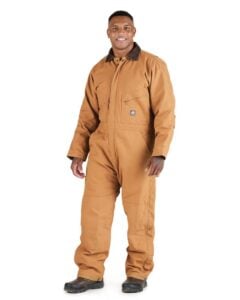
Berne Heritage Duck Insulated Coverall (I417)
A classic quilt-lined duck coverall with a bi-swing back, full-length leg zippers, storm cuffs and sizes to 6XL tall, for less than most Carhartt coveralls.
- Model: I417 (Heritage Duck Insulated Coverall)
- Type: Insulated coverall
- Shell: 10 oz 100% cotton duck, water-repellent finish
- Insulation: Medium-weight polyester quilted to polyester taffeta
Our take
Coveralls are warmer than bibs because there's no gap at the waist and no cold spot across your back when you bend over. If you work outside all day in one place, such as on equipment, on a slab or on a road crew, a good insulated coverall is hard to beat. The Berne Heritage Duck Insulated Coverall is the one we'd buy for most people.
The shell is heavy-duty 10 oz, 100% cotton duck with a water-repellent finish. Inside, Berne quilts medium-weight polyester insulation to a polyester taffeta lining, which slides easily over jeans and sweatshirts. Berne gives it its "Warmest" warmth rating. It's insulated from collar to cuff, so you get even warmth over your whole body.
The cut is made for movement. A pleated bi-swing action back and pleated elbows give you room to reach overhead, and elastic inserts in the waistband keep it from sagging. Hidden knit storm cuffs block wind at the wrists, and the corduroy collar has snaps for an optional hood. A two-way brass front zipper lets you vent or use the bathroom without stripping down. Berne lists full-length brass leg zippers with adjustable leg snaps, so you can get it on over boots.
Storage is good: two zip chest pockets, three inside pockets, two reinforced back pockets, side utility pockets and a hammer loop. Seams are triple-needle stitched and the knees are reinforced. Sizes run from S to 6XL in short, regular and tall, which is wider than most brands.
It has more than 2,600 Amazon ratings averaging 4.6 stars. Owners praise warmth, fit and pockets. One owner wished it were 12 oz duck, and another Berne reviewer said the leg zippers on their pair didn't open as high as expected, so check the fit when it arrives.
Who it's not for: anyone who wants knee pad pockets, anyone who works in steady rain, and anyone who heats up fast with active work. Bibs are easier to vent.
Pros
- Insulated head to toe; Berne's Warmest rating
- Bi-swing back and pleated elbows for reach
- Two-way front zip and full-length leg zips (manufacturer)
- Storm cuffs and hood snaps
- S-6XL in short, regular and tall
Cons
- 10 oz duck is lighter than Carhartt's 12 oz
- No knee pad openings
- Hood sold separately
| Brand | Berne |
|---|---|
| Model | I417 (Heritage Duck Insulated Coverall) |
| Type | Insulated coverall |
| Shell | 10 oz 100% cotton duck, water-repellent finish |
| Insulation | Medium-weight polyester quilted to polyester taffeta |
| Berne warmth rating | Warmest |
| Leg zippers | Full-length brass, adjustable leg snaps (manufacturer) |
| Front zipper | Two-way brass |
| Knees | Reinforced |
| Cuffs and collar | Hidden knit storm cuffs; corduroy collar with hood snaps |
| Sizes | S-6XL; short, regular and tall |
| Colors | Brown Duck, Black |
Why we picked it: A coverall is the warmest way to dress for cold work, and the Berne Heritage gets the details right for less than most Carhartt coveralls. It’s insulated from collar to cuff, Berne rates it “Warmest,” and the bi-swing back and pleated elbows let you reach overhead without the whole suit riding up. Storm cuffs, snaps for a hood and a two-way front zipper are features you notice by lunch. Sizes run to 6XL tall, and more than 2,600 Amazon owners rate it 4.6 stars.
Who it’s for: Equipment operators, truck drivers, road and utility crews, anyone working on a slab or deck in the wind, and anyone who wants one layer that covers everything. It’s also a good fit for bigger and taller workers who struggle to find coveralls.
Watch-outs: The 10 oz duck is a little lighter than Carhartt’s 12 oz. There are no knee pad openings, so it’s less suited to kneeling work. Coveralls are harder to vent than bibs; if you heat up fast, a bib and jacket is more flexible. One Berne reviewer said the leg zippers on their pair didn’t open as high as expected, so check them when it arrives.
4. Best budget: Dickies Duck Insulated Bib (TB839)
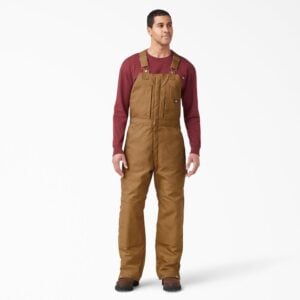
Dickies Duck Insulated Bib Overall (TB839)
The budget pick: cotton duck with a water-repellent finish, insulated lining, double knees and leg zippers that run all the way to the waist, for about $70.
- Model: TB839
- Type: Insulated bib overall
- Shell: 100% cotton duck, DWR finish
- Lining: Polyester/nylon, insulated
Our take
Not everyone needs a $200 bib. If you work outside in the cold a few days a week, plow snow, run a small crew or just want a spare pair in the truck, the Dickies TB839 does the job for about half the price of a Carhartt. It also has one feature you don't get on the Carhartt duck bibs: leg zippers that run all the way to the waist.
The shell is 100% cotton duck with a durable water-repellent (DWR) finish that makes light rain and snow bead up and roll off. The lining is a polyester and nylon blend over insulation. Dickies doesn't publish an insulation weight or warmth rating, but owners describe it as warm for standing and moderate work. Double knees add a second layer where bibs wear out first.
Dickies calls the leg zippers "zip-to-waist," and that's the reason to buy it. You can open the legs completely to step in with boots on, or open them partway to vent heat. Elastic at the shoulders and waist keeps the fit snug without constant strap adjusting, and snap buttons at the hem keep the cuffs from dragging in mud and slush.
Owners like the warmth, fit and price. The complaints are about hardware. Several reviewers on Dickies' own site report a broken strap button or a zipper failing early, which is the trade-off at this price. Treat the zippers gently and keep the receipt.
Who it's not for: anyone who wants knee pad pockets, a verified warmth rating or the heavier construction of a premium bib. If you kneel on concrete all day or work in serious cold every day, spend more on the Carhartt Washed Duck or Yukon Extremes.
Pros
- About half the price of Carhartt
- Zip-to-waist leg zippers
- DWR finish sheds light rain and snow
- Double knees and hem snaps
- Over 5,400 Amazon ratings at 4.6 stars
Cons
- No published insulation weight or warmth rating
- Owners report some zipper and strap button failures
- No knee pad openings
| Brand | Dickies |
|---|---|
| Model | TB839 |
| Type | Insulated bib overall |
| Shell | 100% cotton duck, DWR finish |
| Lining | Polyester/nylon, insulated |
| Warmth rating | Not published |
| Water resistance | Durable water repellent (DWR) |
| Leg zippers | Zip to waist |
| Knees | Double knee |
| Other | Elastic at shoulders and waist; hem snaps |
Why we picked it: It’s the best value in insulated bibs. For about $70 you get cotton duck with a DWR finish, an insulated lining, double knees, hem snaps and the longest leg zippers here. Dickies calls them zip-to-waist, so you can step in with boots on or open them for ventilation. More than 5,400 Amazon owners rate it 4.6 stars, more than any other pick.
Who it’s for: Part-time winter work, snow plowing, farm chores, apprentices buying their first pair, and anyone who wants a spare pair in the truck.
Watch-outs: Dickies doesn’t publish an insulation weight or warmth rating, so it’s hard to compare with Carhartt’s levels. Reviewers on Dickies’ site report some broken strap buttons and zippers. There are no knee pad openings. If you kneel all day or work in serious cold daily, spend more.
5. Best hi-vis: Ergodyne GloWear 8928
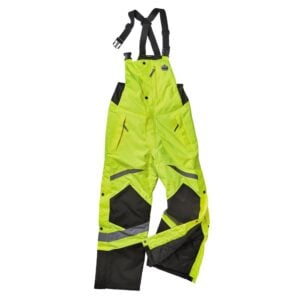
Ergodyne GloWear 8928 Hi-Vis Insulated Bibs, Class E
ANSI/ISEA 107-2020 Class E insulated bibs with a windproof, water-resistant 300D ripstop shell, 160g insulation and a -15°F rating from Ergodyne.
- Model: GloWear 8928
- Type: Hi-vis insulated bib overall
- Hi-vis standard: ANSI/ISEA 107-2020 Class E
- Shell: 300D ripstop polyester, PU coating
Our take
If you work near traffic or moving equipment, your winter bibs should be as visible as your vest. The Ergodyne GloWear 8928 is the hi-vis insulated bib we'd buy. Ergodyne certifies it to ANSI/ISEA 107-2020 Class E, the class for hi-vis pants, bibs and shorts. Worn with a Class 2 or Class 3 jacket or vest, a Class E bib makes the whole outfit Class 3, which is what many highway and night-work jobs require.
The shell is 300-denier ripstop polyester with a PU coating. Ergodyne rates it windproof and water-resistant, so it handles snow, sleet and spray better than cotton duck, though it isn't sold as fully waterproof. Inside is 160g of polyester insulation. Ergodyne rates the bibs to -15°F (-26°C) at a moderate work level and lists a 1.9 CLO value, a lab measure of how much a garment insulates.
The fluorescent lime panels and sewn-on reflective tape cover the legs, and black panels at the cuffs and seat hide dirt where bibs get filthy first. Scuff-resistant knee patches add wear resistance. A heavy-duty front zipper, quick-release suspender buckles, elastic sides and leg zippers make it easy to get in and out with boots on. One chest and two side pockets all zip shut. It's machine washable and comes in S to 5XL.
It has more than 2,300 Amazon ratings averaging 4.5 stars, and it usually sells well below Ergodyne's list price. Ergodyne lists it as a unisex fit, so size it over the layers you'll actually wear.
Who it's not for: anyone who needs flame-resistant or arc-rated clothing (it's polyester, so keep it away from welding and hot work), anyone who wants knee pad pockets, and anyone who doesn't need hi-vis. A duck bib will outlast it on rough work.
Pros
- ANSI/ISEA 107-2020 Class E
- Windproof, water-resistant PU-coated 300D ripstop
- 160g insulation; rated to -15°F (manufacturer)
- Black lower panels hide dirt
- Over 2,300 Amazon ratings at 4.5 stars
Cons
- Not flame resistant
- Only three pockets
- Looser unisex fit
| Brand | Ergodyne |
|---|---|
| Model | GloWear 8928 |
| Type | Hi-vis insulated bib overall |
| Hi-vis standard | ANSI/ISEA 107-2020 Class E |
| Shell | 300D ripstop polyester, PU coating |
| Insulation | 160g polyester fill |
| Temperature rating (manufacturer) | -15°F / -26°C at moderate work; 1.9 CLO |
| Water resistance | Windproof, water-resistant |
| Leg zippers | Yes, for on/off over boots |
| Knees | Scuff-resistant knee patches |
| Care | Machine washable |
| Sizes | S-5XL |
Why we picked it: It’s certified to ANSI/ISEA 107-2020 Class E, it’s warm, and it costs less than many non-hi-vis bibs. The PU-coated 300D ripstop shell is windproof and water-resistant, the 160g insulation is rated by Ergodyne to -15°F at moderate work, and black lower panels hide the dirt that makes most hi-vis pants look gray in a week. More than 2,300 Amazon owners rate it 4.5 stars.
Who it’s for: Highway and bridge crews, flaggers, utility and municipal workers, airport ramp crews, and anyone working near traffic or heavy equipment in the dark winter months. Pair it with a Class 2 or Class 3 jacket or vest for a Class 3 ensemble.
Watch-outs: It’s polyester, not flame resistant, so keep it away from welding, cutting and other hot work. There are only three pockets and no knee pad sleeves. Hi-vis fabric loses brightness with wear and washing, so replace it when it fades. Ergodyne lists a unisex fit, so try it over your layers.
6. Best waterproof: Viking Insulated Journeyman 300D (3907FRWP)
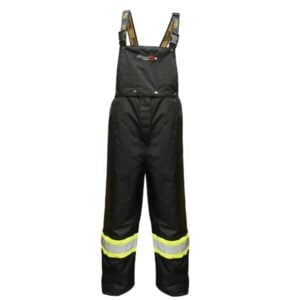
Viking Professional Insulated Journeyman 300D FR Bib Pants (3907FRWP)
A waterproof, windproof insulated bib with a PU-backed 300D ripstop shell, 125 gsm insulation rated to -22°F, reflective tape and an FR-treated fabric.
- Model: 3907FRWP
- Type: Waterproof insulated bib pants
- Shell: 300D FR-treated trilobal ripstop polyester, PU backing
- Insulation: 125 gsm ThermoMAXX
Our take
Cotton duck and DWR finishes are fine for snow and light rain. They are not fine for a day of sleet, a wet excavation or hosing down equipment. For that you need a bib that's actually waterproof, and the Viking Professional Insulated Journeyman is the one we'd pick for wet, cold jobsites.
Viking is a Canadian maker of industrial rainwear, and this bib is built like rain gear with insulation added. The shell is a heavy-duty 300-denier trilobal ripstop polyester with a PU backing. Viking rates it waterproof and windproof and says the fabric resists abrasion, punctures, rips and snags. Inside is 125 gsm of Viking's ThermoMAXX insulation, which Viking says is good to -22°F (-30°C).
The fabric is also FR-treated. Viking tests it to ASTM D6413, which means it self-extinguishes after brief contact with a flame. Be clear on what that does and doesn't cover. Viking states this garment is not intended for protection from hydrocarbon flash fires, electric arc hazards or welding sparks. It is not an NFPA 2112 or arc-rated garment. If you need those, see the Carhartt FR pick.
The bib has 2 in reflective stripes set in 4 in contrasting tape, and Viking lists CSA Z96-22 Class 1, Level 2 and ANSI/ISEA 107-2020 Class E compliance. The pair shown is black, so if your site requires fluorescent bottoms, choose the Ergodyne instead. Other details: 13 in boot zippers with covers and hook-and-loop closures, heavy-duty elastic suspenders with quick-release buckles, an elastic waist with a zip fly, and a detachable bib. Sizes run S to 4XL.
It has more than 360 Amazon ratings averaging 4.6 stars.
Who it's not for: anyone working mostly in dry cold (a breathable duck or nylon bib is more comfortable), anyone who wants lots of pockets or knee pad sleeves, and anyone who needs arc-rated FR.
Pros
- Waterproof and windproof PU-backed 300D ripstop
- 125 gsm insulation rated to -22°F (manufacturer)
- FR-treated fabric (ASTM D6413)
- 13 in boot zippers with storm covers
- Detachable bib
Cons
- Not arc rated or NFPA 2112
- Less breathable than duck or nylon in dry cold
- Few pockets; no knee pad sleeves
| Brand | Viking |
|---|---|
| Model | 3907FRWP |
| Type | Waterproof insulated bib pants |
| Shell | 300D FR-treated trilobal ripstop polyester, PU backing |
| Insulation | 125 gsm ThermoMAXX |
| Temperature rating (manufacturer) | -22°F / -30°C |
| Water resistance | Waterproof and windproof (manufacturer) |
| Flame resistance | ASTM D6413; not for flash fire, arc or welding (manufacturer) |
| Reflective | 2 in reflective on 4 in contrasting tape; Viking lists CSA Z96-22 and ANSI/ISEA 107-2020 Class E |
| Leg zippers | 13 in boot zippers with covers |
| Sizes | S-4XL |
Why we picked it: It’s the only pick that’s actually waterproof. The PU-backed 300D ripstop shell is built like industrial rain gear, Viking rates it waterproof and windproof, and the 125 gsm ThermoMAXX insulation is rated to -22°F. The 13 in boot zippers have covers so water doesn’t run in, and the bib detaches. The fabric is also FR-treated to ASTM D6413.
Who it’s for: Excavation and site utility crews, concrete crews pouring in sleet, dock and marine workers, sewer and water crews, anyone pressure washing in winter, and anyone who spends cold days kneeling in mud.
Watch-outs: Waterproof coated fabric doesn’t breathe like duck or nylon, so you’ll sweat in it during hard work in dry cold. The ASTM D6413 FR treatment is not NFPA 2112 or arc rated, and Viking says it isn’t for flash fire, arc or welding hazards. The pair shown is black with reflective tape, so it won’t meet a site rule calling for fluorescent bottoms.
7. Best flame-resistant: Carhartt FR Duck Insulated Bib (101626)
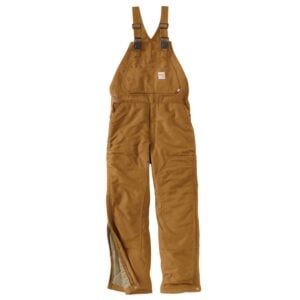
Carhartt Men's FR Duck Insulated Bib Overall (101626)
Flame-resistant 13 oz cotton duck with FR quilted lining, UL classified to NFPA 2112, meets NFPA 70E and carries a CAT 4 arc label. Ankle-to-thigh zips with Nomex tape.
- Model: 101626 (OR1626-FRM)
- Type: Flame-resistant insulated bib overall, loose fit
- Shell: 13 oz 100% cotton FR duck
- Lining and insulation: 11.5 oz FR quilted twill; FR modacrylic fill
Our take
Electricians, linemen, welders, and anyone working around energized equipment or flash fire hazards can't just throw on regular insulated bibs. Standard cotton duck burns, and the nylon lining and polyester insulation in most bibs can melt onto your skin. The Carhartt FR Duck Insulated Bib Overall is made from flame-resistant materials throughout, including the lining, insulation, zipper tape and snaps.
The shell is 13 oz, 100% cotton FR duck, slightly heavier than Carhartt's standard 12 oz duck. It's lined with an 11.5 oz FR quilted twill and insulated with flame-resistant modacrylic fill. Carhartt gives it a Level 3 "Warmest" rating. It's UL classified to NFPA 2112, the standard for flash fire protection in oil, gas and chemical work, and meets the performance requirements of NFPA 70E for electrical arc flash. It carries Carhartt's NFPA 2112 and CAT 4 labels on the front pocket. Under NFPA 70E, PPE Category 4 calls for an arc rating of at least 40 cal/cm². Check your employer's arc flash assessment to confirm what your task requires.
Every piece of hardware is chosen for FR use. The ankle-to-thigh brass leg zippers use Nomex FR zipper tape and have protective flaps with arc-resistant snaps. The high back uses FR suspenders and FR center-release buckles. Double-layer knees take knee pads, and there's a multi-compartment bib pocket, two lower front pockets and two reinforced back pockets.
It's sized by waist (W30 to W54) and inseam (L30 to L36), not S to XL, which makes it easier to get a good fit. Owners on Carhartt's site are split on whether it runs big or small, so measure first. It has 341 Amazon ratings averaging 4.7 stars. Carhartt also sells a newer FR Quick Duck Insulated Bib (107619) with Thinsulate Platinum FR insulation at about $320.
Who it's not for: anyone who doesn't need FR clothing. At about $300, it costs more than twice as much as the Washed Duck bib. Also, follow Carhartt's FR care instructions when you wash it. FR garments generally shouldn't see chlorine bleach or fabric softener.
Pros
- UL classified to NFPA 2112; meets NFPA 70E
- CAT 4 arc label
- FR duck, FR lining and FR insulation
- Ankle-to-thigh brass zips with Nomex tape
- Waist and inseam sizing (W30-W54)
Cons
- About $300
- Heavy 13 oz duck plus 11.5 oz lining
- Owners disagree on whether it runs big or small
| Brand | Carhartt |
|---|---|
| Model | 101626 (OR1626-FRM) |
| Type | Flame-resistant insulated bib overall, loose fit |
| Shell | 13 oz 100% cotton FR duck |
| Lining and insulation | 11.5 oz FR quilted twill; FR modacrylic fill |
| FR standards | UL classified to NFPA 2112; meets NFPA 70E performance requirements |
| Arc label | CAT 4 (NFPA 70E PPE Category 4 = 40 cal/cm² minimum) |
| Carhartt warmth rating | Level 3 - Warmest |
| Leg zippers | Ankle to thigh, brass with Nomex FR tape |
| Knees | Double layer, knee pad openings |
| Sizes | Waist W30-W54; inseam L30-L36 |
| Colors | Carhartt Brown, Dark Navy |
Why we picked it: It’s the most complete FR insulated bib we found. The shell, lining and insulation are all flame resistant, the leg zippers use Nomex tape and arc-resistant snaps, and the bib is UL classified to NFPA 2112 and meets NFPA 70E with a CAT 4 label. It’s also warm, with Carhartt’s Level 3 rating, and it keeps the practical details of a regular Carhartt bib, including ankle-to-thigh zips and knee pad pockets.
Who it’s for: Electricians and linemen working energized or near energized equipment, oil and gas workers, welders and pipefitters in cold climates, and anyone whose employer requires FR or arc-rated clothing as the outer layer.
Watch-outs: It’s about $300, and the 13 oz duck with an 11.5 oz FR lining is heavy. Owners disagree on sizing, so measure your waist and inseam before ordering. Confirm the arc rating your task requires with your employer’s arc flash assessment, and remember that what you wear under it matters too: avoid meltable synthetic base layers.
8. Best for women: Carhartt Women’s Washed Duck Insulated Bib (104049)
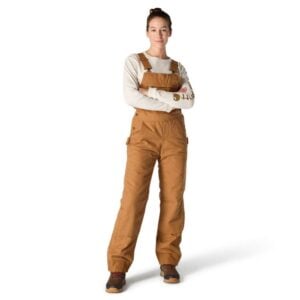
Carhartt Women's Washed Duck Insulated Bib Overall (104049)
A women's-cut insulated bib, not a shrunk men's pattern: 12 oz duck, Thinsulate through the legs, stretch side panels, knee pad pockets and short, regular and tall lengths.
- Model: 104049 (OR4031-W)
- Type: Women's insulated bib overall, relaxed fit
- Shell: 12 oz 100% cotton ringspun duck
- Insulation: 3M Thinsulate through the legs; quilted nylon lining
Our take
Women on job sites have spent decades rolling up the legs of men's bibs. The Carhartt Women's Washed Duck Insulated Bib Overall is cut on a women's pattern and comes in short, regular and tall lengths, so you get a better fit through the hips, seat and inseam. It's our pick for women who work outside in winter.
It shares most of its build with the men's 104031. The shell is 12 oz, 100% cotton ringspun duck, washed for a softer feel from day one. A quilted nylon lining slides on and off easily over work pants, and Carhartt puts 3M Thinsulate insulation through the legs. Carhartt gives it a Level 3 "Warmest" rating. The cut is a relaxed fit with stretch side panels for a more precise fit through the waist.
The work details are all there. Double-layer knees have openings for knee pads and for cleaning out debris. Reinforced Cordura kick panels go all the way around the cuffs, which is where bibs get chewed up by boot heels, ladders and rebar. Main seams are triple-stitched. Ankle-to-knee leg zippers let you pull it on over boots. There's a zip bib pocket for a phone, two lower front ledge pockets and reinforced back pockets. Elastic suspenders with a webbing slider are easy to adjust.
Owners praise warmth and fit. A few shorter owners still hemmed the back of the leg, and one reported early seam wear. Sizes run XS to XL in short, regular and tall. Colors are Black, Carhartt Brown, Dark Brown and Navy.
Who it's not for: women who need waterproof gear (look at Carhartt's Women's Rainier Storm Defender bib) and anyone who needs ankle-to-thigh zips. For extreme cold, layer warm base layers underneath or step up to an insulated coverall.
Pros
- Women's pattern in short, regular and tall
- 12 oz duck with 3M Thinsulate through the legs; Level 3
- Stretch side panels for a better fit
- 360° Cordura kick panels and knee pad pockets
- Over 2,800 Amazon ratings at 4.7 stars
Cons
- Leg zips run ankle to knee only
- Cotton duck isn't waterproof
- Core sizes stop at XL
| Brand | Carhartt |
|---|---|
| Model | 104049 (OR4031-W) |
| Type | Women's insulated bib overall, relaxed fit |
| Shell | 12 oz 100% cotton ringspun duck |
| Insulation | 3M Thinsulate through the legs; quilted nylon lining |
| Carhartt warmth rating | Level 3 - Warmest |
| Leg zippers | Ankle to knee |
| Knees | Double layer, knee pad openings |
| Kick panels | 360° reinforced Cordura |
| Sizes | XS-XL; short, regular and tall |
| Colors | Black, Carhartt Brown, Dark Brown, Navy |
Why we picked it: It’s a real women’s pattern, not a shrunken men’s bib, in short, regular and tall lengths. It has the same 12 oz washed duck, Thinsulate-insulated legs and Level 3 rating as our top pick, plus stretch side panels and Cordura kick panels all the way around the cuffs. More than 2,800 Amazon owners rate it 4.7 stars, tied for the best score of any pick here.
Who it’s for: Women in the trades, on farms and ranches, on survey and inspection crews, and anyone who has given up on rolling the legs of men’s bibs.
Watch-outs: Core sizes stop at XL, the leg zips only run ankle to knee, and cotton duck isn’t waterproof. For wet work, Carhartt’s Women’s Rainier Storm Defender bib is waterproof and insulated (see Also worth considering).
Carhartt insulated bibs compared by model
Carhartt makes most of the insulated bibs you’ll see on a jobsite, and its lineup is confusing because models get renumbered. The old R27 became the Washed Duck 104031, and the classic Firm Duck Insulated Bib now ships as 106672 (model OR4393-M, the same pattern as the older 104393). Here’s how the current men’s and women’s insulated bibs compare, using Carhartt’s own specs and warmth levels.
| Carhartt model | Shell | Insulation | Warmth / leg zips |
|---|---|---|---|
| Firm Duck Insulated Bib (106672) | 12 oz firm duck | Polyester, quilted nylon lining to waist | Level 2 / ankle to thigh |
| Washed Duck Insulated Bib (104031) | 12 oz washed duck | 80g Thinsulate in legs | Level 3 / ankle to knee |
| Camden Super Dux Bib (105004) | 7.75 oz nylon, Rain Defender DWR | 80g Thinsulate below waist, Sherpa above | Not listed / zip to knee |
| Firm Duck Biberall (106682) | 12 oz duck | Arctic-weight polyester | Level 4 / ankle to thigh |
| Yukon Extremes Biberall (104461) | 500D Cordura nylon, DWR | 150g Thinsulate | Level 4 / ankle to thigh |
| FR Duck Insulated Bib (101626) | 13 oz FR duck | FR modacrylic, FR twill lining | Level 3 / ankle to thigh |
| Women’s Washed Duck Bib (104049) | 12 oz washed duck | Thinsulate in legs | Level 3 / ankle to knee |
| Women’s Rainier Bib (107097) | 4.2 oz nylon, Storm Defender waterproof | 100g recycled polyester | Level 4 / ankle to knee |
Carhartt’s warmth levels run from Level 1 (Warm) to Level 4 (Extreme Warmth). Level 2 suits active work in moderate cold, Level 3 is Carhartt’s pick for severely cold conditions, and Level 4 is reserved for its warmest gear. Typical list prices at the time of writing were about $120 for the Firm Duck bib, $130 for the Washed Duck, $150 for the Firm Duck Biberall, $190 for the Camden, $210 for the Yukon Extremes and $300 to $330 for the FR Duck bib.
Which Carhartt bib should you buy? For most people, the Washed Duck 104031: it’s warmer than the Firm Duck for only about $10 more. Buy the Firm Duck 106672 if you wear big boots and want ankle-to-thigh zips, the Firm Duck Biberall if you want Level 4 warmth in classic duck, the Yukon Extremes if you want Level 4 in a lighter, water-shedding nylon, and the Camden if you split time between work and snowmobiling or ice fishing.
Also worth considering
- Carhartt Firm Duck Insulated Bib Overall (106672). The classic brown Carhartt bib. 12 oz firm duck, quilted nylon lining with polyester insulation to the waist, Level 2 warmth, double knees with pad openings, Cordura kick panels and ankle-to-thigh leg zippers. It’s a little less warm than the Washed Duck but easier to get on over big boots. Check price on Amazon.
- Carhartt Yukon Extremes Insulated Coverall (104464). The one-piece version of our extreme-cold pick, with the same 500D Cordura shell, 150g Thinsulate and Level 4 rating, plus storm cuffs and snaps for a hood. It costs about $270 and has 675 Amazon ratings averaging 4.6 stars. Check price on Amazon.
- Dickies Duck Insulated Coverall (TV239). A budget coverall: 10 oz cotton duck with a DWR finish, insulated lining, double knees, a generous fit through the chest and shoulders, and full-length leg zippers, for about $90. It has more than 6,100 Amazon ratings averaging 4.5 stars. Check price on Amazon.
- Carhartt Women’s Rainier Storm Defender Bib Overall (107097). A waterproof, breathable insulated bib for women, with fully taped seams, 100g insulation, Level 4 warmth, ankle-to-knee zips and a zippered drop seat. It’s newer, with only about 50 Amazon ratings so far. Check price on Amazon.
How we chose
We started with the brands tradespeople actually buy: Carhartt, Berne, Dickies, Walls, Key, RefrigiWear, Ergodyne, Viking and Helly Hansen. We checked what ranks in Google for “best insulated bibs” and “best insulated coveralls” and what workers recommend on Reddit and trade forums. Then we narrowed the list on what matters on a jobsite:
- Warmth: insulation type and weight, and the manufacturer’s warmth or temperature rating.
- Shell: fabric, weight or denier, and whether it’s water-repellent or waterproof.
- On and off: leg zipper length, front zippers and suspender hardware.
- Durability: double knees, knee pad openings, kick panels and seam construction.
- Standards: ANSI/ISEA 107 for hi-vis, and NFPA 2112 and NFPA 70E for flame-resistant gear.
- Fit: size range, short and tall lengths, and women’s patterns.
- Owner feedback: rating counts and recurring praise and complaints on Amazon and the makers’ own sites.
We did not lab test or field test these bibs and coveralls. Specs, warmth ratings and standards come from each manufacturer’s product page, and rating counts come from Amazon at the time of writing. Where a figure is the manufacturer’s claim, such as a temperature rating, we say so. We skipped products we couldn’t verify or that had only a handful of reviews. We’ll update this guide as models change.
How to choose insulated bibs and coveralls
Bibs vs coveralls
Both keep your legs warm. The difference is your upper body.
- Bibs cover your legs and chest and are held up by suspenders. You wear a jacket over them. That gives you two layers you can adjust separately: shed the jacket when you’re working hard, add it back at lunch. Bibs are easier to vent and easier to use the bathroom in.
- Coveralls are one piece from collar to ankle. With no gap at the waist and no cold spot across your back when you bend over, they’re warmer for the same insulation. They’re the better choice for standing or sitting work in the cold: equipment operators, flaggers, inspectors and drivers. The trade-off is that they’re hot when you’re moving hard, and you have to undress halfway to take a break.
- Biberalls are a middle ground. Carhartt uses the name for bibs with a two-way front zipper, which makes them easier to get on and off.
Most construction workers end up with a bib plus a good jacket. If you want more warmth without more bulk, a heated jacket over a bib works well. See our guide to the best heated jackets for work.
Insulation weight, warmth ratings and layering
Insulation is usually polyester. 3M Thinsulate is a common branded fiber that’s thin for its warmth. Weights are given in grams per square meter: 80g is a midweight insulation for active work, 150g to 160g is heavy, and anything over 200g is for standing work in severe cold. Several brands also rate their gear on their own scale:
- Carhartt uses Levels 1 to 4. Most of its insulated bibs are Level 2 or 3; the Yukon Extremes line and the Firm Duck Biberall are Level 4.
- Berne rates gear from warm up to Extreme Warmth; the Heritage Duck coverall is rated Warmest.
- Ergodyne, Viking and RefrigiWear give temperature ratings, such as -15°F for the Ergodyne 8928 at a moderate work level. Treat them as a guide. How warm you feel depends on wind, how hard you work and what you wear underneath.
Buy for the work, not just the thermometer. Too much insulation during hard labor means sweat, which makes you colder when you stop. Wear a wicking synthetic or wool base layer, not cotton, and keep your feet and hands dry. Our guides to the best work socks for boots and the best work gloves for construction cover both.
Shell fabric: cotton duck vs nylon vs polyester
- Cotton duck is the classic. It’s tough, quiet, breathable and resists sparks better than synthetics (though regular duck is not flame resistant). Weights run 10 to 13 oz; heavier is tougher but stiffer. The downside is water: wet duck gets heavy and cold.
- Nylon, such as Carhartt’s 500D Cordura on the Yukon Extremes, is lighter, sheds water, dries fast and resists abrasion. It’s louder and melts if it touches a hot surface or spark.
- Polyester ripstop with a PU coating is used on hi-vis and waterproof bibs. It’s windproof and water-resistant or waterproof, but less breathable.
Waterproof vs water-repellent
This is where shoppers get misled most. “Water-resistant” and “water-repellent” usually mean a durable water-repellent (DWR) finish. Water beads up and rolls off in light rain or snow, but it will soak through in steady rain, when you kneel in slush, or as the finish wears off after washing. Carhartt’s Rain Defender and the DWR on the Dickies and Berne picks work this way.
“Waterproof” means the fabric itself blocks water, usually with a coating or membrane, and good waterproof gear also has taped or sealed seams. The Viking Journeyman uses a PU-backed shell, and Carhartt’s Women’s Rainier has a Storm Defender membrane with fully taped seams. Waterproof gear breathes less, so it’s best for wet work, not dry cold.
Leg zippers for boots
Leg zippers decide how easy bibs are to pull on over work boots, and they double as vents. Lengths vary a lot:
- Ankle to knee: fine for standard 6 in or 8 in work boots (Carhartt Washed Duck, Camden, women’s bibs).
- Ankle to thigh: easier over pac boots and rubber boots, and better for venting (Carhartt Firm Duck, Yukon Extremes, FR Duck).
- Zip to waist or full length: the easiest on and off, and you can step in with boots on (Dickies TB839, Berne I417).
Look for storm flaps over the zippers, which keep snow and wind out, and snaps or hook-and-loop tabs at the hem to snug the cuffs around your boots. Our best work boots guide covers what goes underneath.
Knees, kick panels and durability
Bibs wear out at the knees and cuffs first. Look for double-layer knees open at the bottom for knee pad inserts, kick panels (often Cordura) inside the cuffs, and triple-stitched seams with rivets or bar tacks at stress points.
Sizing over layers
Insulated bibs are cut fuller than work pants so you can wear layers underneath, and most brands size them by chest or waist in S to XL, with short, regular and tall lengths. A few tips:
- Measure over the layers you’ll wear on the coldest day, then check the brand’s size chart. Don’t guess from your jeans size.
- Carhartt’s insulated bibs are loose or relaxed fit, and owners often say they run big. Most people should order their normal size, not a size up.
- Get the inseam right. Too long and the cuffs drag in mud and wear out; too short and they ride up over your boots when you kneel. Short and tall lengths exist for a reason.
- The FR Carhartt bib is sized by waist and inseam, like work pants.
Hi-vis requirements: ANSI/ISEA 107 Class E
If you work in or near traffic, your employer or the DOT may require high-visibility clothing that meets ANSI/ISEA 107. The standard has Class 1, 2 and 3 for tops and vests, and Class E for supplemental items such as pants, bibs and shorts. A Class E bib on its own isn’t a complete hi-vis outfit, but worn with a Class 2 or Class 3 top it makes the ensemble Class 3, the highest level. Check the class on the label.
Pair a Class E bib with a proper top. Our guide to the best safety vests covers ANSI classes in detail,.
Flame-resistant requirements: NFPA 2112 and NFPA 70E
Regular insulated bibs are a fire hazard around arc flash, flash fire and hot work. Cotton duck burns, and the nylon linings and polyester insulation in most bibs melt. If your job involves energized electrical work, oil and gas, or combustible dust, your employer should specify FR clothing. Two standards matter:
- NFPA 2112 covers flame-resistant garments for protection against short-duration flash fires, such as in refineries and gas plants. Look for “UL classified to NFPA 2112” or similar third-party certification.
- NFPA 70E covers electrical safety in the workplace. Arc-rated clothing carries an arc rating in cal/cm² (ATPV or EBT). PPE Category 2 calls for at least 8 cal/cm² and Category 4 for at least 40 cal/cm². Your employer’s arc flash risk assessment sets what you need.
- ASTM D6413 is a vertical flame test. Passing it shows a fabric self-extinguishes, but on its own it doesn’t make a garment arc rated or NFPA 2112 compliant.
With FR gear, every layer counts. Don’t wear a non-FR jacket over FR bibs, and avoid synthetic base layers that can melt underneath. Wool and FR-rated base layers are safer choices.
Care and washing
Most insulated bibs and coveralls are machine washable. General rules:
- Empty the pockets, close all zippers and hook-and-loop tabs, and turn them inside out.
- Wash cold or warm on a gentle cycle with a regular detergent. Skip fabric softener, which coats fibers, kills DWR and reduces FR performance.
- Never use chlorine bleach on FR or hi-vis garments.
- Tumble dry low or hang to dry. High heat can damage insulation, coatings and reflective tape.
- Follow the care label, especially on FR and waterproof gear, and wash before storing them for summer.
Templates and guides for this
Insulated bibs keep you working, but winter work also needs a plan. These Essential Construction templates and guides help you plan cold-weather work and brief your crew.
- PPE Policy Template (template)
- Weather Tracking Log Template (template)
- 8 Important Items To Include in Your Winter Protection Plan (guide)
- Toolbox Talk (glossary)
Insulated bibs and coveralls FAQ
What are the best insulated bibs?
For most workers, the Carhartt Washed Duck Insulated Bib (104031): 12 oz duck, 80g Thinsulate and Carhartt’s Level 3 warmth rating for about $130. For extreme cold, the Carhartt Yukon Extremes Biberall, and on a budget, the Dickies TB839.
What are the best insulated coveralls?
The Berne Heritage Duck Insulated Coverall (I417) is our pick for most people. For the most warmth, Carhartt’s Yukon Extremes Insulated Coverall (104464) is Level 4, and the Dickies TV239 is a good budget coverall.
Do bib overalls keep you warm?
Insulated bibs do, as long as you match the insulation to the conditions and wear a jacket up top. For standing work in serious cold, a coverall is warmer because there’s no gap at the waist.
Are Carhartt insulated bibs waterproof?
Most aren’t. The cotton duck bibs resist wind and light rain but soak through in steady rain. The Yukon Extremes and Camden have a Rain Defender DWR finish for light rain. Carhartt’s waterproof options use its Storm Defender membrane, such as the Women’s Rainier insulated bib.
Which brand offers the best quality bib overalls?
Carhartt is the benchmark for insulated work bibs, and its 12 oz duck, triple stitching and knee pad pockets are why. Berne is close in build quality and often cheaper, especially for coveralls. Dickies is the value brand. For specialty needs, Ergodyne is strong in hi-vis and Viking in waterproof gear.
How do you wash insulated coveralls?
Empty the pockets, close the zippers, turn them inside out and wash on cold or warm with regular detergent. Skip bleach and fabric softener, and tumble dry low or hang dry. Follow the care label, especially for FR and waterproof gear.
The bottom line
For most tradespeople, the Carhartt Washed Duck Insulated Bib (104031) is the best insulated bib: tough 12 oz duck, 80g Thinsulate, Level 3 warmth and knee pad pockets for about $130. Go to the Yukon Extremes Biberall for sub-zero work, the Berne Heritage coverall if you want a one-piece, and the Dickies TB839 if price comes first. Traffic crews should buy the Ergodyne GloWear 8928, wet crews the Viking Insulated Journeyman, electrical and oil and gas workers the Carhartt FR Duck Insulated Bib, and women the Carhartt Women’s Washed Duck bib.
Browse all our bib and coverall picks, and finish your cold-weather kit with our guides to the best heated jackets for work, the best safety vests and the best work gloves for construction.
Own one of these? Rate it on its product page or tell us how it holds up in the comments.
Ask AI about this page: ChatGPT, Claude or PerplexityCopy as Markdown