

We may earn a commission when you buy through links on this page, as an Amazon Associate. Learn more.
A utility knife is the tool you reach for more than any other on a job site. It opens boxes, scores drywall, trims house wrap, cuts shims and strips the odd wire. Because you use it all day, small things matter: how fast you can change a blade, whether it opens with one hand, and whether it’s even allowed on your site.
Our short answer: the Milwaukee FASTBACK 48-22-1502 is the best utility knife for most tradespeople. It opens with one hand, changes blades without tools, stores five spares and has a lifetime warranty. If you prefer a retractable, the DeWalt DWHT10998 is solid and costs about $10. If your site bans open blades, get a self-retracting knife like the Slice 10554.
Below are our eight picks for the best utility knife in 2026, covering folding, retractable, snap-off and safety knives. After the reviews, our buying guide explains blade types, blade change mechanisms, site safety rules and when to replace a blade instead of sharpening it.
Quick picks
- Best overall: Milwaukee FASTBACK 48-22-1502. One-handed opening, tool-free blade changes and five-blade storage.
- Best retractable: DeWalt DWHT10998. A zinc-bodied retractable with a blade lock and five-blade storage for about $10.
- Best budget multi-pack: WORKPRO Premium (3-pack). Three aluminum retractables and 10 blades for about $20.
- Best for drywall: OLFA L-5. An 18mm snap-off that gives you a fresh tip in a second.
- Best safety knife: Slice 10554. An auto-retracting knife with a finger-friendly ceramic blade.
- Best multi-tool knife: Milwaukee FASTBACK 6-in-1. A FASTBACK with a fold-out 1/4-inch bit driver and wire stripper.
- Best compact: Gerber EAB Lite. A 2.5 oz stainless folder that takes standard utility blades.
- Best heavy-duty snap-off: OLFA XH-1. A 25mm blade for insulation, foam board and roofing.
Compare the best utility knives
| Pick | Knife | Type | Best for |
|---|---|---|---|
| Best overall | Milwaukee FASTBACK 48-22-1502 | Folding, 5-blade storage | Everyday jobsite cutting |
| Best retractable | DeWalt DWHT10998 | Retractable, zinc body | General cutting, pouch carry |
| Best budget multi-pack | WORKPRO Premium (3-pack) | Retractable, aluminum | Crews, trucks, gang boxes |
| Best for drywall | OLFA L-5 | 18mm snap-off | Drywall, flooring, trim |
| Best safety knife | Slice 10554 | Auto-retracting, ceramic | Sites that ban open blades |
| Best multi-tool knife | Milwaukee FASTBACK 6-in-1 | Folding, bit driver | Electricians, service techs |
| Best compact | Gerber EAB Lite | Small folder, 2.5 oz | Pocket carry, supers |
| Best heavy-duty snap-off | OLFA XH-1 | 25mm snap-off | Insulation, foam, roofing |
Specs are from each manufacturer’s product page. Only the Slice retracts its blade on its own.
The 8 best utility knives
1. Best overall: Milwaukee FASTBACK 48-22-1502
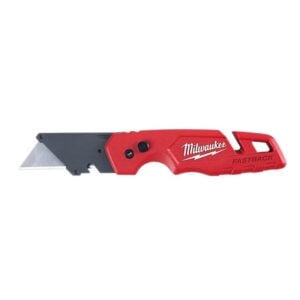
Milwaukee FASTBACK Folding Utility Knife with Blade Storage (48-22-1502)
The folding utility knife you'll see clipped to more tool belts than any other. Press-and-flip opening, tool-free blade changes and room for five spare blades in a metal body.
- Model: 48-22-1502
- Type: Folding (press-and-flip)
- Blade change: Tool-free
- Blade storage: 5 blades
Our take
Milwaukee's FASTBACK changed what tradespeople expect from a utility knife. Instead of a slider and a handle you have to unscrew, you get a folding knife that opens with one hand and takes a new blade in seconds. The 48-22-1502 is the version with onboard blade storage, and it's the one we'd buy first.
To open it, you press the button on the back and flip your wrist. The blade swings out and locks. Folding it back takes one hand too. A blade change is tool-free: press the release, pull the old blade out and slide a new one in. Milwaukee added a metal extension over the release button so you don't knock the blade loose by accident while you're cutting.
The handle stores five extra blades, which means you can run all day without a trip to the truck. Milwaukee also built in a wire stripper and a gut hook for cutting twine, strapping and wrap without opening the blade. The body is metal, the belt clip is a bent wire that is less likely to tear pockets than a flat clip, and there's a lanyard hole for tethering at height.
Milwaukee lists it at 6.87 inches long and 0.28 lb, and it carries a limited lifetime warranty. It takes standard trapezoid utility blades, so any brand of blade fits.
The design has trade-offs. A folding knife has a pivot, and any pivot can develop a little play over years of hard use. If you need a dead-solid blade for long, straight scoring cuts, a fixed or retractable knife can feel more rigid. The wire stripper is handy for the odd conductor, but electricians who strip all day will still reach for real strippers.
Who it's not for: anyone on a site that bans open-blade knives. The FASTBACK doesn't retract on its own, so if your GC requires self-retracting knives, look at the Slice 10554 instead.
Pros
- One-handed press-and-flip opening
- Tool-free blade changes with a guard against accidental release
- Stores 5 spare blades in the handle
- Wire stripper, gut hook and wire belt clip
- Limited lifetime warranty
Cons
- Not self-retracting, so it's banned on some sites
- Folding pivot is less rigid than a fixed blade for long scoring cuts
- Heavier than a basic plastic knife
| Brand | Milwaukee |
|---|---|
| Model | 48-22-1502 |
| Type | Folding (press-and-flip) |
| Blade change | Tool-free |
| Blade storage | 5 blades |
| Extras | Wire stripper, gut hook, wire belt clip, lanyard hole |
| Length | 6.87 in (manufacturer) |
| Weight | 0.28 lb (manufacturer) |
| Warranty | Limited lifetime |
Why we picked it: The FASTBACK solved the two biggest annoyances with old-style utility knives. You open it with one hand by pressing the button and flipping your wrist, and you change blades without a screwdriver. Milwaukee added a metal guard over the blade release so it doesn’t pop the blade out mid-cut, and the handle stores five spare blades. A wire stripper, a gut hook for twine and strapping, and a wire belt clip round it out. With close to 2,000 Amazon ratings averaging 4.7 stars, it’s one of the most-reviewed pro utility knives on the market.
Who it’s for: carpenters, framers, electricians, plumbers, HVAC techs and general laborers who want one knife that lives on their belt or in their pocket. It takes standard utility blades, so you can buy whatever blades you like.
Watch out for: the folding pivot. It’s solid out of the box, but a folding knife will never be as rigid as a fixed blade for long scoring cuts. It doesn’t retract on its own, so it’s not allowed on sites that require self-retracting knives. Milwaukee also sells a lighter Compact version (48-22-1500) without the blade storage.
2. Best retractable: DeWalt DWHT10998
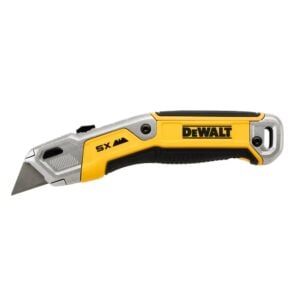
DeWalt Retractable Utility Knife with Blade Storage (DWHT10998)
A zinc-bodied retractable knife with rapid-load blade changes, a blade lock built to stop the blade pulling out mid-cut, and storage for five spare blades. Usually under $10.
- Model: DWHT10998
- Type: Retractable (manual slider)
- Body: Zinc
- Blade change: Rapid-load, tool-free
Our take
Retractable utility knives are the old standard on job sites for a reason. The blade slides back into the handle when you're done, so there's no folding pivot to wear and nothing sharp sticking out when the knife goes back in your pouch. DeWalt's DWHT10998 is a newer take on that design, and at around $10 it's one of the best values in the category.
The body is zinc, which gives it the weight and stiffness that cheaper plastic retractables lack. DeWalt says it re-engineered the slider for smoother, more consistent travel. The part DeWalt highlights most is the blade lock: it's designed to hold the blade firmly so it doesn't pull out of the nose during aggressive cuts, which DeWalt calls blade tearout. That matters when you're hacking through shingles, carpet or thick packaging.
Blade changes are what DeWalt calls rapid-load. There's no screw to undo; you open the knife's quick-change mechanism, swap the blade and close it. The handle stores up to five spare blades, and the knife ships with two. DeWalt lists its carbide and drywall-specific blades as accessories for it. It's covered by DeWalt's limited lifetime warranty.
This is the knife we'd hand to someone who wants one simple tool for general cutting: drywall, house wrap, shims, caulk tubes, cardboard and roofing underlayment.
The catch is that it's a newer model with only a couple of hundred Amazon ratings so far, versus thousands for the Milwaukee FASTBACK. There's no wire stripper or other extras, and zinc makes it a little heavier than an aluminum knife.
Who it's not for: sites that require self-retracting knives. A manual retractable still stays open until you slide the blade back. It's also not the slimmest knife for pocket carry; the Gerber EAB Lite is better for that.
Pros
- Solid zinc body
- Blade lock designed to stop blade pull-out mid-cut
- Rapid-load, tool-free blade changes
- Stores 5 spare blades
- Low price with a limited lifetime warranty
Cons
- Newer model with fewer owner reviews
- No extras like a wire stripper or gut hook
- Manual retract, not self-retracting
| Brand | DeWalt |
|---|---|
| Model | DWHT10998 |
| Type | Retractable (manual slider) |
| Body | Zinc |
| Blade change | Rapid-load, tool-free |
| Blade storage | 5 blades |
| Includes | Knife and 2 blades |
| Warranty | Limited lifetime |
Why we picked it: Some people just prefer a retractable. There’s no pivot to loosen, and the blade slides back into the handle when you’re done. DeWalt’s DWHT10998 has a zinc body, a blade lock DeWalt designed to stop the blade pulling out during aggressive cuts, tool-free rapid-load blade changes and storage for five spare blades. It’s usually under $10 and carries a limited lifetime warranty.
Who it’s for: drywall hangers, roofers, flooring installers and anyone who keeps their knife in a pouch rather than clipped to a pocket. DeWalt lists its carbide and drywall blades as accessories for it.
Watch out for: it’s a newer model with about 200 Amazon ratings so far, so it has less of a track record than the FASTBACK. It has no extras, and like any manual retractable it stays open until you slide the blade back.
3. Best budget multi-pack: WORKPRO Premium (3-pack)
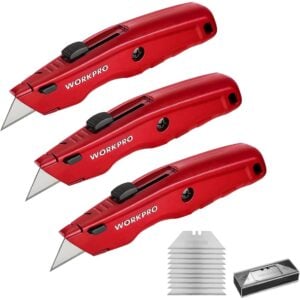
WORKPRO Premium Retractable Utility Knife (3-Pack)
Three aluminum-bodied retractable knives and 10 spare blades for about the price of one name-brand knife. One for the truck, one for the gang box and one for your pouch.
- Type: Retractable (manual slider)
- Pack size: 3 knives plus 10 blades
- Body: Aluminum alloy, powder coated
- Weight: 3.2 oz each (manufacturer)
Our take
Utility knives get lost, borrowed and left on top of ladders. That's why a multi-pack makes sense for most crews. WORKPRO's Premium Utility Knife has more than 11,000 Amazon ratings averaging 4.8 stars across its listings, and the three-pack usually costs around $20, or less than $7 a knife.
Each knife has a powder-coated aluminum alloy body. WORKPRO lists it at 3.2 oz and says it passes a 1.5 m (about 5 ft) drop test. The slider gives three blade positions, so you can set a shallow depth for scoring and a longer one for thick material. When you're done, the blade retracts and locks inside the metal frame.
Blade changes are tool-free. Press the quick-release button, open the knife and swap the blade. WORKPRO includes 10 extra double-ended blades made from SK5 carbon steel, which it says are heat-treated to up to 64 HRC on the Rockwell hardness scale. In practice, they're standard trapezoid blades, so when they run out, any brand of utility blade fits.
WORKPRO lists cardboard, carpet, drywall, rope, vinyl and flooring among its uses. The knife measures about 6.3 by 1.7 by 0.9 inches, so it fits a back pocket or tool pouch.
Be realistic about what you're getting. WORKPRO is a value brand, not a pro-tool brand like Milwaukee or DeWalt, and it doesn't advertise a lifetime warranty on this knife. The included blades are fine for general work, but you can swap in carbide or premium blades if you want longer edge life.
Who it's not for: anyone who wants a single "forever" knife with extras like blade storage and a wire stripper. It's also a manual retractable, not a self-retracting safety knife.
Pros
- Three knives for about $20
- Aluminum alloy body with powder coat
- Three blade positions
- Tool-free quick-release blade change
- 10 spare blades included
Cons
- Value brand without a lifetime warranty
- Included blades dull faster than premium blades
- No wire stripper or gut hook
| Brand | WORKPRO |
|---|---|
| Type | Retractable (manual slider) |
| Pack size | 3 knives plus 10 blades |
| Body | Aluminum alloy, powder coated |
| Weight | 3.2 oz each (manufacturer) |
| Blade positions | 3 |
| Blade change | Tool-free quick-release button |
| Size | 6.3 x 1.7 x 0.9 in |
Why we picked it: Knives walk off. A three-pack of WORKPRO’s Premium retractable costs about the same as one name-brand knife, and each one has an aluminum alloy body, three blade positions and a tool-free quick-release for blade changes. WORKPRO includes 10 spare blades. Across its listings, the knife has more than 11,000 Amazon ratings averaging 4.8 stars, which is a lot of happy owners for a budget tool.
Who it’s for: foremen stocking gang boxes, crews who share tools, apprentices on a budget and anyone who wants a spare knife in every truck.
Watch out for: WORKPRO is a value brand, and it doesn’t advertise a lifetime warranty on this knife. The claims about a 1.5 m drop test and 64 HRC blades are WORKPRO’s own. Swap in better blades for heavy work.
4. Best for drywall: OLFA L-5
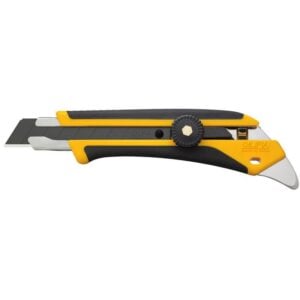
OLFA L-5 18mm Heavy-Duty Snap-Off Utility Knife
An 18mm snap-off knife with a ratchet lock, a stainless steel blade channel and a fiberglass-reinforced handle. Snap off a dull segment and you have a fresh tip in a second, which is why it's our pick for drywall.
- Model: L-5
- Type: Snap-off, 18mm
- Lock: Ratchet wheel
- Handle: Fiberglass-reinforced, anti-slip grip
Our take
OLFA invented the snap-off blade in 1956, and its knives are still the reference point. The L-5 is the 18mm heavy-duty model OLFA describes as built for construction, flooring and drywall, and it's the snap-off knife we'd buy for hanging board.
Drywall dulls blades fast. Gypsum is abrasive, and a dull tip tears the face paper instead of scoring it cleanly. With a snap-off knife, you break off the worn segment and you're back to a sharp point in seconds, without opening the knife to change blades. OLFA's preloaded LBB Ultra-Sharp Black blade has eight segments, so one blade lasts a long time.
The blade locks with a ratchet wheel. Turn it to extend the blade to exactly the depth you need, then it holds. A stainless steel channel supports the blade inside the handle to cut down on flex, and the handle is fiberglass-reinforced with a wraparound anti-slip grip that OLFA says is chemical resistant. Blade changes are tool-free. The L-5 also has a built-in metal pick for scraping caulk, opening lids and detail work, so you don't use your blade as a pry bar.
OLFA claims its black blades are up to 25% sharper than standard blades. The L-5 also accepts OLFA's other 18mm blades, including serrated, hook and solid (non-snap) blades.
Snap-off blades have limits. An 18mm blade is thinner than a standard trapezoid utility blade, so it can snap if you twist or pry with it. That makes it a poor choice for heavy demo, roofing shingles or anything where you lean hard on the tip. It also doesn't fold or retract on its own.
Who it's not for: anyone who wants a knife for prying, heavy roofing or thick carpet. For those, use a standard utility knife or OLFA's 25mm XH-1. Always snap blades into a proper container, never onto the floor.
Pros
- Snap off a segment for a fresh tip in seconds
- Ratchet lock sets precise blade depth
- Stainless steel blade channel reduces flex
- Fiberglass-reinforced, anti-slip handle
- Built-in metal pick for scraping and prying
Cons
- Thinner 18mm blade can snap if twisted or pried
- Not self-retracting
- You need a safe container for used segments
| Brand | OLFA |
|---|---|
| Model | L-5 |
| Type | Snap-off, 18mm |
| Lock | Ratchet wheel |
| Handle | Fiberglass-reinforced, anti-slip grip |
| Blade | LBB Ultra-Sharp Black, 8 segments |
| Blade change | Tool-free |
| Extras | Metal multi-pick |
Why we picked it: Drywall is abrasive, and a dull tip tears the face paper instead of scoring it. A snap-off knife fixes that in a second: break off the worn segment and you’re back to a sharp point. OLFA invented the snap-off blade, and it names drywall as one of the L-5’s main uses. It has a ratchet lock to set exact blade depth, a stainless steel blade channel to reduce flex, a fiberglass-reinforced handle and a metal pick for scraping. Its 18mm black blade has eight segments.
Who it’s for: drywall hangers, flooring installers, trim carpenters and painters who want a sharp tip all day without carrying a box of blades.
Watch out for: snap-off blades are thinner than standard utility blades and can break if you twist or pry with them. Snap segments into a closed container, not onto the floor, and wear safety glasses when you snap.
5. Best safety knife: Slice 10554
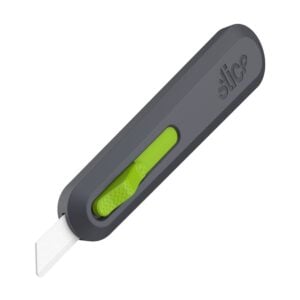
Slice 10554 Auto-Retractable Utility Knife
A self-retracting safety knife with a rounded ceramic blade that Slice designs to be safe to the touch. The knife to buy when your site or employer bans open-blade knives.
- Model: 10554
- Type: Auto-retracting safety knife
- Blade: Zirconium oxide ceramic, finger-friendly edge
- Cutting depth: 0.79 in (manufacturer)
Our take
More general contractors, owners and warehouses now require self-retracting knives. The idea is simple: if the blade can't be left out, it can't cut someone reaching into a bucket or picking a knife up off a pallet. Slice is one of the best-known names in that category, and the 10554 is its general-purpose utility knife.
It has two layers of protection. First, the blade retracts automatically, so Slice says it can never be accidentally left out. Second, the blade itself is different. It's made from zirconium oxide, a ceramic, and Slice grinds it with what it calls a finger-friendly edge. Slice says that edge is safe to the touch and causes fewer and less severe injuries than a standard steel blade, while still cutting cardboard, tape, plastic sheeting and similar materials.
The 10554 has a longer blade than Slice's box cutters, with a cutting depth of 0.79 inch. Slice lists it at 6.06 inches long and 0.21 lb, with a reinforced nylon handle. It works for left- or right-handed users, has a lanyard hole, and the blade changes without tools. Ceramic is non-conductive and never rusts, and Slice claims its blades last 11.2 times longer than steel blades.
The trade-off is cutting power. A finger-friendly ceramic edge isn't as keen as a fresh steel utility blade, and 0.79 inch of depth won't get through thick insulation or carpet in one pass. Ceramic can also chip if you twist it or use it to pry. Owner reviews are more mixed than for the steel knives on this list, with a 4.2-star average from a few hundred ratings.
Who it's not for: anyone who needs a knife for drywall, roofing, flooring or other heavy cutting, where a steel blade works better. If your site requires self-retracting knives but you need steel, look for a self-retracting model that takes standard blades.
Pros
- Blade retracts automatically
- Ceramic blade designed to be safe to the touch
- Non-conductive and rust-proof
- Tool-free blade change; works for lefties
- Slice claims blades last 11.2x longer than steel
Cons
- Less cutting power than a steel blade
- Shallow 0.79 in cutting depth
- More expensive than a basic knife; mixed owner reviews
| Brand | Slice |
|---|---|
| Model | 10554 |
| Type | Auto-retracting safety knife |
| Blade | Zirconium oxide ceramic, finger-friendly edge |
| Cutting depth | 0.79 in (manufacturer) |
| Handle | Reinforced nylon |
| Length | 6.06 in (manufacturer) |
| Weight | 0.21 lb (manufacturer) |
| Handedness | Left or right |
Why we picked it: More general contractors and facility owners now require self-retracting knives. The Slice 10554 retracts automatically, and its zirconium oxide ceramic blade has a finger-friendly edge that Slice says is safe to the touch and causes fewer and less severe injuries than steel. It has a 0.79-inch cutting depth, a tool-free blade change, and works for left- and right-handed users.
Who it’s for: anyone working on a site or for an employer that bans open-blade knives, plus supers and receivers who mostly cut boxes, tape, banding and plastic sheeting.
Watch out for: the ceramic edge doesn’t cut like a fresh steel blade, and 0.79 inch of depth won’t handle thick insulation or carpet. Owner reviews are more mixed than for the steel knives here, with a 4.2-star average from about 230 ratings. Slice’s 11.2x blade life figure is the company’s own claim.
6. Best multi-tool knife: Milwaukee FASTBACK 6-in-1
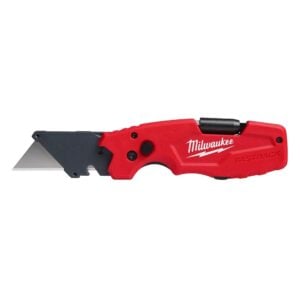
Milwaukee FASTBACK 6-in-1 Folding Utility Knife (48-22-1505)
A FASTBACK folding knife with a fold-out 1/4-inch bit holder, a reversible Phillips and slotted bit, a wire stripper and a bottle opener. Good for electricians and service techs who want fewer tools in their pockets.
- Model: 48-22-1505
- Type: Folding (press-and-flip) multi-tool
- Driver: Folding 1/4 in hex bit holder, PH2/slotted bit
- Other tools: Wire stripper, bottle opener
Our take
If you're constantly switching between a knife and a screwdriver, the FASTBACK 6-in-1 puts both in one handle. It's built on the same press-and-flip knife as our top pick, with tools added around it.
The knife side works like any FASTBACK. Press the button and flip your wrist to open it one-handed, and change blades without tools. Milwaukee added the same metal extension over the release button to prevent accidental blade removal, and a blade holder it says is designed for scoring.
The extras are what set it apart. A folding 1/4-inch hex bit holder swings out of the handle and comes with a reversible Phillips #2 and 1/4-inch slotted bit, which covers most device screws, covers and panels. Because it takes standard 1/4-inch hex bits, you can swap in square or Torx bits. There's also a wire stripper and a bottle opener. The handle holds one spare blade, the clip is Milwaukee's wire belt clip, and there's a lanyard hole. Milwaukee covers it with a limited lifetime warranty.
It's a popular knife, with more than 2,300 Amazon ratings averaging 4.8 stars.
The trade-offs come from the extra hardware. It's thicker and heavier in the pocket than the standard FASTBACK, and it stores only one spare blade instead of five. A fold-out bit holder is handy for quick jobs, but it won't replace a real screwdriver or impact driver for driving a lot of screws. Like any multi-tool, if one part wears out, you replace the whole knife.
Who it's not for: anyone who mostly cuts. If you rarely need a driver, the regular FASTBACK with five-blade storage is the better knife. And as a folding knife, it's not allowed on sites that require self-retracting blades.
Pros
- One-handed press-and-flip opening
- Folding 1/4 in bit holder takes standard hex bits
- Reversible Phillips #2 and slotted bit included
- Wire stripper and tool-free blade change
- Limited lifetime warranty
Cons
- Bulkier than the standard FASTBACK
- Stores only 1 spare blade
- Not self-retracting
| Brand | Milwaukee |
|---|---|
| Model | 48-22-1505 |
| Type | Folding (press-and-flip) multi-tool |
| Driver | Folding 1/4 in hex bit holder, PH2/slotted bit |
| Other tools | Wire stripper, bottle opener |
| Blade change | Tool-free |
| Blade storage | 1 blade |
| Warranty | Limited lifetime |
Why we picked it: The FASTBACK 6-in-1 is the same press-and-flip, tool-free-blade knife as our top pick, plus a folding 1/4-inch hex bit holder with a reversible Phillips #2 and slotted bit, a wire stripper and a bottle opener. For a lot of quick jobs, like pulling a cover plate or tightening a terminal, it saves digging for a screwdriver. It has more than 2,300 Amazon ratings averaging 4.8 stars.
Who it’s for: electricians, low-voltage techs, HVAC and appliance service techs and maintenance staff who want fewer tools in their pockets.
Watch out for: it’s bulkier than the standard FASTBACK and stores just one spare blade instead of five. The bit holder is for quick jobs, not for driving a box of screws.
7. Best compact: Gerber EAB Lite
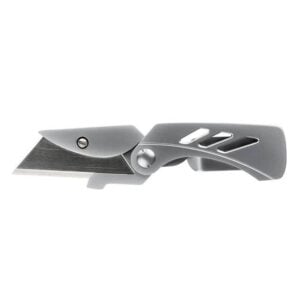
Gerber EAB Lite Folding Utility Knife
A 2.5 oz stainless steel folder that takes standard utility blades and clips to your pocket like a money clip. The best utility knife for everyday carry when a full-size knife is too much.
- Model: 31-000345 (EAB Lite)
- Type: Folding, liner lock
- Body: Stainless steel
- Blade: Standard utility blade
Our take
Not everyone wants a full-size utility knife in their pocket. Superintendents, project managers, inspectors and service techs often need a blade a few times a day, but don't want a 7-inch knife digging into their leg. The Gerber EAB Lite (EAB stands for Exchange-A-Blade) is the answer for them, and with more than 10,000 Amazon ratings averaging 4.7 stars, it's one of the most popular small utility knives sold.
Gerber lists it at 5.1 inches open, 2.85 inches closed and 2.5 ounces. The body is stainless steel, and the handle doubles as a pocket clip or money clip. A liner lock holds the blade open, and deep finger grooves help with grip.
The key feature is the blade: it takes standard contractor-grade utility blades, the same trapezoid blades you buy in 100-packs. When it gets dull, you swap it out instead of sharpening it. Gerber says the blades can easily be replaced. It's covered by Gerber's limited lifetime warranty.
The small size is the trade-off. There's less handle to hold, so it's less comfortable for long cuts or heavy material than a full-size knife. There's no spare-blade storage and no one-hand press-and-flip opening like the Milwaukee FASTBACK; you open it manually. The short handle is also harder to control with thick winter gloves.
Who it's not for: anyone who cuts all day, such as drywall hangers, roofers or flooring installers. They're better off with a full-size knife. It's also not allowed on sites that ban folding knives without auto-retract.
For a light, flat knife that disappears into a pocket and still takes cheap replacement blades, it's hard to beat for the price.
Pros
- Light at 2.5 oz and flat in the pocket
- Takes standard utility blades
- Stainless steel body with liner lock
- Pocket or money clip
- Very large number of positive owner reviews
Cons
- Small handle for long or heavy cuts
- No blade storage or press-and-flip opening
- Harder to handle with thick gloves
| Brand | Gerber |
|---|---|
| Model | 31-000345 (EAB Lite) |
| Type | Folding, liner lock |
| Body | Stainless steel |
| Blade | Standard utility blade |
| Length | 5.1 in open, 2.85 in closed (manufacturer) |
| Weight | 2.5 oz (manufacturer) |
| Warranty | Limited lifetime |
Why we picked it: A full-size utility knife is overkill if you only cut a few things a day. Gerber’s EAB Lite is 2.5 ounces and 2.85 inches long closed, with a stainless steel body, a liner lock and a handle that works as a pocket or money clip. It takes standard utility blades, so you replace a dull one instead of sharpening it. With more than 10,000 Amazon ratings averaging 4.7 stars, it’s one of the most popular small utility knives you can buy.
Who it’s for: superintendents, project managers, inspectors and estimators, and anyone who wants a light backup knife.
Watch out for: the small handle isn’t comfortable for long or heavy cuts, there’s no blade storage, and it doesn’t open one-handed like the FASTBACK.
8. Best heavy-duty snap-off: OLFA XH-1
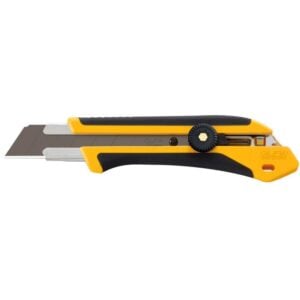
OLFA XH-1 25mm Extra Heavy-Duty Utility Knife
A 25mm snap-off knife with a ratchet lock and a thick, wide blade for roofing underlayment, insulation, foam board and carpet. The heavy-duty snap-off for cuts an 18mm blade can't handle.
- Model: XH-1
- Type: Snap-off, 25mm
- Lock: Ratchet wheel
- Handle: Fiberglass-reinforced, anti-slip grip
Our take
When an 18mm snap-off feels flimsy, step up to 25mm. OLFA's XH-1 uses a blade about an inch wide, and OLFA describes it as a heavy-duty knife for cutting tough materials in construction, roofing and industrial work.
The wide blade is the point. It flexes less than an 18mm blade, so it tracks straighter through thick, soft materials. OLFA lists foam board, insulation, house wrap, carpet, linoleum, laminates, plastic sheeting, shrink wrap and roofing applications. It's a natural fit for insulators, roofers, flooring installers and anyone cutting rigid foam.
The blade locks with a ratchet wheel, so you can extend it a long way for thick insulation batts and lock it at that length. A stainless steel channel adds stability, and the fiberglass-reinforced body has a wraparound anti-slip grip. Blade changes are tool-free. OLFA preloads its 25mm Ultra-Sharp Black snap-off blade, which it says is up to 25% sharper than standard blades. The XH-1 also accepts all of OLFA's 25mm blades, including saw blades and hook blades.
Like any snap-off, you get a fresh tip by snapping off the worn segment, which saves time when you're cutting abrasive materials like foam board and insulation.
It's a big knife. At around $17, it costs more than the 18mm models, and it's too bulky for fine trim work or pocket carry. Even a 25mm snap-off blade is scored to break, so you still shouldn't use it to pry. And it doesn't retract or fold on its own.
Who it's not for: anyone who wants one compact knife for everything. For general cutting, a standard utility knife or the OLFA L-5 is easier to carry. If your site requires self-retracting knives, this won't pass.
Pros
- Wide 25mm blade flexes less on thick cuts
- Ratchet lock holds long blade extensions
- Stainless steel channel and fiberglass-reinforced body
- Accepts OLFA 25mm saw and hook blades
- Tool-free blade change
Cons
- Bulky for fine work or pocket carry
- Snap-off blades still shouldn't be used to pry
- Not self-retracting
| Brand | OLFA |
|---|---|
| Model | XH-1 |
| Type | Snap-off, 25mm |
| Lock | Ratchet wheel |
| Handle | Fiberglass-reinforced, anti-slip grip |
| Blade | 25mm Ultra-Sharp Black snap-off |
| Blade change | Tool-free |
| Compatible blades | OLFA 25mm snap, saw and hook blades |
Why we picked it: An 18mm snap-off feels flimsy in thick insulation or rigid foam. OLFA’s XH-1 uses a 25mm blade that flexes less, a ratchet lock that holds long blade extensions, a stainless steel channel and a fiberglass-reinforced body. OLFA lists roofing, insulation, foam board, house wrap and carpet among its uses, and it accepts OLFA’s 25mm saw and hook blades.
Who it’s for: insulators, roofers, flooring installers and anyone cutting foam board, batts or underlayment.
Watch out for: it’s a big knife that doesn’t fit in a pocket, and even a 25mm snap blade is scored to break, so don’t use it to pry.
Also worth considering
- Stanley Classic 99E. Stanley’s retractable has been around since 1952. Stanley lists a die-cast zinc body and room for spare blades in the handle. It’s cheap and nearly indestructible, but opening the handle to change blades takes a screwdriver, which feels slow next to a FASTBACK. Check price on Amazon.
- Milwaukee 48-22-1512 Self-Retracting Utility Knife. If your site requires self-retracting knives but you want a standard steel blade, this Milwaukee retracts the blade when you release the button, changes blades without tools and stores up to five spares, according to Milwaukee. We couldn’t find a reliable Amazon listing for it, so check your local supply house.
- Klein Tools 44304 Flickblade. Klein’s folding utility knife with a built-in driver is a good alternative to the FASTBACK 6-in-1 for electricians who already carry Klein. Check price on Amazon.
- Lenox Gold Quick-Change Retractable. A long-running retractable with quick blade changes and more than 1,100 Amazon ratings. Check price on Amazon.
How we chose
We started with the utility knives tradespeople actually buy: the best-sellers in the utility knife category on Amazon, the knives stocked at supply houses and big-box stores, and the ones that come up again and again in trade forums and the guides that rank for this search. Then we compared them on what matters on a job site:
- Blade change: whether you need a tool, and how many steps it takes with gloves on.
- Opening and locking: one-handed opening, how securely the blade locks, and whether it can retract on its own.
- Build: body material (zinc, aluminum, stainless, fiberglass-reinforced plastic or nylon), clip and lanyard options.
- Blade storage and compatibility: spare blade capacity, and whether it takes standard blades you can buy anywhere.
- Safety: self-retracting mechanisms, safety blades, and how the knife fits common site rules.
- Owner feedback: recurring praise and complaints across thousands of Amazon owner reviews, weighted by how many people reviewed each knife.
- Price and warranty: what you get for the money, and whether the maker stands behind it.
We did not lab test or field test these knives. Specs and features come from each manufacturer’s product page, and where a maker claims something we can’t verify, like a sharper blade or a longer blade life, we say it’s their claim. Ratings and review counts come from Amazon at the time of writing. Our star ratings are editorial and reflect specs, features and owner feedback.
How to choose a utility knife
1. Pick the right type
Most arguments about the best utility knife are really arguments about type. Each one has a place:
| Type | Good for | Watch out for |
|---|---|---|
| Fixed blade | Rigid, simple, cheap; long scoring cuts | Blade is always exposed; banned on many sites |
| Retractable | General cutting; safe in a pouch | Slider can wear; manual retract only |
| Folding | Pocket carry; fast one-hand use | Pivot can loosen; not self-retracting |
| Snap-off | Always-sharp tip; drywall, flooring | Thinner blade can break if pried |
| Self-retracting | Sites that ban open blades | Less control; slower for long cuts |
A fixed blade knife holds the blade in the same position all the time. It’s the most rigid design and the hardest to break, but the blade is always out, so you need a sheath or a pouch, and many sites don’t allow it. A retractable knife slides the blade in and out of the handle with a thumb slider, usually with three or more positions. It’s the classic jobsite knife. A folding utility knife works like a pocket knife but takes replaceable utility blades. Most lock open, and the best ones, like the FASTBACK, open with one hand.
A snap-off knife uses a long, thin blade scored into segments. When the tip dulls, you snap off a segment. They come in 9mm (precision), 18mm (general and drywall) and 25mm (heavy-duty) widths. A self-retracting or auto-retracting knife pulls the blade back into the handle on its own, either when you release the slider or when the blade leaves the material. These are the knives safety programs require.
2. Look hard at the blade change
You’ll change blades far more often than you think, especially on drywall, roofing and insulation. There are three common systems:
- Screw-together handles, like the Stanley 99E, need a screwdriver. They’re simple and durable, but slow.
- Tool-free quick-change designs use a button or lever to release the blade. Most modern knives, including the FASTBACK, DeWalt and WORKPRO, work this way. Look for a guard or lock that stops the button being pressed by accident.
- Snap-off blades skip most blade changes. You only replace the blade after you’ve used all its segments.
Try a blade change with gloves on before you commit. If it’s fiddly at the store, it’ll be worse on a ladder in January.
3. Decide whether you need blade storage
Onboard storage is easy to overlook, but it’s the difference between swapping a dull blade on the spot and putting up with it until lunch. The Milwaukee FASTBACK 48-22-1502 and DeWalt DWHT10998 each store five spare blades. The FASTBACK 6-in-1 holds one. Small knives like the Gerber EAB Lite usually hold none, so keep a blade dispenser in your pouch or truck.
4. Understand blade types and steel
Nearly every knife on this list except the snap-offs and the Slice takes the same standard trapezoid utility blade, so the blade you buy matters as much as the knife. The main options:
- Standard carbon steel blades are the cheapest and sharpest out of the pack. Many are SK5 carbon steel. They dull and rust faster than premium blades, but at a few cents each, that’s fine.
- Carbide and bi-metal blades cost more but hold an edge longer. Milwaukee, for example, says its general purpose blades use a micro-carbide steel that lasts up to three times longer than standard carbon blades.
- Drywall blades are sold by Milwaukee, DeWalt and others for gypsum and sheet material. They fit standard knives.
- Hook blades have a hooked edge that cuts from underneath, which is great for roofing shingles, carpet and underlayment without cutting what’s beneath.
- Snap-off blades come in 9, 18 and 25mm widths and only fit snap-off knives of the same width.
- Ceramic blades, used by Slice, don’t rust and are non-conductive. Slice designs its edges to be safe to the touch, but they don’t cut thick material as well as steel.
Most utility blades are double-ended. When one end dulls, flip it around before you throw it away.
5. Safety: retraction, gloves and site rules
Utility knives cause a lot of hand injuries on job sites, usually when a blade slips, someone cuts toward their body or a knife is left open. That’s why more general contractors, owners and industrial sites now ban open-blade knives and require self-retracting ones. OSHA’s construction rules (29 CFR 1926.300) require hand tools to be kept in safe condition but don’t name a specific knife type, so the rule you have to follow is usually your employer’s or the GC’s. Check before you buy.
- Wear cut-resistant gloves. Cut protection is rated under ANSI/ISEA 105 from A1 to A9. For knife work, many safety programs call for A4 or higher. Our guide to the best work gloves for construction explains cut levels and recommends specific gloves.
- Cut away from your body and keep your free hand behind the blade, never in its path.
- Retract or close the blade every time you set the knife down, even for a second.
- Wear eye protection when snapping blades. Snapped segments can fly. Our picks for the best safety glasses for construction cover that.
- Dispose of blades safely. Use a blade bank or a closed container, not the trash bag or the floor.
- Don’t use a knife as a pry bar or screwdriver. Blades snap, and broken tips fly. Use the pick on the OLFA or the driver on the FASTBACK 6-in-1 instead.
6. Sharpen or replace?
You can sharpen a utility blade on a stone, but it rarely makes sense. Replacement blades cost a few cents each in bulk, they’re thin enough that sharpening changes the edge geometry, and a factory edge is sharper than most people can get by hand. A dull blade is also dangerous, because you push harder and the knife is more likely to slip. Change the blade (or snap a segment) as soon as it starts tearing paper or dragging. Pocket knives with fixed blades are a different story: those are made to be sharpened.
7. Think about how you’ll carry it
Folding knives like the FASTBACK and EAB Lite clip to a pocket. Milwaukee’s wire clip is designed to reduce pocket tearing, and Gerber’s handle doubles as a money clip. Retractable and snap-off knives usually ride in a tool pouch or belt holder. If you work at height, look for a lanyard hole so you can tether the knife; the Milwaukee and Slice knives here have one. A dropped knife is a dropped object, and our guide to the best hard hats for construction covers the other side of that problem.
8. Match the knife to your trade
If you’re still torn, start with what you cut most:
- Drywall: an 18mm snap-off like the OLFA L-5, or a rigid retractable loaded with drywall blades. Long blade extension and a sharp tip matter more than extras.
- Roofing and flooring: a solid retractable or fixed knife with hook blades for shingles, underlayment and carpet. A 25mm snap-off like the OLFA XH-1 handles thick underlayment and foam.
- Insulation: a 25mm snap-off with the blade extended. Batts and foam board dull blades fast, so snap often.
- Electrical and low voltage: a folding knife you can open with one hand, ideally with a driver like the FASTBACK 6-in-1. Keep real strippers for stripping wire.
- Framing and general carpentry: a FASTBACK or similar folder for shims, house wrap, caulk tubes and sheathing tape.
- Supervision, receiving and inspection: a compact knife like the Gerber EAB Lite, or a safety knife if your site requires one.
9. Utility knife vs. pocket knife
A pocket knife has a fixed, sharpenable blade, usually with a pointed or drop-point shape. A utility knife uses cheap, replaceable razor blades. On a job site, the utility knife wins for most cutting because you can always have a fresh edge, and a lost or broken blade costs pennies. Many tradespeople carry both: a utility knife for materials and a pocket knife for everything else.
Utility knife FAQ
What is the best utility knife for construction?
For most tradespeople, the Milwaukee FASTBACK 48-22-1502. It opens with one hand, changes blades without tools, stores five spares and has a lifetime warranty. If you prefer a retractable, the DeWalt DWHT10998 is a solid choice for about $10. If your site requires self-retracting knives, choose one like the Slice 10554 or Milwaukee 48-22-1512.
What utility knife is best for drywall?
Drywall dulls blades quickly, so you want a sharp tip without constant blade changes. An 18mm snap-off like the OLFA L-5 gives you a fresh point in a second. If you prefer a standard blade, a rigid retractable like the DeWalt DWHT10998 with drywall blades works well.
Who has the best utility blades?
Milwaukee, DeWalt, Lenox, Stanley and OLFA all make well-regarded blades. Carbide and bi-metal blades last longer than standard carbon steel, and OLFA’s black snap-off blades are a favorite for snap-off knives. Because most knives take standard blades, try a few brands and buy the one that lasts longest in your material.
Can you sharpen a box cutter blade?
You can, but it’s rarely worth it. Utility and box cutter blades are cheap and thin, and a new blade will be sharper than one you touch up by hand. Flip the blade to its other end, snap off a segment, or replace it instead.
Are ceramic box cutters better?
They’re safer and longer lasting, but not better at cutting. Ceramic blades like Slice’s don’t rust, are non-conductive, and are designed to be safe to the touch. Slice claims its blades last 11.2 times longer than steel. But they’re not as sharp as a fresh steel blade and can chip if twisted, so they’re best for boxes, tape and plastic, not drywall or roofing.
Is a folding or retractable utility knife better?
It’s mostly preference. Folding knives are slimmer in the pocket and often open with one hand. Retractable knives have no pivot to loosen and are easier to drop into a pouch. Neither retracts on its own, so if your site bans open blades, you need a self-retracting knife instead.
What is a self-retracting utility knife?
A self-retracting (or auto-retracting) knife pulls the blade back into the handle on its own, either when you release the slider or, on some models, as soon as the blade leaves the material. They reduce cuts from knives left open and are required on many commercial and industrial sites.
How often should you change a utility knife blade?
As soon as it starts dragging or tearing instead of slicing. On drywall, insulation or roofing that can mean several blade changes a day. On cardboard, a blade can last days. Keep spares in the handle or your pouch so you’re not tempted to push through with a dull blade.
The bottom line
If you buy one utility knife, make it the Milwaukee FASTBACK 48-22-1502. It’s fast, tough and easy to live with. Prefer a retractable? Get the DeWalt DWHT10998. Hanging drywall? Grab an OLFA L-5 and a pack of black blades. And if your site bans open blades, the Slice 10554 keeps you compliant.
Browse all our utility knife picks, and round out your kit with our guides to the best work gloves for construction, the best safety glasses for construction, the best hard hats for construction and the best work boots.
Use one of these knives? Rate it on its product page or tell us what you think in the comments.
Ask AI about this page: ChatGPT, Claude or PerplexityCopy as Markdown